Living alone in old age is now the normal way to grow old in the richer half of the world, and it is spreading to the rest. This page collects every published figure we could verify about how many older adults live alone, where, at what ages, how that has changed and will change, who they are and what they want, and, further down, what living alone does to money, health and safety.
01 / United States
How many older adults live alone in the United States?
15,784,869 U.S. adults aged 65 and over lived alone in 2024 (U.S. Census Bureau, American Community Survey 2024 1-year estimates, Table B09021).[1]
Roughly one older American in four lives alone, two thirds of them women. The exact share depends on which survey you read and who it counts, which is why the same question is answered with 26%, 27% and 28% by equally reputable sources. The table below lines them up with their bases.
- 10,382,978 U.S. women aged 65 and over were householders living alone in 2024 - 65.8% of all people 65+ living alone (ACS 2024 1-year, Table B11010; share derived).[9]
- 5,401,891 U.S. men aged 65 and over were householders living alone in 2024 (ACS 2024 1-year, Table B11010).[9]
- About 28% (16.2 million) of U.S. adults aged 65 and over living in the community lived alone in 2023 - 5.7 million men (22% of older men) and 10.5 million women (33% of older women) (ACL, 2023 Profile of Older Americans; CPS ASEC).[10]
- 26% of U.S. adults aged 65 and over lived alone in 2023, down from 29% in 1990 (Pew Research Center analysis of Census Bureau data, December 2025).[11]
- 16,194,000 U.S. one-person households were headed by someone aged 65 or over in 2023 - 8,207,000 aged 65-74 and 7,987,000 aged 75 and over (CPS ASEC 2023, Table H2; sum derived).[12]
- 54% of U.S. adults aged 65 and over lived with a spouse in 2023 - the highest figure in Census Bureau data going back to 1900 (Pew Research Center, December 2025).[11]
- 3% of U.S. adults aged 65 and over lived in nursing homes or other group quarters in 2023, down from 6% in 1990 (Pew Research Center, December 2025).[11]
- There were 39.7 million one-person households in the United States in 2025, 29% of all households, up from 20% in 1975 (U.S. Census Bureau, CPS ASEC 2025 release).[14]
- 25% of U.S. adults aged 65-79 who lived in their own homes lived alone in 2021, rising to 41% of those aged 80 and over (JCHS, Housing America's Older Adults 2023; ACS 2021).[15]
| Source and base | Share | Scope | Source |
|---|---|---|---|
| ACS 2024: share of people 65+ living in households (excludes nursing homes) | 26.6% | Civilian population aged 65+ living in households · United States · 2024 | [1] |
| ACL Profile 2023: share of community-dwelling adults 65+ (CPS) | 28% | Civilian noninstitutional ('community') population aged 65+ · United States · 2023 | [10] |
| Pew, Dec 2025: share of all adults 65+ (ACS 2023, incl. group quarters) | 26% | All adults aged 65+ (including group quarters) · United States · 2023 | [11] |
| Census P20-587: share of adults 65+ (CPS ASEC 2022) | 28% | Civilian noninstitutional population aged 65+ (CPS ASEC) · United States · 1967-2022 | [16] |
| OECD HM1.4: share of people 65+ in private households (ACS 2023) | 26.53% | Persons aged 65+ in private households, United States · United States · 2023 | [3] |
| Pew 2020: share of adults 60+ (not 65+), 2010-18 data | 27% | adults aged 60+ · United States vs world (130 countries) · 2010-2018 census/survey data | [17] |
How to read the numbers on this page. Four things move a living-alone statistic: the age cut-off (60+, 65+, 75+), the base (people or households; everyone or only those in private households), the year, and the survey. A "share of people living alone who are over 65" is not a "share of over-65s living alone". Every statement below names its base, and the country table uses one definition throughout.
By state
- California had the largest number of residents aged 65 and over living alone in 2024 - 1,401,504 - even though its share (22.1% of the 65+ household population) was among the three lowest in the country (ACS 2024 1-year, Table B09021).[1]
02 / UK, Europe, Asia, world
How many live alone in the UK, Europe, Japan and worldwide?
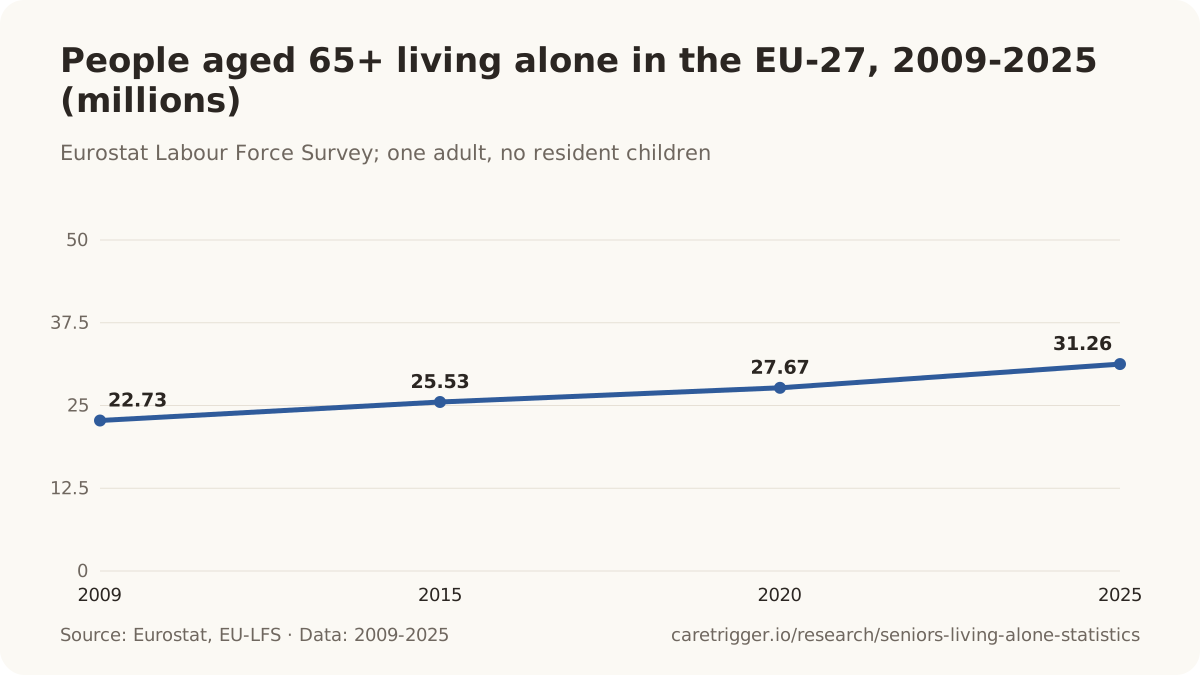
31.26 million people aged 65+ in the EU-27 lived alone (one adult, no resident children) in 2025, out of 97.18 million aged 65+ - 32.2% (Eurostat LFS, lfst_hhindws).[2]
The counts are large everywhere ageing has arrived: more than thirty million in the EU, four million in the UK, nine million in Japan, six million in Germany, two and a half million households in South Korea, thirty million households in China. The shares are a different story, from a third of older people in northern Europe to one in twenty in India.
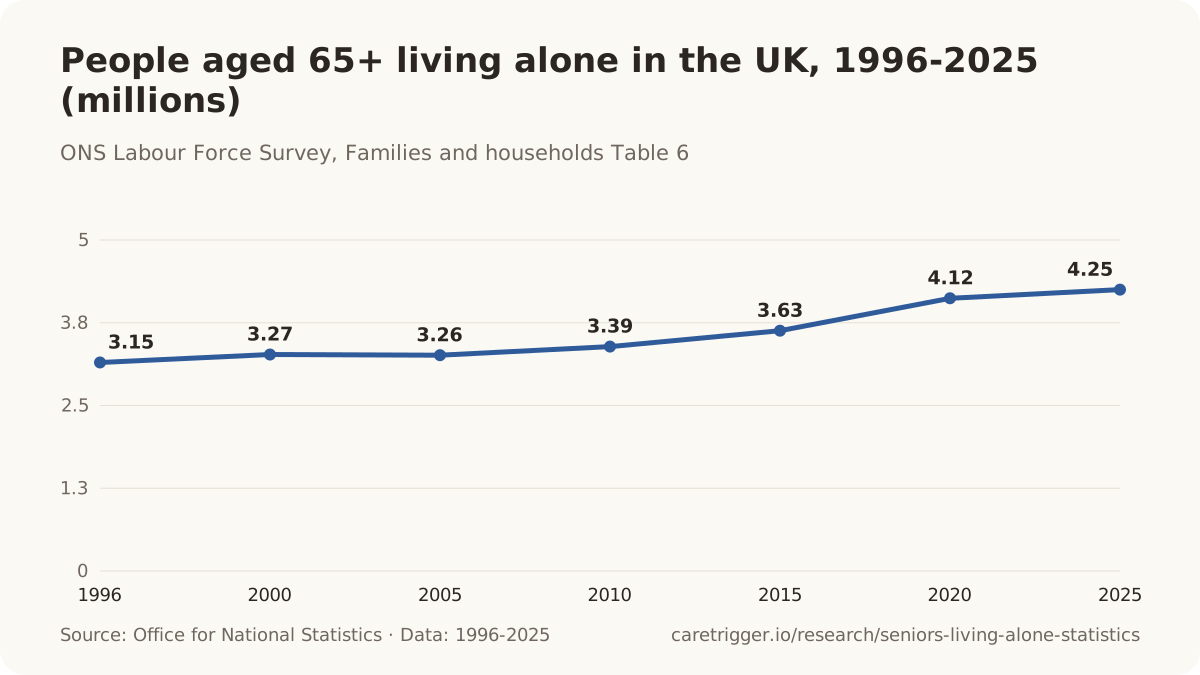
- 4.25 million people aged 65 and over lived alone in the UK in 2025 (ONS Labour Force Survey, Families and households Table 6).[18]
- 3.3 million people aged 65 and over lived alone in England and Wales on Census Day 2021 - 30.1% of the older population (ONS, Census 2021).[19]
- About 6.33 million people aged 65+ lived alone in Germany in 2025 (4.842 million aged 65-84 plus 1.485 million aged 85+); 4.467 million of them women (Destatis, derived).[22]
- 32% of people aged 65+ in France lived alone in their home in 2021 (Figure 1: 32.4%, versus 31.1% in 1990), while 57% lived as a couple (Insee, census 2021).[23]
- 2,131,400 people aged 65+ lived alone in Spain in 2020 - 43.6% of the 4,849,900 people living alone - and 1,511,000 of them (70.9%) were women (INE, Encuesta Continua de Hogares 2020).[24]
- About 2.7 million Italian households are a single person aged 75 or over - 10% of all households in 2023 (Istat, permanent census).[25]
- 2,456,000 South Korean households were a person aged 65+ living alone on 1 November 2025, 10.9% of all 22,495,000 ordinary households and up 7.3% in one year (2025 register-based census).[27]
- 24.1% of South Koreans aged 65+ lived alone in 2025 by the national indicator definition (65+-headed one-person households ÷ 65+ population), up from 16.2% in 2000.[28]
- 29,938,548 Chinese households were a single person aged 65+ living alone in 2020, 22.5% of the 132,865,245 households containing someone aged 65+ (table 5-5).[29]
- 188,569 Hong Kong residents aged 65 and over lived alone at the 2021 census, 13.0% of all older persons (2021 Population Census Thematic Report: Older Persons).[31]
- 88,400 Singapore residents aged 65 and over lived alone in 2025, more than triple the 27,900 of 2010 (Department of Statistics, General Household Survey 2025).[32]
- 27.6% of Australians aged 65+ living in households lived alone in 2022 (ABS Survey of Disability, Ageing and Carers).[33]
- 1,698,970 Canadians aged 65 and over lived alone in 2021 - 25.8% of the 6,586,870 people aged 65+ in private households (2021 Census).[35]
- About 266,000 Israelis aged 65 and over live alone - 23% of the age group, versus about 7% of adults aged 18-64 (CBS, September 2024).[36]
- 1,836,496 people aged 65+ in Türkiye lived alone in 2025 (up from 1,750,900 in 2024); 73.5% of them were women.[37]
- 1.8 million Mexicans aged 60 and over live alone - 16.8% of the 10.9 million households that include an older person are one-person households (Censo 2020).[38]
- 28.7% of Brazil's 19,721,686 household heads aged 60 and over lived alone at the 2022 Census - versus 18.9% of household heads of all ages.[39]
- 11.1% of South Africans aged 60+ lived alone in 2024 (638,000 of 5,681,000), up from 9.9% in 2003 (General Household Survey).[40]
- Globally, living with extended family is the most common arrangement for people 60+ (38%), followed by living as a couple (31%) and living alone (16%).[42]
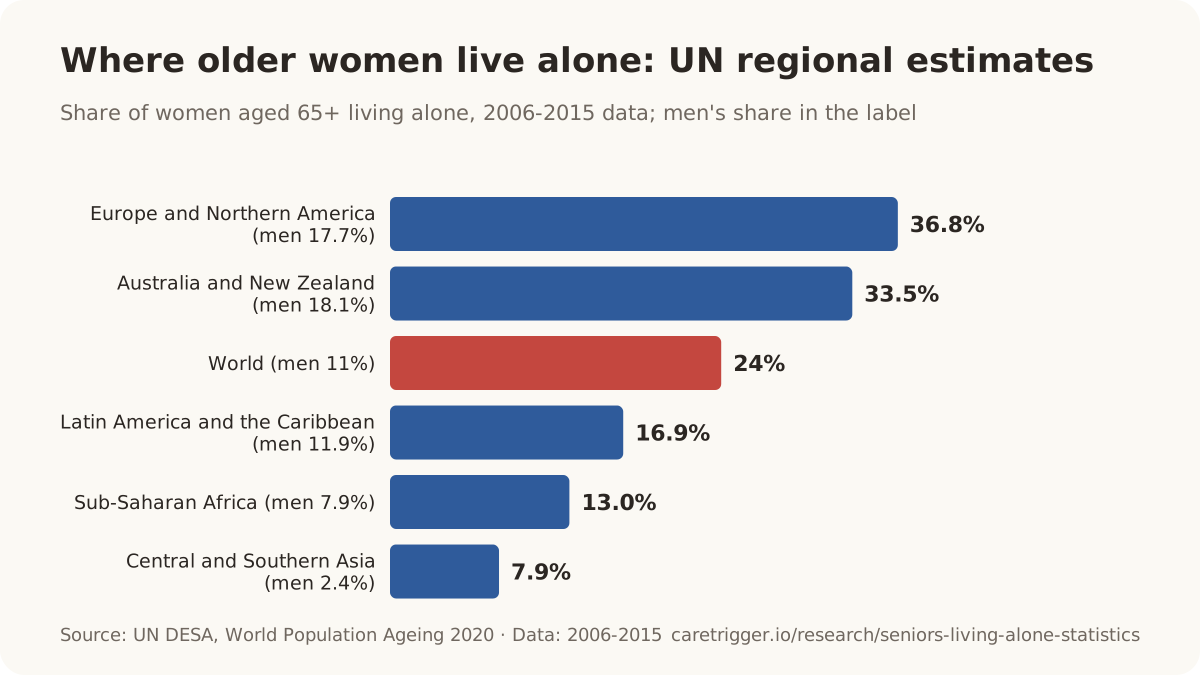
- Worldwide, 24% of women aged 65 and over lived alone in 2006-2015, more than twice the share of men the same age (11%) - UN DESA's harmonised estimate across countries with data.[4]
| Geography | People living alone | Scope | Source |
|---|---|---|---|
| United States | 15,784,869 | Civilian population aged 65+ living in households (excludes group quarters) · 2024 | [1] |
| EU-27 (2020 composition) | 31.26 million | People aged 65+ in private households (EU-LFS) · 2025 | [2] |
| Japan | 9,031,000 people | People aged 65+ in private households (65歳以上の者), Japan · 2024 (as of 6 June 2024) | [26] |
| Germany | 6,327,000 people aged 65+ living alone | People aged 65+ in one-person households · 2025 | [22] |
| United Kingdom | 4,254,000 people aged 65+ living alone | People aged 65+ in private households (LFS) · 2025 | [18] |
| South Korea | 2,456,000 households | One-person households of persons aged 65+ (고령자 1인가구), 일반가구 · 2025-11-01 | [27] |
| Spain | 2,131,400 people aged 65+ living alone | People aged 65+ in one-person households · 2020 | [24] |
| Türkiye | 1,836,496 (73.5% women) | Persons aged 65+, Türkiye (ABPRS) · 2025 | [37] |
| Canada | 1,698,970 persons | Persons aged 65+ in private households · 2021 (Census, 11 May 2021) | [35] |
| Austria | 605,000 people aged 65+ living alone | People aged 65+ in private households (Mikrozensus-Arbeitskräfteerhebung) · 2024 | [43] |
| Israel | 266,000 persons aged 65+ living alone | Persons aged 65+ in households, Israel · 2023 (release 29 Sep 2024) | [36] |
| New Zealand | 192,204 people | People aged 65+ living alone · 2023 (census) | [34] |
| Hong Kong SAR | 188,569 people | Population aged 65+ (domestic and non-domestic households) · 2021 (census, mid-2021) | [31] |
| Ireland | 189,574 people aged 65+ living alone | People aged 65+ in private households · 2022 (2016, 2011 comparison) | [44] |
| Singapore | 88,400 people | Residents aged 65+ in resident households, living in one-person households · 2025 | [32] |
03 / Age
How does living alone rise with age?
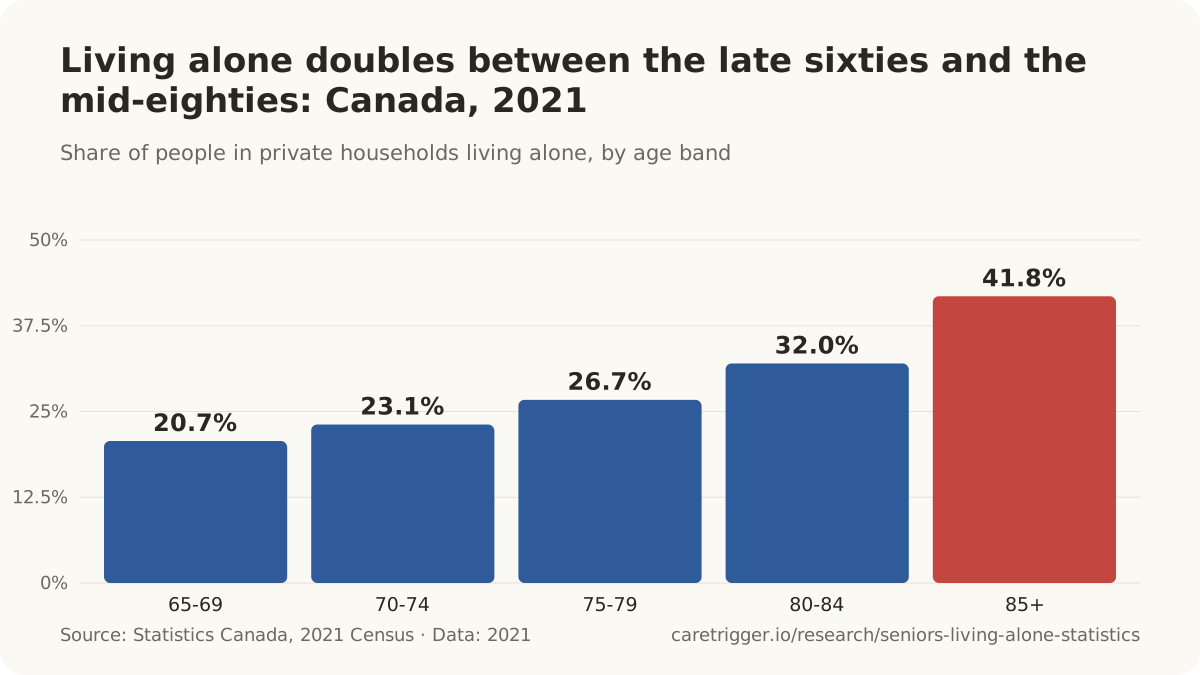
Just over a quarter of people aged 65-74 in France lived alone in 2021, rising to nearly one in two at ages 90-94 (Insee).[23]
The share of people living alone climbs with every five years of age until the mid-eighties, when it levels off or dips, not because people stop being alone but because more of them move into care. In the oldest bands the figures are startling: more than half of Germans over 85, two thirds of Finnish women at 90, nearly half of Aucklanders over 90.
- 38% of U.S. adults aged 85 and over lived alone in 2023 (Pew Research Center analysis of 2023 ACS data, December 2025).[11]
- 25% of U.S. adults aged 65-79 who lived in their own homes lived alone in 2021, rising to 41% of those aged 80 and over (JCHS, Housing America's Older Adults 2023; ACS 2021).[15]
- 55.8% of people aged 85 and over in Germany lived alone in 2025 - more than one in two (Destatis, Mikrozensus 2025).[45]
- 44% of people aged 85 and over in Ireland lived alone in 2022 (CSO, Census 2022).[46]
- 43% of Finns aged 75+ lived alone in 2024, down two points from 45% in 2014 (Statistics Finland, dwelling-population statistics).[47]
- 65% of Finnish women aged 90 lived alone in 2024 (the peak), versus 40% of men; at age 80 about 51% of women and 26% of men lived alone (Statistics Finland).[47]
- 34% of home-dwelling Norwegians aged 67+ lived alone in 2025 - 304,600 people (200,600 women, 104,000 men); 29% of 67-79-year-olds and 71% of those 90+ (SSB).[48]
- Living alone rises steeply with age: 14.4% of Aucklanders aged 65–69 lived alone in 2023, but 48.3% of those aged 90 and over did.[49]
- In 2019, 765,000 people aged 65-69, 882,000 aged 70-74 and 2,376,000 aged 75+ lived alone in the UK (ONS ad hoc LFS table, 1996-2019).[50]
- 260,695 Canadians aged 85 and over lived alone in 2021 - 41.8% of the 623,530 people 85+ in private households.[35]
- A quarter (25%) of older Australians lived alone at the 2016 Census; 35% of those aged 85+ did; older women (31%) were far more likely than older men (18%) to live alone.[51]
- 7.72 million Chinese aged 80+ were living alone in empty-nest households in 2020 (Population Research 2023, 7th census analysis).[52]
- 10.2% of U.S. adults aged 85 and over lived in nursing facilities in the 2020 Census, versus 2.7% of 75-84-year-olds, 0.9% of 65-74-year-olds and 2.5% of all adults 65+ (U.S. Census Bureau, The Older Population: 2020).[53]
- 12% of U.S. women aged 85 and over lived in a nursing home or other group quarters in 2023, down from 27% in 1990; for men 85+ the share fell from 17% to 7% (Pew Research Center, December 2025).[11]
| Country and age band | Living alone | Scope | Source |
|---|---|---|---|
| France, ages 65-74 (Insee 2021) | just over 25% | People aged 65-74 and 90-94 in ordinary housing · France · 2021 | [23] |
| Australia, ages 65+; 35% at 85+ (Census 2016) | 25% | People aged 65+ living in private dwellings · Australia · 2016 (census) | [51] |
| United States, ages 65-79 vs 80+, own homes (JCHS 2021) | 25% vs 41% | Adults 65+ living in their own homes (not in others' homes or group quarters) · United States · 2021 | [15] |
| Finland, ages 75+ (2024) | 43% | People aged 75+ in dwelling households (asuntokunnat) · Finland · 2024 (2014 comparison) | [47] |
| United States, ages 85+ (Pew / ACS 2023) | 38% | All adults aged 85+ · United States · 2023 | [11] |
| Ireland, ages 85+ (Census 2022) | 44% | People aged 85+ in private households · Ireland · 2022 (Census) | [46] |
| Germany, ages 85+ (Destatis 2025) | 55.8% | People aged 85+ in private households · Germany · 2025 | [45] |
| Auckland, ages 90+; 14.4% at 65-69 (Census 2023) | 48.3% | People aged 90+ in Auckland region · Auckland, New Zealand · 2023 (census) | [49] |
| Finland, women aged 90 (2024) | 65% | Women aged 90 (single-year age) · Finland · 2024 | [47] |
04 / Men and women
Do more older women or men live alone?
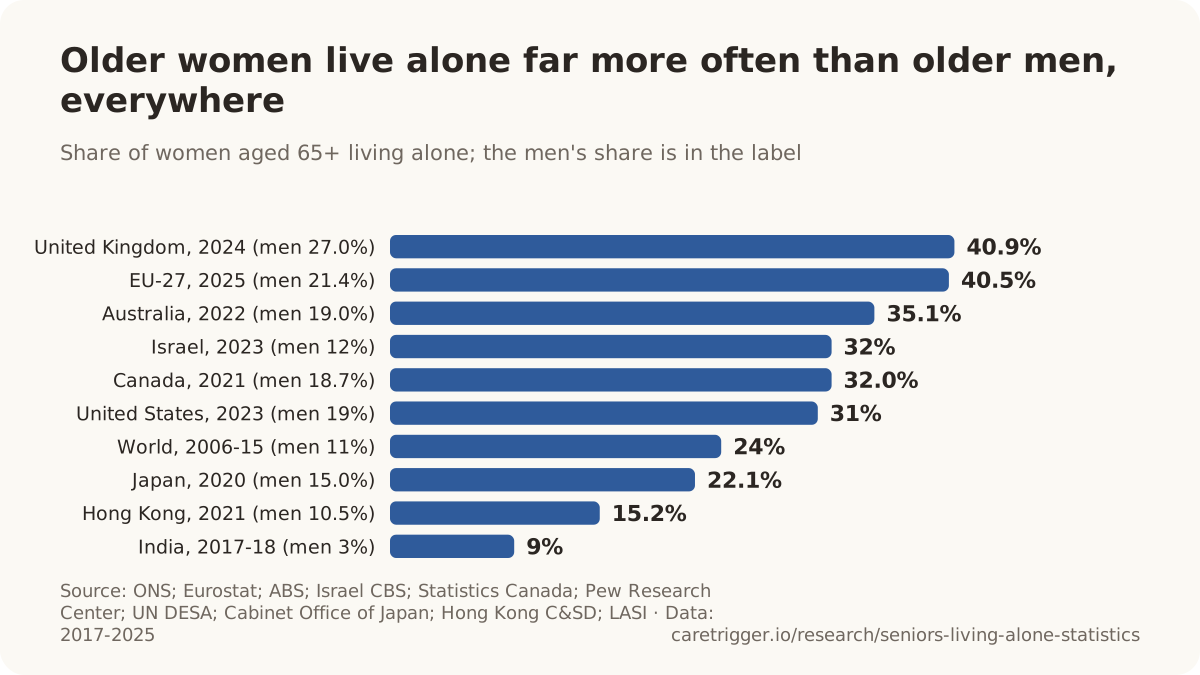
Worldwide, 24% of women aged 65 and over lived alone in 2006-2015, more than twice the share of men the same age (11%) - UN DESA's harmonised estimate across countries with data.[4]
Two to one, in every country with data, because women outlive their husbands. The gap is closing from both ends: men are living longer, so fewer women are widowed young, and more men are reaching old age unmarried. In the UK the number of men over 75 living alone has more than doubled since 1996; in the EU single men over 65 grew more than twice as fast as single women over the last decade.
- 31% of U.S. women aged 65 and over lived alone in 2023, down from 38% in 1990 (Pew Research Center, December 2025).[11]
- 19% of U.S. men aged 65 and over lived alone in 2023, up from 15% in 1990 (Pew Research Center, December 2025).[11]
- 68% of U.S. men aged 65 and over were married in 2023, versus 47% of women the same age (ACL, 2023 Profile of Older Americans; CPS ASEC).[10]
- Among U.S. adults aged 75 and over in 2022, 67% of men lived with a spouse compared with 35% of women - the mirror image of the living-alone gap (U.S. Census Bureau, America Counts, 2024; CPS ASEC).[54]
- 22.06 million women and 9.20 million men aged 65+ lived alone in the EU-27 in 2025 - 40.4% of older women versus 21.6% of older men (Eurostat LFS).[2]
- Between 2016 and 2025 the number of single men aged 65+ in the EU rose 37.0%, more than double the 16.8% rise for single women of that age (Eurostat).[55]
- The number of men aged 75 and over living alone in the UK more than doubled between 1996 and 2025 (+112.3%, 382,000 to 811,000), while women 75+ living alone rose 22.7% (1.40 million to 1.71 million).[18]
- 1.54 million men aged 65 and over lived alone in the UK in 2025, up 96.5% from 782,000 in 1996; women 65+ living alone rose 14.6% (2.37 million to 2.72 million).[18]
- 36.3% of women aged 65+ in England and Wales lived alone in 2021, down from 39.2% in 2011; for men the share rose from 21.8% to 22.7% (ONS, Census 2021).[19]
- 26.4% of men aged 85 and over in private households lived alone in Canada in 2021 (67,500 of 255,675), half the rate of women the same age (52.5%; 193,195 of 367,855).[35]
- Women made up 74.0% of people aged 65+ living alone in Türkiye in 2024; men 26.0%.[58]
- 44.1% of women aged over 85 in Spain lived alone in 2020, compared with 24.2% of men (INE, ECH 2020).[24]
- 53% of women aged 85+ in France lived alone at home in 2021, compared with 28% of men of that age (Insee, census 2021).[23]
- Two in three Norwegian women aged 80+ (66.9%) lived alone in 2019, versus one in three men (32.1%); about 111,000 people aged 80+ lived alone (SSB).[59]
- At the 2016 Census, 41% of Australian women aged 85+ lived alone compared with 25% of men aged 85+, the widest gender gap of any age group.[51]
- Nine percent of Indian women aged 60+ live alone compared with 3% of men, and 19% of divorced, separated or deserted elders live alone (LASI Wave 1, 2017–18).[41]
- Globally, 38% of men aged 65+ but only 23% of women live with a spouse only - a 15-point gap that widens to 23 points in Europe and Northern America (56% vs 33%).[4]
- Across 130 countries, 20% of women aged 60 and older live alone versus 11% of men - older women are nearly twice as likely to be in solo households (Pew Research Center, 2020).[17]
- Among Christians aged 60+, 30% of women live alone versus 14% of men - the widest gender gap of any religious group (Pew).[42]
| Geography | Women · men | Scope | Source |
|---|---|---|---|
| United Kingdom | women 40.9% · men 27.0% | people aged 65+ in households · 2024 | [60] |
| EU-27 (2020 composition) | women 40.5% · men 21.4% | Women aged 65+ in private households (EU-SILC) · 2025 | [21] |
| France | women 46.3% · men 25.5% | People aged 65+ in private households (EU-SILC) · 2025 (2015 comparison) | [21] |
| Germany | women 45.4% · men 22.5% | People aged 65+ in private households (EU-SILC) · 2025 (2015 comparison) | [21] |
| Australia | women 35.1% · men 19.0% | People aged 65+ living in private households, by sex · 2022 | [33] |
| Canada | women 32.0% · men 18.7% | Women aged 65+ in private households · 2021 | [35] |
| Israel | women 32% · men 12% | Women aged 65+ in households, Israel · 2023 (release 2024) | [36] |
| United States | women 31% · men 19% | All women aged 65+ · 2023 | [11] |
| World | women 24% · men 11% | Men aged 65+ living in households, world aggregate · 2006-2015 | [4] |
| Japan | women 22.1% · men 15.0% | people aged 65+ (one-person households) · 2020 (Census) | [61] |
| Hong Kong SAR | women 15.2% · men 10.5% | Population aged 65+, by sex · 2021 (census) | [31] |
| India | women 9% · men 3% | Persons aged 60+, by sex and marital status · 2017–2018 | [41] |
| Geography | Women · men | Scope | Source |
|---|---|---|---|
| Netherlands | women 46.9% · men 21.3% | Women aged 65+ living in households, Netherlands · 2011 | [4] |
| United Kingdom | women 44.1% · men 25.4% | Women aged 65+ living in households, United Kingdom · 2011 | [4] |
| Russian Federation | women 35.8% · men 16.3% | Women aged 65+ living in households, Russian Federation · 2010 | [4] |
| Canada | women 34.9% · men 17.1% | Women aged 65+ living in households, Canada · 2011 | [4] |
| United States of America | women 34.3% · men 19.3% | Women aged 65+ living in households, United States of America · 2015 | [4] |
| Israel | women 34.2% · men 12.6% | Women aged 65+ living in households, Israel · 2008 | [4] |
| Uruguay | women 32.0% · men 18.9% | Women aged 65+ living in households, Uruguay · 2011 | [4] |
| Egypt | women 28.7% · men 8.6% | Women aged 65+ living in households, Egypt · 2006 | [4] |
| Argentina | women 25.7% · men 14.6% | Women aged 65+ living in households, Argentina · 2010 | [4] |
| Republic of Korea | women 23.9% · men 10.8% | Women aged 65+ living in households, Republic of Korea · 2015 | [4] |
| Japan | women 21.3% · men 14.0% | Women aged 65+ living in households, Japan · 2015 | [4] |
| Brazil | women 17.5% · men 10.9% | Women aged 65+ living in households, Brazil · 2010 | [4] |
| South Africa | women 16.1% · men 13.8% | Women aged 65+ living in households, South Africa · 2011 | [4] |
| Mexico | women 14.1% · men 10.8% | Women aged 65+ living in households, Mexico · 2015 | [4] |
| India | women 7.3% · men 2.5% | Women aged 65+ living in households, India · 2009 | [4] |
| Afghanistan | women 0.1% · men 0.4% | Women aged 65+ living in households, Afghanistan · 2015 | [4] |
05 / Country ranking
Which countries have the most older people living alone?
54.25% of people aged 65 and over in private households in Lithuania lived alone (2024; rank 1 of 39 countries in the OECD Affordable Housing Database HM1.4, 2025 update).[3]
The Baltic states and the Nordic countries top every ranking; southern and eastern Europe, Latin America and Asia sit at the bottom; the United States is in the middle of the rich world. The pattern follows widowhood, housing and whether grown children stay: where extended families are the norm, almost nobody old lives alone.
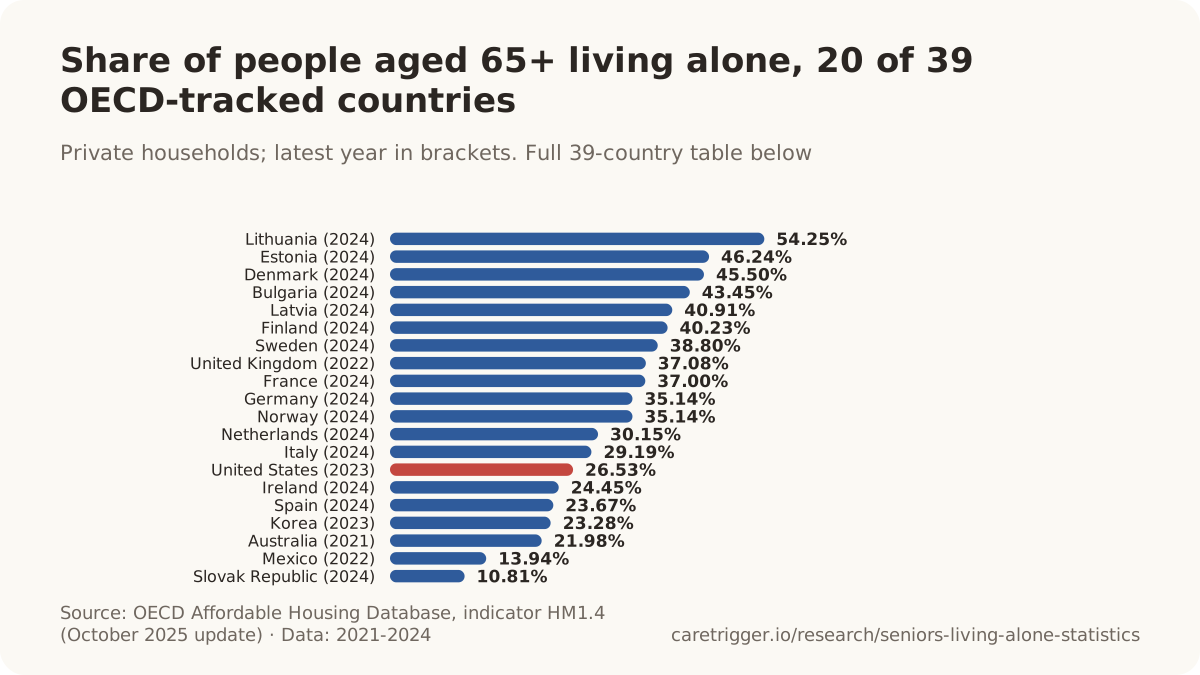
- 46.24% of people aged 65 and over in private households in Estonia lived alone (2024; rank 2 of 39 countries in the OECD Affordable Housing Database HM1.4, 2025 update).[3]
- 45.50% of people aged 65 and over in private households in Denmark lived alone (2024; rank 3 of 39 countries in the OECD Affordable Housing Database HM1.4, 2025 update).[3]
- 10.81% of people aged 65 and over in private households in Slovak Republic lived alone (2024; rank 39 of 39 countries in the OECD Affordable Housing Database HM1.4, 2025 update).[3]
- 13.94% of people aged 65 and over in private households in Mexico lived alone (2022; rank 38 of 39 countries in the OECD Affordable Housing Database HM1.4, 2025 update).[3]
- On average across the OECD about 31% of seniors in private households live alone, 41% live with at least one other senior and 28% live with someone under 65.[62]
- Europe and North America have the largest shares of adults 60+ living alone - a quarter or more - and just under half living as couples; few live with extended family (Pew).[42]
- Globally, living with extended family is the most common arrangement for people 60+ (38%), followed by living as a couple (31%) and living alone (16%).[42]
- 38% of adults aged 60+ worldwide live in extended-family households - two-thirds or more in Iraq, Namibia and India - versus just 6% in the United States.[17]
- 46% of Americans aged 60+ live with only a spouse or partner, compared with 31% of older adults globally (Pew, 130 countries).[17]
- In many Asia-Pacific, sub-Saharan African and Middle East-North Africa countries - such as Afghanistan, Mali and Algeria - fewer than 5% of adults aged 60+ live alone (Pew).[17]
- Only 9% of adults aged 60+ in sub-Saharan Africa live as a couple without others, versus 46% in the US; half live with extended family (Pew).[17]
- In Afghanistan, 0.1% of women aged 65 and over lived alone versus 0.4% of men (2015 data compiled by UN DESA).[4]
- In 2024, 28.4% of South Africa's older persons living alone (181,000 people) lived in Gauteng, the largest share of any province; Northern Cape had the smallest (2.8%) (Stats SA, General Household Survey 2024).[40]
- Elderly living alone is most common in Tamil Nadu (15% of those aged 60+), followed by Nagaland (13%) and Telangana (11%), LASI Wave 1.[41]
- Balıkesir has Türkiye's highest share of one-person elderly households (34.3%), followed by Çanakkale (34.1%) and Burdur (33.7%); Hakkari the lowest (8.3%).[63]
- The UN DESA Database on Household Size and Composition 2022 harmonises 1,059 data sources from 196 countries or areas (1960-2021), the reference dataset behind UN one-person-household and older-person living-arrangement indicators.[64]
| Geography | Living alone | Scope | Source |
|---|---|---|---|
| Lithuania | 54.25% | Persons aged 65+ in private households, Lithuania · 2024 | [3] |
| Estonia | 46.24% | Persons aged 65+ in private households, Estonia · 2024 | [3] |
| Denmark | 45.5% | Persons aged 65+ in private households, Denmark · 2024 | [3] |
| Bulgaria | 43.45% | Persons aged 65+ in private households, Bulgaria · 2024 | [3] |
| Latvia | 40.91% | Persons aged 65+ in private households, Latvia · 2024 | [3] |
| Finland | 40.23% | Persons aged 65+ in private households, Finland · 2024 | [3] |
| Sweden | 38.8% | Persons aged 65+ in private households, Sweden · 2024 | [3] |
| United Kingdom | 37.08% | Persons aged 65+ in private households, United Kingdom · 2022 | [3] |
| France | 37% | Persons aged 65+ in private households, France · 2024 | [3] |
| Romania | 36.62% | Persons aged 65+ in private households, Romania · 2024 | [3] |
| Luxembourg | 36.19% | Persons aged 65+ in private households, Luxembourg · 2024 | [3] |
| Austria | 35.6% | Persons aged 65+ in private households, Austria · 2024 | [3] |
| Belgium | 35.54% | Persons aged 65+ in private households, Belgium · 2024 | [3] |
| Germany | 35.14% | Persons aged 65+ in private households, Germany · 2024 | [3] |
| Norway | 35.14% | Persons aged 65+ in private households, Norway · 2024 | [3] |
| Czechia | 35.03% | Persons aged 65+ in private households, Czechia · 2024 | [3] |
| Hungary | 34.59% | Persons aged 65+ in private households, Hungary · 2023 | [3] |
| Malta | 33.82% | Persons aged 65+ in private households, Malta · 2024 | [3] |
| Switzerland | 33.02% | Persons aged 65+ in private households, Switzerland · 2023 | [3] |
| Netherlands | 30.15% | Persons aged 65+ in private households, Netherlands · 2024 | [3] |
| Iceland | 29.8% | Persons aged 65+ in private households, Iceland · 2020 | [3] |
| Croatia | 29.74% | Persons aged 65+ in private households, Croatia · 2024 | [3] |
| Slovenia | 29.31% | Persons aged 65+ in private households, Slovenia · 2024 | [3] |
| Italy | 29.19% | Persons aged 65+ in private households, Italy · 2024 | [3] |
| Greece | 28.42% | Persons aged 65+ in private households, Greece · 2024 | [3] |
| United States | 26.53% | Persons aged 65+ in private households, United States · 2023 | [3] |
| Portugal | 25.98% | Persons aged 65+ in private households, Portugal · 2024 | [3] |
| Ireland | 24.45% | Persons aged 65+ in private households, Ireland · 2024 | [3] |
| Spain | 23.67% | Persons aged 65+ in private households, Spain · 2024 | [3] |
| Türkiye | 23.39% | Persons aged 65+ in private households, Türkiye · 2020 | [3] |
| Korea | 23.28% | Persons aged 65+ in private households, Korea · 2023 | [3] |
| Poland | 22.26% | Persons aged 65+ in private households, Poland · 2024 | [3] |
| Australia | 21.98% | Persons aged 65+ in private households, Australia · 2021 | [3] |
| Colombia | 19.2% | Persons aged 65+ in private households, Colombia · 2024 | [3] |
| Cyprus | 17.88% | Persons aged 65+ in private households, Cyprus · 2024 | [3] |
| Chile | 16.26% | Persons aged 65+ in private households, Chile · 2022 | [3] |
| Costa Rica | 15.6% | Persons aged 65+ in private households, Costa Rica · 2024 | [3] |
| Mexico | 13.94% | Persons aged 65+ in private households, Mexico · 2022 | [3] |
| Slovak Republic | 10.81% | Persons aged 65+ in private households, Slovak Republic · 2024 | [3] |
One definition for the whole table. The OECD figures count people aged 65 and over in private households who live in a one-person household, from each country's income or household survey. National figures elsewhere on this page use other bases (Eurostat's "single adult" counts, census one-person households, register data), so a country can show 54% here and 60% a few sections up without either being wrong.
Every EU member state, 2025
| Geography | Living alone | Scope | Source |
|---|---|---|---|
| Lithuania | 59.9% | People aged 65+ in private households (EU-SILC) · 2025 (2015 comparison) | [21] |
| Denmark | 49% | People aged 65+ in private households (EU-SILC) · 2025 (2015 comparison) | [21] |
| Estonia | 45.5% | People aged 65+ in private households (EU-SILC) · 2025 (2015 comparison) | [21] |
| Latvia | 43.3% | People aged 65+ in private households (EU-SILC) · 2025 (2015 comparison) | [21] |
| Bulgaria | 41.8% | People aged 65+ in private households (EU-SILC) · 2025 (2015 comparison) | [21] |
| Finland | 40.3% | People aged 65+ in private households (EU-SILC) · 2025 (2015 comparison) | [21] |
| Norway | 40.1% | People aged 65+ in private households (EU-SILC) · 2025 | [21] |
| Sweden | 38.3% | People aged 65+ in private households (EU-SILC) · 2025 (2015 comparison) | [21] |
| France | women 46.3% · men 25.5% | People aged 65+ in private households (EU-SILC) · 2025 (2015 comparison) | [21] |
| Czechia | 36.7% | People aged 65+ in private households (EU-SILC) · 2025 (2015 comparison) | [21] |
| Belgium | 36.2% | People aged 65+ in private households (EU-SILC) · 2025 (2015 comparison) | [21] |
| Romania | 35.9% | People aged 65+ in private households (EU-SILC) · 2025 (2015 comparison) | [21] |
| Luxembourg | 35.9% | People aged 65+ in private households (EU-SILC) · 2025 (2015 comparison) | [21] |
| Germany | women 45.4% · men 22.5% | People aged 65+ in private households (EU-SILC) · 2025 (2015 comparison) | [21] |
| Austria | 34.3% | People aged 65+ in private households (EU-SILC) · 2025 (2015 comparison) | [21] |
| Hungary | 33.7% | People aged 65+ in private households (EU-SILC) · 2025 (2015 comparison) | [21] |
| Switzerland | 33.4% | People aged 65+ in private households (EU-SILC) · 2024 | [21] |
| EU-27 (2020 composition) | 32.2% | People aged 65+ in private households (EU-SILC) · 2025 | [21] |
| Italy | 31.7% | People aged 65+ in private households (EU-SILC) · 2025 (2015 comparison) | [21] |
| Netherlands | 31.3% | People aged 65+ in private households (EU-SILC) · 2025 (2015 comparison) | [21] |
| Greece | 29.3% | People aged 65+ in private households (EU-SILC) · 2025 (2015 comparison) | [21] |
| Slovenia | 28.8% | People aged 65+ in private households (EU-SILC) · 2025 (2015 comparison) | [21] |
| Croatia | 28.5% | People aged 65+ in private households (EU-SILC) · 2025 (2015 comparison) | [21] |
| Malta | 26.2% | People aged 65+ in private households (EU-SILC) · 2025 (2015 comparison) | [21] |
| Portugal | 25.7% | People aged 65+ in private households (EU-SILC) · 2025 (2015 comparison) | [21] |
| Ireland | 24.8% | People aged 65+ in private households (EU-SILC) · 2025 (2015 comparison) | [21] |
| Spain | 22.8% | People aged 65+ in private households (EU-SILC) · 2025 (2015 comparison) | [21] |
| Poland | 22.2% | People aged 65+ in private households (EU-SILC) · 2025 (2015 comparison) | [21] |
| Cyprus | 19.1% | People aged 65+ in private households (EU-SILC) · 2025 (2015 comparison) | [21] |
| Slovakia | 7.4% | People aged 65+ in private households (EU-SILC) · 2025 (2015 comparison) | [21] |
Slovakia's 7.4% is a break in the series, not a social change. Eurostat's 2025 figure for Slovakia (7.4%, down from 30.4% in 2015) reflects a change in how the survey records households; the OECD table above, drawn from the same survey family, shows 10.81%. Quote Slovakia with that caveat or not at all.
06 / Over time
Is living alone rising or falling?
26% of U.S. adults aged 65 and over lived alone in 2023, down from 29% in 1990 (Pew Research Center analysis of Census Bureau data, December 2025).[11]
Both headlines you have read are true. In the United States, the share of older adults living alone peaked around 1990 and has drifted down since, mostly because more older women now have a living husband; the number keeps rising because the older population is growing so fast. Canada's share has barely moved in forty years while its count more than doubled. In Japan, Korea, Singapore and most of Europe both share and count are still climbing.
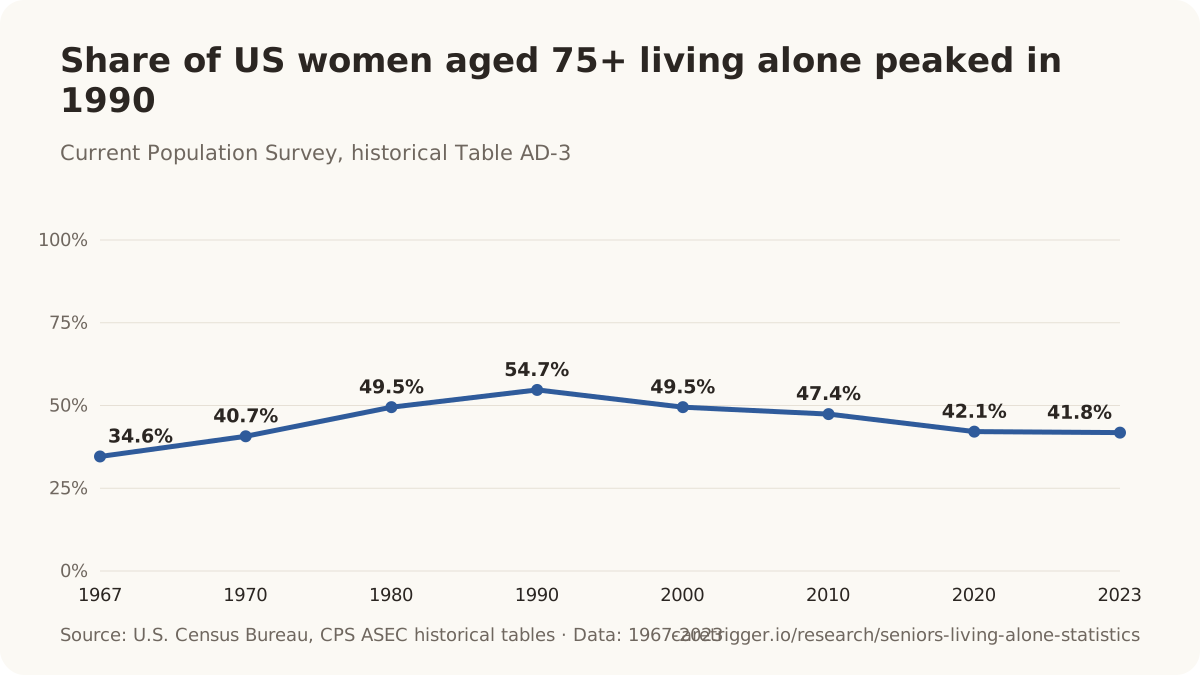
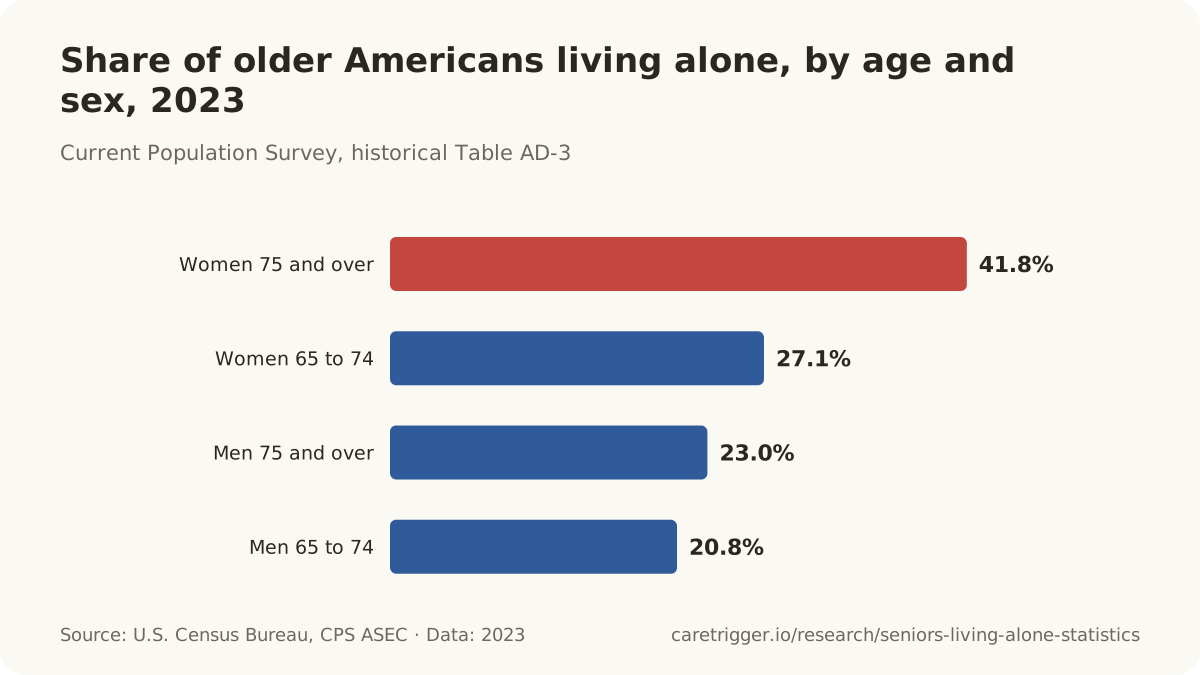
- 54.7% of U.S. women aged 75 and over lived alone in 1990 (of 7,267,000 women 75+) - the peak of the series; by 2023 the share had fallen to 41.8% (U.S. Census Bureau, CPS ASEC, historical Table AD-3).[65]
- 20.8% of U.S. men aged 65 to 74 lived alone in 2023 (of 15,997,000 men 65-74) - almost double the 10.9% of 1967 (U.S. Census Bureau, CPS ASEC, historical Table AD-3).[66]
- About 28% of U.S. adults aged 65 and over lived alone in 2022, up about 4 percentage points from about 24% in 1967 (U.S. Census Bureau, P20-587, CPS ASEC 1967-2022).[16]
- 12,088,000 U.S. one-person households were headed by someone aged 65 or over in 2013 - 5,423,000 aged 65-74 and 6,665,000 aged 75 and over (CPS ASEC 2013, Table H2; sum derived).[67]
- Single-person households were only 13% of all U.S. households in 1960; by 2022 the share had more than doubled to 29% (U.S. Surgeon General's Advisory, 2023, citing Census Bureau data).[68]
- 1,215,690 Canadians aged 65 and over lived alone in 2011 - 26.7% of the 4,551,900 people 65+ in private households (2011 Census).[35]
- The number of people aged 75 and over living alone in the UK rose 41.9%, from 1.78 million in 1996 to 2.52 million in 2025 (ONS LFS).[18]
- The number of single adults aged 65+ in the EU grew 22.1% between 2016 and 2025, versus 14.6% for ages 18-64 (Eurostat, Household composition statistics).[55]
- The number of South Koreans aged 65+ living alone rose 47.9% in five years, from 1,661,000 households (2020) to 2,456,000 (2025), share of all households from 7.9% to 10.9%.[27]
- One-person households of people aged 65+ in Singapore more than doubled in a decade, from 42,100 in 2014 to 87,200 in 2024 (MOH parliamentary reply, 12 January 2026).[70]
- 119,376 Hong Kong residents aged 65+ lived alone in 2011 (12.7% of older persons); the count rose 58% to 188,569 by 2021 while the share barely moved (13.0%).[71]
- 38% of Danes aged 65+ lived alone in 2019 (38.1%, about 430,000 people), the lowest share since 1986 and down from 44.6% in 2000 (Danmarks Statistik).[72]
- 35% of Norwegians aged 67+ lived alone in 2019 (women 44.6%, men 23.8%), down from 37% in 2014 (Statistics Norway).[59]
- One-person households of people aged 65+ in Spain grew 6.1% in a single year (2019 to 2020), with men 65+ living alone up 11.4%, while under-65 one-person households fell 0.9% (INE).[24]
- 40.35% of people aged 65+ in private households in Lithuania lived alone in 2010 (OECD Affordable Housing Database HM1.4.A1 back series).[3]
- 9.9% of South Africans aged 60+ lived alone in 2003 (326,000 of 3,292,000).[40]
| Period | Households | Scope | Source |
|---|---|---|---|
| 2013 | 12,088,000 one-person households, householder 65+ | One-member households by age of householder (CPS ASEC) · United States | [67] |
| 2015 | 13,281,000 one-person households, householder 65+ | One-member households by age of householder (CPS ASEC) · United States | [74] |
| 2018 | 14,259,000 one-person households, householder 65+ | One-member households by age of householder (CPS ASEC) · United States | [75] |
| 2019 | 14,745,000 one-person households, householder 65+ | One-member households by age of householder (CPS ASEC) · United States | [76] |
| 2021 | 15,252,000 one-person households, householder 65+ | One-member households by age of householder (CPS ASEC) · United States | [77] |
| 2023 | 16,194,000 one-person households, householder 65+ | One-member households by age of householder (CPS ASEC) · United States | [12] |
- In 1981, 35.9% of Canadians aged 85 and over in private households lived alone (2016: 43.3%; 2021: 41.8%).[78]
- In 1981, 19.6% of Canadians aged 65 to 69 in private households lived alone (2016: 20.2%; 2021: 20.7%).[78]
- In 1981, 37.3% of Canadians aged 80 to 84 in private households lived alone (2016: 33.0%; 2021: 32.0%).[78]
- 33.4% of U.S. women aged 65 to 74 lived alone in 1990 (of 9,966,000 women 65-74) (U.S. Census Bureau, CPS ASEC, historical Table AD-3).[66]
- 16.9% of U.S. men aged 75 and over lived alone in 1967 (of 2,723,000 men 75+) (U.S. Census Bureau, CPS ASEC, historical Table AD-3).[65]
- 34.6% of U.S. women aged 75 and over lived alone in 1967 (of 3,835,000 women 75+) (U.S. Census Bureau, CPS ASEC, historical Table AD-3).[65]
| Period | People | Scope | Source |
|---|---|---|---|
| 1996 | 1,777,000 people aged 75+ living alone | People aged 75+ in private households (LFS) · United Kingdom | [18] |
| 2005 | 1,986,000 people aged 75+ living alone | People aged 75+ in private households (LFS) · United Kingdom | [18] |
| 2015 | 2,079,000 people aged 75+ living alone | People aged 75+ in private households (LFS) · United Kingdom | [18] |
| 2025 | 2,522,000 people aged 75+ living alone | People aged 75+ in private households (LFS) · United Kingdom | [18] |
| Period | Men | Scope | Source |
|---|---|---|---|
| 1996 | 382,000 men aged 75+ living alone | Men aged 75+ in private households · United Kingdom | [18] |
| 2005 | 502,000 men aged 75+ living alone | Men aged 75+ in private households · United Kingdom | [18] |
| 2015 | 581,000 men aged 75+ living alone | Men aged 75+ in private households · United Kingdom | [18] |
| 2025 | 811,000 men aged 75+ living alone | Men aged 75+ in private households · United Kingdom | [18] |
| Period | People | Scope | Source |
|---|---|---|---|
| 2010 | 27,900 people | Residents aged 65+ in resident households, living in one-person households · Singapore | [32] |
| 2015 | 41,200 people | Residents aged 65+ in resident households, living in one-person households · Singapore | [32] |
| 2020 | 63,800 people | Residents aged 65+ in resident households, living in one-person households · Singapore | [32] |
| 2025 | 88,400 people | Residents aged 65+ in resident households, living in one-person households · Singapore | [32] |
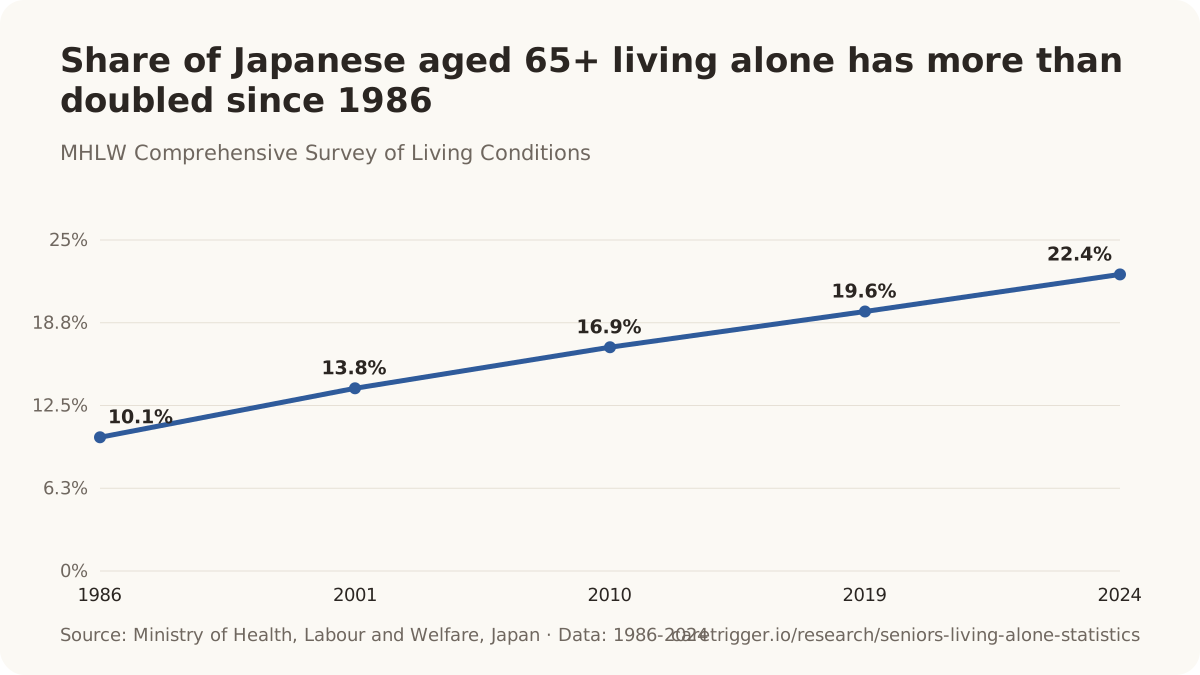
| Period | Living alone | Scope | Source |
|---|---|---|---|
| 2010 | 31.4% | People aged 65+ in private households (EU-SILC) · EU-27 (2020 composition) | [21] |
| 2015 | 32.2% | People aged 65+ in private households (EU-SILC) · EU-27 (2020 composition) | [21] |
| 2019 | 32.5% | People aged 65+ in private households (EU-SILC) · EU-27 (2020 composition) | [21] |
| 2020 | 30.9% | People aged 65+ in private households (EU-SILC) · EU-27 (2020 composition) | [21] |
| 2022 | 31.7% | People aged 65+ in private households (EU-SILC) · EU-27 (2020 composition) | [21] |
| 2024 | 31.9% | People aged 65+ in private households (EU-SILC) · EU-27 (2020 composition) | [21] |
| 2025 | 32.2% | People aged 65+ in private households (EU-SILC) · EU-27 (2020 composition) | [21] |
07 / 2030 to 2050
How many will live alone in 2030, 2040 and 2050?
By 2050 one in five Japanese households (20.6%) will be a person aged 65+ living alone; 32 prefectures exceed 20%, led by Kochi (27.0%), Tokushima (25.3%) and Ehime (24.9%).[6]
Japan and South Korea publish the projections everyone else lacks, and they point the same way: older people living alone become the single most common household type. The United States has only a projection for the over-80s, the Netherlands and England for the next decade. No official projection of the number of people aged 65 and over living alone exists for the United States, the United Kingdom or the EU as a whole; the nearest proxies are below.
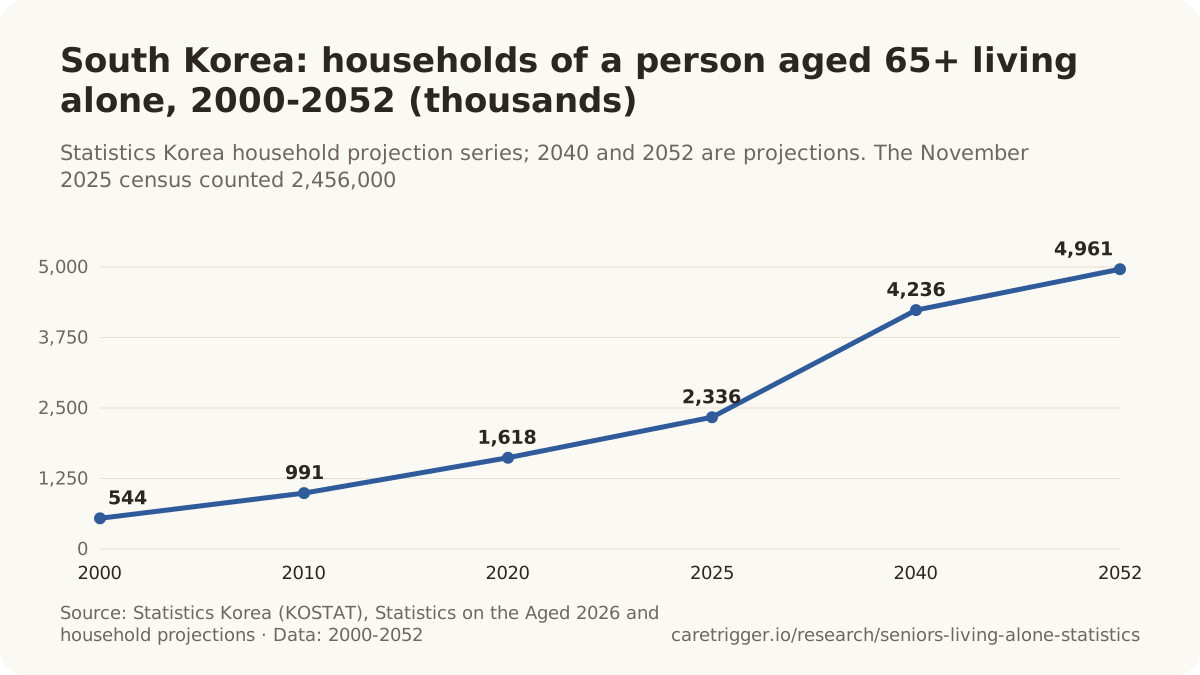
- 4,961,000 South Korean households were a person aged 65+ living alone in 2052 (projection), 42.1% of the 11,788,000 households headed by someone aged 65+ (Statistics Korea, 2025 Statistics on the Aged, table 고령자 가구).[79]
- The number of U.S. single-person households headed by someone aged 80 or over is projected to grow from 4.7 million in 2018 to 10.1 million in 2038 (JCHS 2018 Household Projections).[81]
- The U.S. population aged 85 and over is projected to nearly triple from 6,486,000 in 2022 to 17,375,000 in 2050 (U.S. Census Bureau, 2023 National Population Projections, main series).[82]
- The number of U.S. women aged 85 and over is projected to rise from 4,202,000 in 2022 to 10,458,000 in 2050, versus 2,284,000 to 6,917,000 for men (U.S. Census Bureau, 2023 National Population Projections, main series).[82]
- The U.S. population aged 65 and over is projected to reach 82,130,000 in 2050, up from 57,795,000 in 2022 (U.S. Census Bureau, 2023 National Population Projections, main series).[82]
- 21.1 million white and black Americans aged 50 and over are projected to have no living partner or biological children in 2060 (Verdery & Margolis, PNAS, 2017).[83]
- The number of people aged 75 and over living on their own in England is projected to increase by 461,000 in the ten years to 2028 (ONS 2018-based household projections).[84]
- Of the more than 500,000 additional households headed by someone aged 65+ expected in the Netherlands by 2035, more than 300,000 will be one-person households (CBS household forecast, December 2024).[85]
- Between 3.4 and 4.0 million Australians are projected to be living alone in 2046, up from 2,637,500 in 2021 (1,185,500 men; 1,452,000 women), ABS Household and Family Projections 2021–2046.[86]
- Between 31% and 35% of Australians aged 85 and over are projected to be living alone in 2046 (ABS Household and Family Projections, 2024).[86]
- About 122,000 Singapore citizens aged 65+ are projected to be living alone by 2030, up from about 76,000 in 2023 (Singapore Public Sector Outcomes Review 2024).[87]
- Canada's population aged 85 and over doubled since 2001 to 861,000 in 2021 and could triple to 2.7 million over the next 30 years - the age group most likely to live alone.[88]
- There were 727 million people aged 65 or over worldwide in 2020, projected to more than double to over 1.5 billion by 2050 (9.3% to about 16.0% of the population).[4]
08 / Who they are
Who are the older people living alone?
Widows were 29% of all U.S. women aged 65 and over in 2023 - 9 million people, more than three times the 2.9 million widowers (ACL, 2023 Profile of Older Americans; CPS ASEC).[10]
Mostly widows, increasingly never-married men, and a growing minority with no close family at all. Two terms get mixed up here: living alone (a household of one, any age, any family ties) and solo agers, AARP's label for people over 50 who live alone with no partner and no living children. About one in eight older Americans is a solo ager; most people living alone have children somewhere.
- 68% of U.S. men aged 65 and over were married in 2023, versus 47% of women the same age (ACL, 2023 Profile of Older Americans; CPS ASEC).[10]
- 36.3% of U.S. adults aged 55 and over had no living spouse or partner in 1998-2010; among those 75 and over, 70.6% of women lacked a spouse or partner versus 30.6% of men (Margolis & Verdery, 2017; HRS).[89]
- 6.6% of U.S. adults aged 55 and over had neither a living spouse nor biological children in 1998-2010 (Margolis & Verdery, Journals of Gerontology B, 2017; Health and Retirement Study).[89]
- 1% of U.S. adults aged 55 and over had no living partner or spouse, children, siblings or parents in 1998-2010 (Margolis & Verdery, 2017; Health and Retirement Study).[89]
- At ages 50-54, the share with no spouse or biological children rose from 6.7% of Americans born 1931-1941 to 9.0% of those born 1948-1953 (Margolis & Verdery, 2017; HRS).[89]
- 22.6% of older Americans were at high risk of becoming 'elder orphans' - unmarried and either childless or out of contact with their children - in a 2010 Health and Retirement Study sample of 22,034 respondents (Carney et al., 2016).[90]
- More than 24 million U.S. adults aged 50 and over live alone - 21% of the 50-plus population - according to Census data cited by AARP in its 2025 solo-agers study (AARP Research, November 2025).[91]
- 12% of U.S. adults aged 50 and over were 'solo agers' - living alone, not married or partnered, and with no living children - in 2020 (AARP Research / NORC, 2021).[92]
- Only about one-third of U.S. solo agers (50+, living alone, no partner, no children) said they have someone who could manage their household or day-to-day expenses if they no longer could (AARP Research / NORC survey, 2020).[92]
- 46% of U.S. solo agers fear dying alone, versus 37% of other adults 50+; 50% versus 33% fear being moved somewhere against their will (AARP Research / NORC survey, 2020).[92]
- 40% of U.S. solo agers (people 50+ living alone) have lived alone for more than 20 years (AARP Research survey, 2025, n=503 solo agers).[91]
- AARP projected that 1.2 million Americans aged 65+ would live alone with no living children or siblings in 2020, up from 682,000 in 1990 (AARP Public Policy Institute, 2013, citing R. Stone).[93]
- 66.5% of the 15,784,869 U.S. householders aged 65 and over who lived alone in 2024 owned their home (10,494,696); 5,290,173 rented (ACS 2024 1-year, Table B25011; share derived).[94]
- 77% of U.S. renter households headed by someone aged 80 or over were single-person households in 2018, versus just under half of owner households that age (JCHS, 2020).[81]
- Nearly half (49.0%; 92,460) of Hong Kong's 188,569 older people living alone lived in public rental housing in 2021.[31]
- One-person households headed by a woman aged 65 or over made up 9.5% of U.S. White non-Hispanic households in 2023 (8,060,000 of 84,491,000) (CPS ASEC 2023, Table H3).[95]
- One-person households headed by a woman aged 65 or over made up 7.2% of U.S. Black alone households in 2023 (1,305,000 of 18,077,000) (CPS ASEC 2023, Table H3).[95]
- One-person households headed by a woman aged 65 or over made up 3.7% of U.S. Hispanic (any race) households in 2023 (721,000 of 19,319,000) (CPS ASEC 2023, Table H3).[95]
- One-person households headed by a woman aged 65 or over made up 4.2% of U.S. Asian alone households in 2023 (320,000 of 7,609,000) (CPS ASEC 2023, Table H3).[95]
- 23% of Jewish Israelis aged 65+ live alone compared with 18% of Arab Israelis the same age (CBS 2024).[36]
- 23% of Christians aged 60+ worldwide live alone - the highest of any religious group analysed - the same share as live with extended family.[42]
- Only 6% of Hindu women and 2% of Hindu men aged 60+ live alone; 72% of older Hindus live in extended families (Pew).[42]
- In Canada, 47% of Hindus aged 60+ live with extended family - compared with 72% of Hindus worldwide - a marker of how immigrant seniors' living arrangements differ from the Canadian norm.[42]
- 92.8% of Italians aged 75+ living alone say they can count on relatives, 69.2% on neighbours and 58.9% on friends; 3.2% have none of these (Istat 2023).[25]
- One in four older Norwegians living alone (24%, 73,700 people) has no family living within 30 minutes' drive (Statistics Norway, 2025).[48]
Living alone with dementia
In 2023, 40% of the 205,507 people with a dementia diagnosis in England's Clinical Practice Research Datalink (excluding care-home residents) were living alone, a share that has risen since 2009 (Gamble et al., BMC Medicine, 2025).[96]
- An estimated 31% of US older adults with cognitive impairment live alone (NHATS 2015-2017, weighted national estimate), and nearly half of them (46%) take at least one high-risk medication (Growdon et al., Journal of the American Geriatrics Society, 2024).[97]
- Among US older adults with cognitive impairment, 34% of those living alone took at least one high-risk medication without any help managing their medicines, versus 23% of those living with others (Growdon et al., 2024).[97]
09 / What they want
Do older people want to live alone, and who do they have?
75% of U.S. adults aged 50 and over want to remain in their current home for as long as possible, and 73% want to stay in their community (AARP 2024 Home and Community Preferences Survey, n=3,090 adults 18+).[5]
Overwhelmingly, people want to stay in their own homes and, given the choice, to live on their own. What they lack is not the wish but the backup: only a third of solo agers have someone who could run their household if they were ill, a quarter of older Norwegians living alone have no family within half an hour, and the ratio of potential family carers to people over 80 is falling fast.
- 72% of older Americans say they would ideally reside in their own home and live on their own; 23% would accept a family member or friend moving in and only 6% would move in with family or friends (AARP 2024 Home and Community Preferences Survey).[99]
- 44% of U.S. adults aged 50 and over expect to relocate at some point, despite most wanting to age in place (AARP 2024 Home and Community Preferences Survey).[5]
- 22% of U.S. adults 50+ who live alone said loneliness is the worst part of living alone, while 35% named freedom and autonomy as the best part (AARP Research survey, 2025).[91]
- Among 1,306 French patients aged 75+ admitted via emergency departments, 45% of those who lived alone did not feel lonely, while 34% of those who lived with others did feel lonely; living alone was associated with longer, not shorter, survival (Simo et al., Gériatrie et Psychologie Neuropsychiatrie du Vieillissement, 2025).[100]
- 92.8% of Italians aged 75+ living alone say they can count on relatives, 69.2% on neighbours and 58.9% on friends; 3.2% have none of these (Istat 2023).[25]
- Only about one-third of US solo agers (50+, living alone with no spouse, partner or children) say they have someone who could help manage their household or day-to-day expenses if they could no longer do so (AARP Research, 2021).[92]
- One in four older Norwegians living alone (24%, 73,700 people) has no family living within 30 minutes' drive (Statistics Norway, 2025).[48]
- 32% of older Norwegians living alone receive at least one municipal health or care service, versus 10% of those living with a partner (SSB, 2025).[48]
- The US 'caregiver support ratio', the number of potential family caregivers aged 45-64 for each person aged 80+, was 7.2 in 2010 and is projected to fall to 4.1 by 2030 and 2.9 by 2050 as the baby boom reaches its 80s (Redfoot, Feinberg & Houser, AARP Public Policy Institute, August 2013).[93]
- An estimated 2 million people aged 65+ in England have unmet needs for care and support, including hundreds of thousands unable to complete three or more activities of daily living who receive no help or inadequate help (Age UK analysis of ELSA Wave 10, 2021-23; State of Health and Care of Older People in England 2025).[101]
- One in five (20.7%, about 629,000) Americans aged 70+ who needed help with daily activities reported receiving inadequate assistance in 1994; living alone was one of three factors linked to unmet need, and nearly half of those with unmet needs suffered a consequence such as being unable to eat when hungry (Desai, Lentzner & Weeks, The Gerontologist, 2001).[102]
- 32% of older Americans who had difficulty with or received help for daily activities (outside nursing homes) experienced an adverse consequence from an unmet need in the past month, rising to nearly 60% among community residents with a paid caregiver (Freedman & Spillman, Milbank Quarterly, 2014; NHATS 2011).[103]
- About 31,000 Israelis aged 65+ live with a non-relative, usually a live-in caregiver - about 10% of seniors in non-family households, down from 12% in 2022 and 13% in 2021.[36]
- Only 67,003 older people were on Taiwan's local-government registers of 'elderly living alone needing care' at end-2025 (27,583 men, 39,420 women), about 1.4% of the 65+ population, versus 25.8% actually registered as living alone.[104]
10 / Money
How many older people living alone are poor?
18.4% of U.S. householders aged 65 and over who lived alone were below the official poverty line in 2025 (3,358,000 of 18,250,000), versus 5.4% of people 65+ living in primary families (U.S. Census Bureau, CPS ASEC 2026, Table POV-01).[105]
One income, one pension, one rent: living alone roughly triples the odds of being poor in old age in the United States, Canada and the EU alike, and the gap is worst for women and in eastern Europe, where more than three in five older people living alone are below the poverty line.
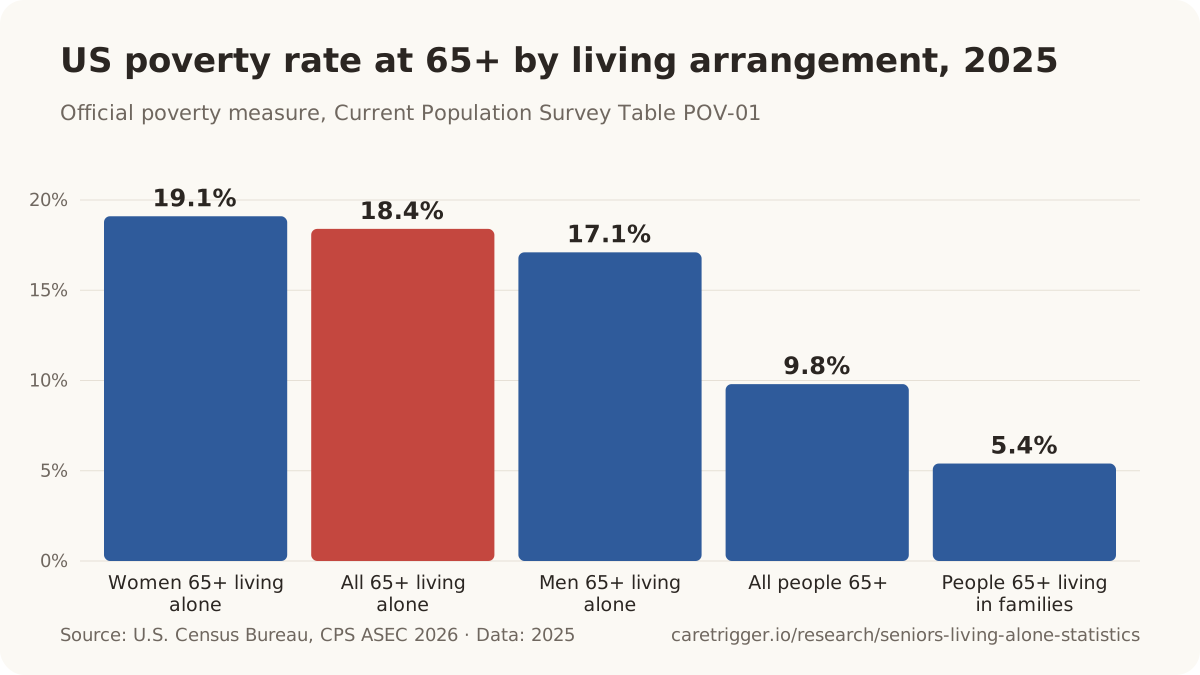
- 19.1% of U.S. women aged 65 and over living alone were in poverty in 2025 (2,202,000 of 11,510,000), versus 17.1% of men 65+ living alone (U.S. Census Bureau, CPS ASEC 2026, Table POV-01).[105]
- 17.1% of U.S. men aged 65 and over living alone were in poverty in 2025 (1,157,000 of 6,746,000) (U.S. Census Bureau, CPS ASEC 2026, Table POV-01).[105]
- 17.4% of U.S. householders aged 65 and over who lived alone were below the official poverty line in 2024 (2,972,000 of 17,120,000), versus 6.1% of people 65+ in primary families (U.S. Census Bureau, CPS ASEC 2025, Table POV-01).[106]
- 17.7% of U.S. adults aged 65 and over living alone were poor in 2022, compared with 6.6% of older people living with families (ACL, 2023 Profile of Older Americans; CPS ASEC).[10]
- 37% of older Asian American women who lived alone were in poverty in 2022 - the highest poverty rate of any older group identified by ACL (2023 Profile of Older Americans; CPS ASEC).[10]
- The official poverty rate for Americans aged 65+ was 9.9% in 2024, but under the Supplemental Poverty Measure, which counts out-of-pocket medical costs, it was 15.0%, the highest of any age group; 5.2% of older people had resources below half the SPM threshold (US Census Bureau, Poverty in the United States: 2024, P60-287).[107]
- $14,036 was the 2022 official poverty threshold for a U.S. householder aged 65 or over living alone (ACL, 2023 Profile of Older Americans, footnote 1; Census Bureau thresholds).[10]
- $36,317 was the 2024 median household income of U.S. men aged 65 and over living alone (ACS 2024 1-year, Table B19215; 2024 inflation-adjusted dollars).[108]
- $31,179 was the 2024 median household income of U.S. women aged 65 and over living alone (ACS 2024 1-year, Table B19215; 2024 inflation-adjusted dollars).[108]
- 47% of U.S. single-adult older households were housing cost burdened (spending over 30% of income on housing) in 2021, versus 21% of older couples (JCHS, Housing America's Older Adults 2023).[15]
- Just over 58% of U.S. adults aged 75 and over who live alone have very low incomes - at or below 50% of area median income (JCHS, Housing America's Older Adults 2023).[15]
- Only 13% of U.S. adults aged 75 and over living alone across 97 metro areas could afford assisted living without dipping into assets, and 14% could afford a daily home-health-aide visit on top of housing costs (JCHS, Housing America's Older Adults 2023).[15]
- U.S. adults aged 80 and over who lived alone had a median income of $22,200 in 2018, compared with $51,700 for married couples the same age (JCHS, 2020).[81]
- 48% of U.S. single-person households aged 80 and over were housing cost burdened in 2018, more than twice the 22% of married couples the same age; among solo renters 80+ the rate was nearly 64% (JCHS, 2020).[81]
- In the United States in 2014, 19% of older women who lived alone were in poverty, versus 15% of older men living alone; older people living alone are about three times more likely to be poor than those living with others.[4]
- 26.8% of EU-27 people living alone aged 65+ were at risk of poverty in 2025 (income below 60% of national median), versus 16.3% of the whole population (Eurostat EU-SILC, ilc_li03).[109]
- In the EU in 2024, 26.9% of people in single-person households aged 65 or over were at risk of poverty (income below 60% of the national median), versus 12.4% of two-adult households with at least one person aged 65+ and 16.2% of the whole population (Eurostat, EU-SILC, dataset ilc_li03).[110]
- Two-adult EU households with at least one member aged 65+ had an at-risk-of-poverty rate of 12.4% in 2024, less than half the 26.9% for older people living alone (Eurostat, ilc_li03).[110]
- 64.4% of people aged 65+ living alone in Croatia were at risk of poverty in 2025 (EU-27 average 26.8%) - Eurostat EU-SILC, ilc_li03.[109]
- 63.2% of people aged 65+ living alone in Latvia were at risk of poverty in 2025 (EU-27 average 26.8%) - Eurostat EU-SILC, ilc_li03.[109]
- 62.3% of people aged 65+ living alone in Estonia were at risk of poverty in 2025 (EU-27 average 26.8%) - Eurostat EU-SILC, ilc_li03.[109]
- 11.1% of unattached seniors (people 65+ not living in an economic family, mostly living alone) were in poverty in Canada in 2024, nearly three times the 4.0% rate for people in senior families.[111]
- People in senior families in Canada had a poverty rate of 4.0% in 2024, unchanged from 2023, versus 11.1% for unattached seniors; all seniors 65+: 5.4%.[111]
- Unattached seniors in Canada had a median after-tax income of $38,600 in 2024 (+3.5%), less than half the $83,200 median of senior families.[111]
- 13.8% of unattached seniors in Canada were in poverty in 2022 - more than three times the 4.3% rate for people in senior families.[112]
- 37.7% of South Koreans aged 66+ lived in relative income poverty in 2024 (down 2.1 points from 39.8% in 2023), still the highest old-age poverty rate in the OECD.[113]
- Across the OECD, 17.5% of people aged 76+ and 13.0% of those 66-75 live in relative income poverty, versus 11.4% of the total population (2022 or latest).[114]
- Old-age income poverty averages 16.9% for women and 11.7% for men across the OECD; the report links the gap to lower pensions and to older women more often living alone after widowhood.[114]
- Relative income poverty among people over 65 is 40% in Korea, above 30% in Estonia, Latvia and New Zealand, and 20% or more in Australia, Costa Rica, Japan, Lithuania and the United States; 5% or below in Denmark, Finland, Iceland, the Netherlands and Norway.[114]
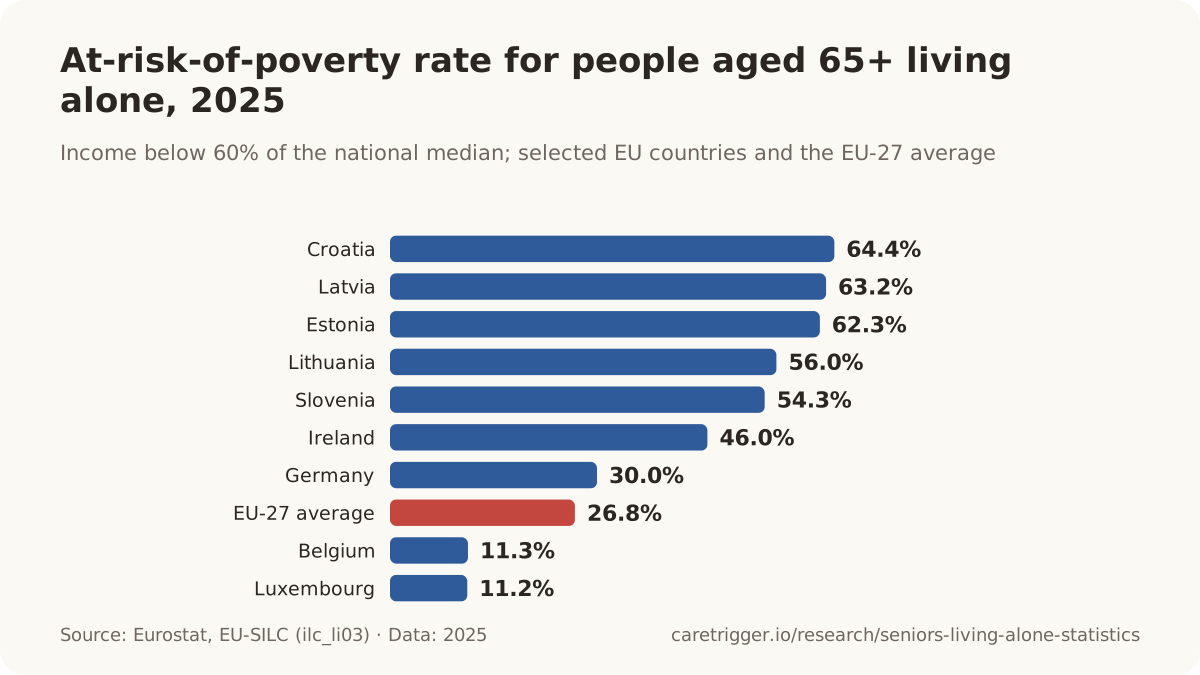
| Period | At risk of poverty | Scope | Source |
|---|---|---|---|
| 2015 | 21.9% | Persons in one-adult households aged 65+ · EU-27 (2020 composition) | [109] |
| 2019 | 25.7% | Persons in one-adult households aged 65+ · EU-27 (2020 composition) | [109] |
| 2022 | 27.9% | Persons in one-adult households aged 65+ · EU-27 (2020 composition) | [109] |
| 2025 | 26.8% | Persons in one-adult households aged 65+ · EU-27 (2020 composition) | [109] |
11 / Health
What does living alone do to health?
Among older adults, living alone was associated with a 21% higher risk of all-cause death (hazard ratio 1.21, 95% CI 1.13-1.30) in a meta-analysis of 86 prospective studies (Nakou et al., Aging Clinical and Experimental Research, 2025).[115]
Living alone is a risk factor of about the same size as the loneliness and social isolation it is often confused with, and the three are not the same thing. A person can live alone and be surrounded by friends; a person can live with family and be isolated. The table collects the effect sizes with their confidence intervals so they can be quoted correctly, and the list below keeps the three exposures apart.
- Living alone was associated with a 32% higher likelihood of death (odds ratio 1.32) across 70 prospective studies with 3,407,134 participants followed for an average of 7 years (Holt-Lunstad et al., Perspectives on Psychological Science, 2015).[7]
- Loneliness (the subjective feeling) was associated with a 26% higher likelihood of death (odds ratio 1.26) in the 70-study meta-analysis, the smallest of the three social-deficit effects (Holt-Lunstad et al., 2015).[7]
- Loneliness was associated with a 14% higher risk of all-cause mortality (pooled effect size 1.14, 95% CI 1.08-1.20), less than half the excess seen for social isolation, in the 90-cohort meta-analysis (Wang et al., 2023).[116]
- A GRADE-rated meta-analysis of 18 cohorts (62,174 adults) found living alone raised all-cause mortality by 15% overall (RR 1.15, 95% CI 1.08-1.23), but the excess was confined to younger adults (RR 1.41) and absent in older adults (RR 1.05, 95% CI 0.91-1.22) (Zhao et al., EClinicalMedicine, 2022).[117]
- In the 2010 meta-analysis, a simple yes/no measure of living alone was the weakest social predictor of mortality (odds ratio 1.19, 95% CI 0.99-1.44, 17 studies), versus 1.91 for complex measures of social integration (Holt-Lunstad et al., 2010).[118]
- In the English Longitudinal Study of Ageing (4,888 people followed 8.5 years), living alone was associated with a 20% higher risk of death (HR 1.20, 95% CI 1.04-1.38) after adjusting for wealth, health, behaviours and loneliness (Abell & Steptoe, Age and Ageing, 2021).[119]
- ELSA participants who moved to living alone after divorce or bereavement had a 34% higher mortality risk (HR 1.34, 95% CI 1.01-1.79) than those who lived with others throughout; those who began living alone for other reasons showed no excess risk (Abell & Steptoe, 2021).[119]
- In UK Biobank (458,146 adults, 12.6-year follow-up), people who lived alone and never had friends or family visit had 77% higher all-cause mortality (HR 1.77, 95% CI 1.61-1.95) than those with daily visits who did not live alone; living alone with daily visits still carried HR 1.19.[120]
- Among people with established cardiovascular disease, living alone was associated with a 48% higher risk of all-cause death (HR 1.48, 95% CI 1.20-1.83; 15 studies, 80,243 patients) (Long et al., Psychosomatic Medicine, 2023).[122]
- Cancer patients living alone had a 22% higher risk of death from any cause (HR 1.22, 95% CI 1.13-1.32) in a meta-analysis of 21 cohorts covering 2,497,397 patients (Huang et al., Frontiers in Oncology, 2026).[123]
- Older Singaporeans living alone had a 66% higher risk of death over 8 years than those living with others (HR 1.66, 95% CI 1.05–2.63), rising to HR 2.36 for men, Singapore Longitudinal Ageing Studies (2,553 Chinese adults aged 55+, 7.4% living alone).[124]
- Contrary to most cohorts, Chinese older adults living alone had 15% lower all-cause mortality than those living with family (HR 0.85, 95% CI 0.76–0.95) in a propensity-matched CLHLS analysis of 7,963 people (2014–2018).[126]
- Living alone was associated with a 30% higher risk of incident dementia (pooled RR 1.30, 95% CI 1.15-1.46) across 12 longitudinal studies, with a population attributable fraction of 8.9% using UK Census prevalence (Desai et al., Ageing Research Reviews, 2020).[127]
- The 2024 Lancet standing Commission estimates that 14 modifiable risk factors, including social isolation, together account for 45.3% of dementia cases worldwide (Livingston et al., The Lancet, 2024).[129]
- In the French MEMENTO memory-clinic cohort (2,269 people, median age 71.5), living alone did not raise dementia risk (HR 0.88) but tripled the risk of moving into an institution over five years (HR 3.21, 95% CI 1.09-9.48) (Huvent-Grelle et al., Frontiers in Aging, 2026).[132]
- People living alone had 42% higher odds of developing depression (pooled OR 1.42, 95% CI 1.19-1.70) in a meta-analysis of seven longitudinal studies covering 123,859 people without prior psychiatric history (Wu, Liu & Huang, Frontiers in Psychiatry, 2022).[133]
- 16.1% of South Korean elders living alone had depressive symptoms versus 7.8% of those living as a couple; only 34.2% of those living alone rated themselves healthy versus 48.6% of couples (2023 National Survey of Older Koreans).[134]
- Chinese adults aged 60+ who lived alone had 33% higher odds of depressive symptoms than those living with others (OR 1.33, 95% CI 1.14–1.54; 5,311 participants), and the risk was concentrated in those with low financial support (cohort OR 1.83), CHARLS 2015–2018.[135]
- Singaporeans aged 60+ who live alone were twice as likely to report depressive symptoms as those who do not (Duke-NUS Centre for Ageing Research and Education, cited by MOH, January 2026).[70]
- Lonely older adults were more likely to die within six years (22.8% vs 14.2%; adjusted HR 1.45, 95% CI 1.11-1.88) and to lose ability in daily activities (24.8% vs 12.5%; adjusted RR 1.59) (Perissinotto et al., 2012).[137]
- Among Chinese adults over 65 living alone, often feeling lonely doubled the risk of new cardiovascular disease (HR 2.17, 95% CI 1.20-3.93) compared with never feeling lonely; loneliness overall raised CVD risk 28% (HR 1.28) while living alone per se showed no association (Tan et al., Journals of Gerontology A, 2024).[139]
- 32.2% of community-dwelling older men living alone in a South Korean cohort (n = 230, aged 65+) were malnourished on the Mini Nutritional Assessment-Short Form; meal skipping tripled the odds (OR 3.26) (Kim et al., Nutrition Research and Practice, 2024).[141]
- Older adults reported to social services for self-neglect had nearly six times the risk of dying within a year (HR 5.82, 95% CI 5.20-6.51) in the Chicago Health and Aging Project (9,318 people aged 65+, 1993-2005) (Dong et al., JAMA, 2009).[142]
| Outcome, population, study | Effect size | Scope | Source |
|---|---|---|---|
| All-cause death, older adults living alone, meta-analysis (Nakou 2025) | HR 1.21 (95% CI 1.13-1.30) | older adults in prospective cohort/longitudinal studies · Global (multi-country meta-analysis) · studies to 31 Dec 2023 | [115] |
| All-cause death, living alone, England 8.5 years (ELSA, 2021) | HR 1.20 (95% CI 1.04-1.38) | adults aged 50+ in ELSA · England · ELSA waves 2 (2004-05) to 4 (2008-09); mean 8.5-year follow-up | [119] |
| All-cause death, living alone with cardiovascular disease (Long 2023) | HR 1.48 (95% CI 1.20-1.83) | adults with established cardiovascular disease · Global (multi-country meta-analysis) · studies to 25 Nov 2021 | [122] |
| All-cause death, cancer patients living alone (Huang 2026) | HR 1.22 (95% CI 1.13-1.32) | cancer patients (55.6% female) · Global (multi-country meta-analysis) · studies to 10 July 2026 | [123] |
| Death after a heart attack treated with PCI, living alone, Japan (2023) | HR 2.60 | acute myocardial infarction patients treated with PCI; 83 (30%) lived alone · Japan · single-centre cohort, published 2023 | [144] |
| Death after hip fracture, men living alone, Norway (Dahl 2021) | HR 1.37 | hip fracture patients aged 50-79 (NOREPOS) · Norway · fractures 2002-2013; 12.8 years follow-up; living situation from 2001 Census | [145] |
| Heat-related death, living alone, Chicago 1995 (Semenza 1996) | OR 2.3 | 339 heat-wave decedents vs 339 neighbourhood- and age-matched controls · United States (Chicago) · 14-17 July 1995 | [146] |
| Incident dementia, living alone, 12 studies (Desai 2020) | RR 1.30 (95% CI 1.15-1.46) | older adults in longitudinal cohort studies · Global meta-analysis; PAF uses UK Census prevalence · studies to Aug 2019 | [127] |
| Institutionalisation, memory-clinic patients living alone, France (MEMENTO 2026) | HR 3.21 | memory-clinic patients with cognitive complaints or MCI; 30.7% lived alone · France · 5-year median follow-up | [132] |
| Incident depression, living alone, 7 studies (Wu 2022) | OR 1.42 (95% CI 1.19-1.70) | adults without history of psychosis (65.3% female) · Global (multi-country meta-analysis) · studies to May 2022 | [133] |
| Becoming a faller, adults 60+ living alone, Switzerland (2024) | OR 1.76 (95% CI 1.11-2.79) | community-dwelling adults 60+ at risk of falling; mean age 74.7; 63% women · Switzerland · three RCTs (secondary analysis), published 2024 | [147] |
| Emergency hospital admissions, 65+ living alone, England (Lloyd 2022) | RR 1.14 (95% CI 1.14-1.15) | GP-registered adults 65+ with at least one admission in prior 3 years · England · cohort defined 16 Dec 2018; 1-year follow-up | [148] |
| Emergency-department admission, older adults living alone, Singapore (2021) | OR 1.28 (95% CI 1.08-1.51) | Singapore Chinese Health Study participants, mean age 73 (range 61-96) · Singapore · interviews 2014-2016; 1-year follow-up via MediClaim | [149] |
| Discharge to a nursing facility instead of home, patients 50+ living alone (Lage 2018) | OR 2.23 | community-dwelling adults 50+ admitted to the medical service; 24.8% lived alone; 10.9% discharged to SNF · United States (Boston) · July 2014 - August 2015 | [150] |
Living alone, lonely and isolated are three different measurements. Living alone is a household fact. Social isolation is an objective count of contacts. Loneliness is a feeling. The three overlap only partly: in one US survey 43% of people over 60 felt lonely while 18% lived alone, and in a French hospital cohort 45% of patients who lived alone were not lonely at all. Each row above says which exposure it measured.
Loneliness and isolation
The National Academies' 2020 consensus report states that approximately one-quarter (24 percent) of community-dwelling Americans aged 65 and older are socially isolated, and that 43 percent of adults aged 60 and older report feeling lonely (NASEM, 2020).[151]
- 43% of US adults over 60 reported feeling lonely in the 2002 Health and Retirement Study psychosocial module, although only 18% lived alone (Perissinotto, Stijacic Cenzer & Covinsky, Archives of Internal Medicine, 2012).[137]
- One in six people worldwide is affected by loneliness, which the WHO Commission on Social Connection links to more than 871,000 deaths a year, about 100 every hour (WHO, From loneliness to social connection, 30 June 2025).[153]
- 47% of U.S. adults aged 50-80 who lived alone reported lacking companionship some of the time or often in the past year, versus 33% of those who lived with others (University of Michigan National Poll on Healthy Aging, January 2023).[154]
- 38% of U.S. adults aged 50-80 who lived alone felt isolated from others some of the time or often in the past year, versus 32% of those who lived with others (University of Michigan National Poll on Healthy Aging, January 2023).[154]
- The share of US adults aged 50-80 feeling isolated from others some of the time or often jumped from 26.6% in 2018 to 55.7% in June 2020 and had fallen back to 29.2% by March 2024 (Malani et al., JAMA, 2025).[155]
- 33% of U.S. adults aged 50-80 felt lonely some of the time or often in 2024, about the same as in 2018 (34%) after peaking at 42% during the pandemic (University of Michigan National Poll on Healthy Aging; JAMA, December 2024).[156]
- U.S. adults aged 60 and over who live alone spend about 10.5 hours a day alone - almost twice as much as those who live with a spouse (Pew Research Center analysis of the American Time Use Survey, 2014-2017).[157]
- 7% of people aged 65+ in the UK (1 in 14, about 930,000 people) often or always feel lonely (Age UK analysis of Understanding Society wave 13, 2024).[158]
- 270,000 people aged 65+ in England (3%, about 1 in 40) go a week without speaking to a friend or family member (Age UK analysis of ELSA wave 10).[158]
- People aged 50+ in England who live alone are 1.6 times more likely to be often lonely than those who live with somebody, independent of age, sex and how often they meet people; being widowed (5.2x), having no one to open up to (5.5x) and poor health (3.7x) are stronger predictors (Age UK analysis of ELSA, All the Lonely People, 2018).[159]
- Around 1.4 million people aged 50+ in England, one in twelve (about 7.5% on the 2006/07-2016/17 average), are often lonely, and Age UK projected the number would reach 2 million by 2025/26 if nothing changed (Age UK, All the Lonely People, 2018).[159]
- 69% of widowed older homeowners living alone with long-term health conditions reported feeling lonely 'occasionally' or more often, versus 46% of all adults (ONS analysis of the Community Life Survey 2016-17).[160]
- Age UK projects that by 2034 there will be 1.2 million people over 65 in England who often feel lonely, without urgent action.[158]
- 48.9% of South Koreans living alone said they often or sometimes feel lonely in 2025, 10.7 points more than the population as a whole (38.2%).[161]
- Among 1,306 French patients aged 75+ admitted via emergency departments, 45% of those who lived alone did not feel lonely, while 34% of those who lived with others did feel lonely; living alone was associated with longer, not shorter, survival (Simo et al., Gériatrie et Psychologie Neuropsychiatrie du Vieillissement, 2025).[100]
- 41.8% of older Indians living alone reported low life satisfaction, the highest of any living arrangement, and those living with spouse and children had 3.15 times the relative odds of high satisfaction (LASI Wave 1 analysis of 30,370 adults aged 60+).[162]
- 16% of Canadian seniors felt isolated from others often or some of the time, according to the National Seniors Council's 2017 literature review on social isolation.[163]
12 / When something happens
When something happens at home, who notices, and how fast?
Stroke patients who lived alone were far less likely to reach hospital within 2.5 hours of symptom onset: 28.3% versus 40.0% of those living with others (adjusted OR 0.54, 95% CI 0.48-0.60), among 10,048 patients in the Registry of the Canadian Stroke Network 2003-2008 (Reeves et al., Stroke, 2014).[164]
This is where living alone stops being a demographic fact and becomes a clinical one. Strokes are treated later and worse; falls are more likely and more likely to end on the floor; people found helpless at home die far more often when they have been down for days than when they are found within the hour; and in Japan, the only country that counts, tens of thousands of people who lived alone are found days or weeks after they died. Every figure here is also on our statistics page on falls and the long lie, which goes deeper on what happens on the floor.
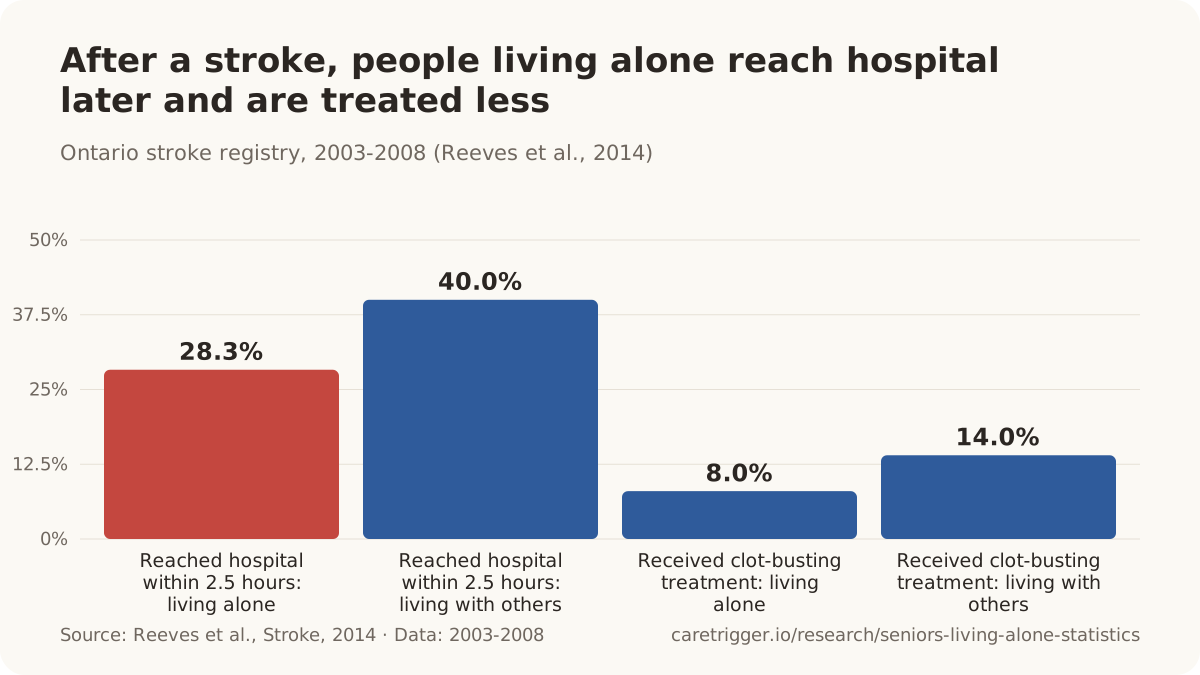
- Only 8.0% of stroke patients living alone received clot-busting thrombolysis, versus 14.0% of those living with others (adjusted OR 0.52) (Reeves et al., Stroke, 2014).[164]
- Acute ischaemic stroke patients living alone had 2.9 times the odds of short-term functional worsening (79.3% worsened by at least one modified Rankin grade vs 59.5% of those living with family; adjusted OR 2.90, 95% CI 1.50-5.58) in a Japanese cohort of 365 patients (Ishikawa, Hifumi & Urashima, IJERPH, 2020).[165]
- Among ischaemic stroke patients under 70, 36% of those living alone died over a median 8.6 years versus 17% of those living with someone; for men living alone the adjusted hazard ratio was 3.47 (95% CI 2.13-5.65), with no significant effect in women (Redfors et al., BMC Neurology, 2016).[166]
- After a heart attack treated with PCI, patients living alone (30% of 277) died at more than twice the rate of those living with others (18% vs 8% all-cause; 14% vs 4% cardiac), with adjusted hazard ratios of 2.60 for all-cause and 4.17 for cardiac death (Fukumoto et al., Coronary Artery Disease, 2023).[144]
- Men living alone after a first acute heart-failure admission had twice the risk of being rehospitalised for heart failure over three years (adjusted HR 2.02, 95% CI 1.07-3.70); no difference was seen in women (HR 0.99) (Takabayashi et al., International Heart Journal, 2020).[167]
- Among people aged 65 or older living alone, 31.6 per 1,000 per year were found helpless or dead at home (men 42.2, women 27.6 per 1,000) in San Francisco, 1993 (Gurley et al., NEJM, 1996).[168]
- Among men aged 85 or older living alone, the rate of being found helpless or dead at home was 123 per 1,000 per year (women 85+ living alone: 59 per 1,000) in San Francisco, 1993 (Gurley et al., NEJM, 1996).[168]
- Among people living alone who were found helpless or dead at home in San Francisco in 1993, total mortality was 67% for those estimated to have been helpless for more than 72 hours, versus 12% for those helpless for less than 1 hour (Gurley et al., NEJM, 1996).[168]
- When the time spent helpless at home was estimated at under 1 hour, total mortality was 12% (10% found dead, 2% died in hospital) among people living alone found helpless or dead in San Francisco, 1993 (Gurley et al., NEJM, 1996).[168]
- Of 387 episodes of people living alone being found helpless or dead at home in San Francisco in 1993, 23% were found dead and a further 5% died in hospital, a total mortality of 28% (Gurley et al., NEJM, 1996).[168]
- Half of the 125 home fallers aged 65+ lived alone and one fifth lived with an aged spouse only (Wild, Nayak & Isaacs, BMJ, 1981).[169]
- A 2022 BMC Geriatrics scoping review states that after a fall, more than half of older people living alone are unable to get up or get help independently (citing Simpson 2014, Tinetti 1993 and Vellas 1987).[170]
- Community-dwelling Swiss adults aged 60+ who lived alone had 1.76 times the odds of becoming a faller (OR 1.76, 95% CI 1.11-2.79), rising to 2.19 above age 74.6, in pooled data from three fall-prevention trials (494 participants, 643 falls over 936.5 person-years) (Braendle et al., BMJ Open, 2024).[147]
- In the US Health and Retirement Study (2012-2020, n = 1,893), poorly maintained stairways (OR 2.65) and nearby green space (OR 2.10) raised the odds of falling over eight years only among older adults living alone, not among those living with others (Lee & Lim, Innovation in Aging, 2023).[171]
- Norwegian hip-fracture patients aged 50-79 who lived alone had higher mortality over 12.8 years than those living with a partner: HR 1.37 (95% CI 1.29-1.44) for men and 1.23 (1.18-1.28) for women, among 12,770 men and 22,067 women fractured 2002-2013 (Dahl et al., Journal of Bone and Mineral Research, 2021).[145]
- Eight years after a hip fracture, relative survival (vs the general population) was 43% for men and 61% for women who lived alone, compared with 51% and 67% for those living with a partner (Dahl et al., 2021).[145]
- In a London case-control study, 79% of patients admitted with hypothermia after being found ill indoors (mean age 80) had been found on the floor, versus 14% of controls; 86% lived alone (vs 43%) (Woodhouse, Keatinge & Coleshaw, The Lancet, 1989).[172]
- During the July 1995 Chicago heat wave (at least 700 excess deaths), people who lived alone had 2.3 times the odds of heat-related death; in multivariate analysis living alone (OR 2.3) and being confined to bed (OR 8.2) were the strongest risk factors, while a working air conditioner cut the risk by 70% (OR 0.3) (Semenza et al., NEJM, 1996).[146]
- Chicago residents who did not leave home each day had 6.7 times the odds of dying in the 1995 heat wave, and those unable to care for themselves 4.1 times (Semenza et al., NEJM, 1996).[146]
- A systematic review of 11 controlled studies on house fires in high-income countries found that living alone was associated with a higher risk of injurious fires (though not of fires per se), and households with older residents were at increased risk of injurious fires despite being less likely to have a fire at all (Turner et al., Injury Prevention, 2017).[173]
- Across 4,876,285 people aged 65+ in England, those living alone had 14% more emergency hospital admissions (adjusted rate ratio 1.14, 95% CI 1.14-1.15) and 9% more A&E attendances (1.09) over a year than those in households of two to six people (Lloyd et al., BMJ Open, 2022).[148]
- Older Singaporeans living alone had 28% higher odds of an emergency-department admission over one year (OR 1.28, 95% CI 1.08-1.51), 0.61 more inpatient days and US$322 higher inpatient costs than those living with others, regardless of multimorbidity (Barrenetxea et al., BMC Health Services Research, 2021).[149]
- In Stockholm's SNAC-K cohort (3,130 older adults, 56.5% living alone), living alone was associated with a 21% higher risk of an unplanned hospital admission over two years (HR 1.21, 95% CI 1.01-1.45) and 35% more admissions (IRR 1.35); among men the hazard was 1.52 (Pimouguet et al., European Journal of Public Health, 2017).[174]
- Hospital patients aged 50+ who lived alone had more than twice the odds of being discharged to a skilled nursing facility rather than home (adjusted OR 2.23, 95% CI 1.85-2.69), even at similar clinical and functional status, in 7,029 medical admissions at Massachusetts General Hospital 2014-15 (Lage et al., Journal of the American Geriatrics Society, 2018).[150]
- After elective hip replacement, 22.0% of patients living alone were discharged somewhere other than home versus 10.5% of propensity-matched patients with others at home (adjusted OR 2.84, 95% CI 2.30-3.54), with longer stays (2.05 vs 1.72 days) in 2021 US NSQIP data (Agnor, Knio & Zuo, PLoS ONE, 2025).[175]
- Older patients receiving home nursing after a medical hospitalisation who were ADL-dependent and lived alone were 3.5 times more likely to enter a nursing home within a month (95% CI 1.0-11.9) and 3.3 times less likely to regain function than those living with others (Mahoney et al., Journal of General Internal Medicine, 2000).[176]
- 21% of people aged 65+ who live alone visit their GP at least once a month, compared with 14% of older people who live with others (Dreyer et al. 2018, as compiled by Age UK).[177]
- Patients aged 65+ living alone had 50% higher odds of using emergency department services (OR 1.50, 95% CI 1.16-1.93) and 40% higher odds of GP use (OR 1.40, 1.04-1.88) than those living with others - London general-practice cohort of 1,447 patients.[178]
- 32% of older Norwegians living alone receive at least one municipal health or care service, versus 10% of those living with a partner (SSB, 2025).[48]
Found too late
In 2025, 76,941 people in Japan who lived alone died at home and were handled by police, 37.6% of 204,562 police-handled bodies, up from 76,020 in 2024.[8]
- Of 58,044 people aged 65+ who lived alone and were found dead at home in Japan in 2024, 22,734 (39.2%) were found within one day of death, while 4,538 (7.8%) were not found for more than 30 days (National Police Agency of Japan, 2025).[181]
- In Amsterdam, bodies lying unnoticed at home for two weeks or more occurred at 5.3 per 100,000 person-years (379 cases) versus 1.4 per 100,000 in surrounding municipalities (58 cases); all but three of the 437 people lived alone, and among people living alone the rate was 2.7 times higher in the city.[189]
- Of 88 decomposed bodies from non-traumatic in-home deaths of older people examined in Turkey, 85.2% had lived alone, 83.0% were men and the mean age was 70.9.[191]
- In eastern Attica (Greece), 217 decomposing bodies were found indoors over 2012-2021; the typical case was a Greek man over 65, single, childless and living alone, found by relatives or neighbours within a month of death, with a natural cause.[192]
13 / Data
Download the dataset
Every statistic on this page, with its verbatim source quote, locator, population, period and verification status, in one file. Each chart's CSV is linked under the chart.
Download all statistics (CSV) Download all statistics (JSON)
Charts and figures on this page may be reused with a link to https://caretrigger.io/research/seniors-living-alone-statistics as the source. Each chart's CSV is published next to it.
14 / Methodology
Methodology
What we included. Published figures on older adults living alone: counts and shares by country, age and sex; time series and official projections; who they are; and the measured consequences for health, safety, care and income. National statistical offices, Eurostat, the OECD, the UN and peer-reviewed cohort studies and meta-analyses are preferred; survey organisations (Pew, AARP, the University of Michigan poll) are included and labelled as surveys; news reports are used only to reach an official table that could not be fetched directly, and say so in the dataset.
How each figure was verified. Every record carries the exact sentence or table cell from the source (quote) and where it sits (locator). A researcher confirmed each one against the source document; a script then re-fetched every source on the date shown at the top of the page, using publisher APIs, data tables and PDF text where the web page blocks automated access, and checked for the quote. Records the script could not confirm are kept only if the researcher's check was complete, and are marked for human review in the dataset. Where the same figure was captured twice, one record is kept and the other marked as superseded.
What we excluded. Figures we could not trace to a document, vendor pages that cite each other rather than a source, and three widely copied claims: that older adults living alone face an "average detection delay of 12 to 72 hours" (no source exists), that "nearly 50% of women over 75 live alone" (the Census Bureau's figures are 41.8% to 42.5%), and that Singapore will have "83,000 seniors living alone by 2030" (the government's projection is about 122,000).
Rounding and derivation. Numbers are reproduced as published. Derived figures (a share computed from two published counts, a state share from an ACS table) say so in the statement and name both inputs. The bold figure in each statement is a reading aid, not an edit.
Updates. Sources are re-checked and new figures added quarterly, timed to the releases that matter here: ONS in April, Eurostat and the ACL Profile in May, Statistics Korea in September, Pew in December. The next scheduled refresh is January 2027. Corrections are welcome through the support page.
Cite this page
CareTrigger. "Statistics on Seniors Living Alone: How Many, Where, and What Happens Next." https://caretrigger.io/research/seniors-living-alone-statistics. Last updated 2026-10-09.
15 / FAQ
Frequently asked questions
How many seniors live alone in the United States?
15,784,869 Americans aged 65 and over lived alone in 2024, 26.6% of older adults living in households, according to the Census Bureau's American Community Survey. The figure you will see more often, 28% or 16.2 million, comes from a different survey (the Current Population Survey, used by the Administration for Community Living) and counts only community-dwelling older adults; Pew's 26% counts everyone aged 65 and over, including nursing-home residents. All three are right on their own base.[1][1][10][11]
What percentage of older adults live alone worldwide?
About 16% of people aged 60 and over worldwide live alone, according to Pew Research Center's analysis of 130 countries; living with extended family is far more common (38%). The UN's harmonised estimate for people 65 and over is 24% of women and 11% of men. Europe and North America have by far the highest shares, Central and Southern Asia and Sub-Saharan Africa the lowest.[42][4][4][4]
Which country has the most elderly people living alone?
Lithuania, where 54.25% of people aged 65 and over in private households live alone, followed by Estonia (46.24%) and Denmark (45.50%), in the OECD's 39-country comparison. The United Kingdom (37.08%) and France (37.00%) are near the top; the United States (26.53%) sits mid-table. The lowest shares are in the Slovak Republic (10.81%) and Mexico (13.94%). Outside the OECD, 5.68% of Indians aged 60 and over live alone and almost nobody does in Afghanistan.[3][3][3][3][3][41][4]
Do more older women or men live alone?
Women, by roughly two to one, everywhere. Worldwide 24% of women aged 65 and over live alone against 11% of men; in the EU it is 40.5% versus 21.4%, in the US 31% versus 19%, in the UK 40.9% versus 27.0%. The gap is widowhood: women live longer and marry older men. It is narrowing, though: the number of men aged 75 and over living alone in the UK more than doubled between 1996 and 2025, and men's share of solo-living seniors in Canada rose from 23% to 32% in a generation.[4][21][11][60][18][56]
How does living alone change with age?
It roughly doubles between the late sixties and the mid-eighties. In Canada, 20.7% of people aged 65 to 69 live alone and 41.8% of those 85 and over; in the United States 38% of people 85 and over live alone; in Germany 55.8% of people 85 and over do; in France the share goes from just over a quarter at 65 to 74 to nearly one in two at 90 to 94. Above 85 the share levels off or falls only because more people move into care homes.[193][193][11][45][23]
Will more older people live alone in the future?
Yes, in every country that projects it. Japan expects one in five of all households (20.6%) to be a person aged 65 or over living alone by 2050; South Korea projects 4,961,000 such households by 2052, 42.1% of all households headed by an older person; the United States expects single-person households headed by someone 80 or over to more than double to 10.1 million by 2038. No official projection of the number of people aged 65 and over living alone exists for the United States, the United Kingdom or the EU as a whole.[6][79][81]
How many older people living alone are poor?
In the United States, 18.4% of people aged 65 and over who live alone were below the official poverty line in 2025, against 5.4% of older people living in families. In the EU, 26.8% of people 65 and over living alone were at risk of poverty in 2025 versus 16.3% of the whole population, and in Croatia, Latvia and Estonia more than three in five were. In Canada the poverty rate for unattached seniors was 11.1% in 2024, nearly three times the 4.0% for people in senior families.[105][109][109][111]
Is living alone bad for your health?
On average it is linked to higher risk, by about as much as loneliness and somewhat less than social isolation, and it is not the same thing as being lonely. Older adults living alone have a 21% higher risk of death in the largest meta-analysis of older people (hazard ratio 1.21), a 30% higher risk of dementia, 42% higher odds of depression and 28% higher odds of an emergency-department admission. Social isolation carries a larger mortality risk (35%), and in a French cohort of hospital patients aged 75 and over, 45% of those who lived alone said they did not feel lonely.[115][127][133][149][115][100]
16 / Sources
Sources
Numbered in order of first appearance. Each entry lists the record ids it supports; the dataset carries the verbatim quote for each.
- [1]U.S. Census Bureau. American Community Survey 2024 1-Year Estimates, Table B09021: Living Arrangements of Adults 18 Years and Over by Age. Accessed 2026-10-09.Used for: us-acs-2024-65plus-lives-alone-count, us-acs-2024-65plus-lives-alone-share, us-acs-2024-dc-65plus-living-alone-share, us-acs-2024-nd-65plus-living-alone-share, us-acs-2024-ne-65plus-living-alone-share, us-acs-2024-ca-65plus-living-alone-count, us-acs-2024-ut-65plus-living-alone-share, us-acs-2024-hi-65plus-living-alone-share, us-acs-2024-65plus-living-with-spouse
- [2]Eurostat. Persons by household composition and labour status (EU-LFS, lfst_hhindws) - 'One adult without resident children', age 65+. Published 2026-09-10. Accessed 2026-10-09.Used for: eu-eurostat-lfs-2025-65plus-living-alone-count, eu-eurostat-lfs-2025-women-65plus-living-alone-22-1m, eu-eurostat-lfs-2009-65plus-living-alone-count, eu-eurostat-lfs-2015-65plus-living-alone-count, eu-eurostat-lfs-2020-65plus-living-alone-count
- [3]OECD. OECD Affordable Housing Database - indicator HM1.4 Living arrangements by age groups (last updated 02/10/2025). Published 2025-10-02. Accessed 2026-10-09.Used for: oecd-hm14-2025-lithuania-65plus-living-alone-2024, oecd-hm14-2025-united-states-65plus-living-alone-2023, oecd-hm14-2025-estonia-65plus-living-alone-2024, oecd-hm14-2025-denmark-65plus-living-alone-2024, oecd-hm14-2025-slovak-republic-65plus-living-alone-2024, oecd-hm14-2025-mexico-65plus-living-alone-2022, oecd-hm14-2025-bulgaria-65plus-living-alone-2024, oecd-hm14-2025-latvia-65plus-living-alone-2024, oecd-hm14-2025-finland-65plus-living-alone-2024, oecd-hm14-2025-sweden-65plus-living-alone-2024, oecd-hm14-2025-united-kingdom-65plus-living-alone-2022, oecd-hm14-2025-france-65plus-living-alone-2024, oecd-hm14-2025-romania-65plus-living-alone-2024, oecd-hm14-2025-luxembourg-65plus-living-alone-2024, oecd-hm14-2025-austria-65plus-living-alone-2024, oecd-hm14-2025-belgium-65plus-living-alone-2024, oecd-hm14-2025-germany-65plus-living-alone-2024, oecd-hm14-2025-norway-65plus-living-alone-2024, oecd-hm14-2025-czechia-65plus-living-alone-2024, oecd-hm14-2025-hungary-65plus-living-alone-2023, oecd-hm14-2025-malta-65plus-living-alone-2024, oecd-hm14-2025-switzerland-65plus-living-alone-2023, oecd-hm14-2025-netherlands-65plus-living-alone-2024, oecd-hm14-2025-iceland-65plus-living-alone-2020, oecd-hm14-2025-croatia-65plus-living-alone-2024, oecd-hm14-2025-slovenia-65plus-living-alone-2024, oecd-hm14-2025-italy-65plus-living-alone-2024, oecd-hm14-2025-greece-65plus-living-alone-2024, oecd-hm14-2025-portugal-65plus-living-alone-2024, oecd-hm14-2025-ireland-65plus-living-alone-2024, oecd-hm14-2025-spain-65plus-living-alone-2024, oecd-hm14-2025-turkiye-65plus-living-alone-2020, oecd-hm14-2025-korea-65plus-living-alone-2023, oecd-hm14-2025-poland-65plus-living-alone-2024, oecd-hm14-2025-australia-65plus-living-alone-2021, oecd-hm14-2025-colombia-65plus-living-alone-2024, oecd-hm14-2025-cyprus-65plus-living-alone-2024, oecd-hm14-2025-chile-65plus-living-alone-2022, oecd-hm14-2025-costa-rica-65plus-living-alone-2024, oecd-hm14-2025-lithuania-65plus-living-alone-2010, oecd-hm14-2025-lithuania-65plus-living-alone-2023, oecd-hm14-2025-united-states-65plus-living-alone-2010, oecd-hm14-2025-canada-65plus-living-alone-2010, oecd-hm14-2025-canada-65plus-living-alone-2011
- [4]United Nations DESA, Population Division. World Population Ageing 2020 Highlights: Living arrangements of older persons (ST/ESA/SER.A/451). Accessed 2026-10-09.Used for: un-wpa2020-world-65plus-women-living-alone-24pct, un-wpa2020-world-65plus-spouse-only-men-38pct-women-23pct, un-wpa2020-world-65plus-men-living-alone-11pct, un-wpa2020-netherlands-2011-65plus-women-living-alone-46-9pct, un-wpa2020-united-kingdom-2011-65plus-women-living-alone-44-1pct, un-wpa2020-russia-2010-65plus-women-living-alone-35-8pct, un-wpa2020-canada-2011-65plus-women-living-alone-34-9pct, un-wpa2020-united-states-2015-65plus-women-living-alone-34-3pct, un-wpa2020-israel-2008-65plus-women-living-alone-34-2pct, un-wpa2020-uruguay-2011-65plus-women-living-alone-32-0pct, un-wpa2020-egypt-2006-65plus-women-living-alone-28-7pct, un-wpa2020-argentina-2010-65plus-women-living-alone-25-7pct, un-wpa2020-korea-2015-65plus-women-living-alone-23-9pct, un-wpa2020-japan-2015-65plus-women-living-alone-21-3pct, un-wpa2020-brazil-2010-65plus-women-living-alone-17-5pct, un-wpa2020-south-africa-2011-65plus-women-living-alone-16-1pct, un-wpa2020-mexico-2015-65plus-women-living-alone-14-1pct, un-wpa2020-india-2009-65plus-women-living-alone-7-3pct, un-wpa2020-afghanistan-2015-65plus-women-living-alone-0-1pct, un-wpa2020-world-65plus-population-727-million-2020-1-5-billion-2050, un-wpa2020-usa-2014-older-women-living-alone-in-poverty-19pct, un-wpa2020-europe-northern-america-65plus-women-living-alone-36-8pct, un-wpa2020-central-southern-asia-65plus-women-living-alone-7-9pct, un-wpa2020-australia-new-zealand-65plus-women-living-alone-33-5pct, un-wpa2020-latin-america-caribbean-65plus-women-living-alone-16-9pct, un-wpa2020-sub-saharan-africa-65plus-women-living-alone-13-0pct, un-wpa2020-institutional-population-60plus-under-5pct
- [5]AARP Research. 2024 Home and Community Preferences Survey (AARP Research; page updated November 21, 2025). Published 2025-11-21. Accessed 2026-10-09.Used for: us-aarp-2024-hcp-want-to-remain-in-home-75pct, us-aarp-2024-hcp-expect-to-relocate-44pct
- [6]National Institute of Population and Social Security Research, Japan (国立社会保障・人口問題研究所). 日本の世帯数の将来推計(都道府県別推計)令和6(2024)年推計 — 結果の概要. Accessed 2026-10-09.Used for: jp-ipss-2024-65plus-one-person-share-of-all-households-2050, jp-ipss-2024-75plus-living-alone-rate-2050, jp-ipss-2024-65plus-one-person-share-of-all-households-2020, jp-ipss-2024-65plus-living-alone-rate-2050-national, jp-ipss-2024-tokyo-65plus-living-alone-rate-2050, jp-ipss-2024-tokyo-one-person-share-of-65plus-households-2050
- [7]Association for Psychological Science (SAGE). Loneliness and Social Isolation as Risk Factors for Mortality: A Meta-Analytic Review. Published 2015-03-01. Accessed 2026-10-09. (paywalled)Used for: holt-lunstad-2015-living-alone-mortality-32pct, holt-lunstad-2015-social-isolation-mortality-29pct, holt-lunstad-2015-loneliness-mortality-26pct
- [8]National Police Agency of Japan. 令和7年中における死体取扱状況(警察取扱死体のうち、自宅において死亡した一人暮らしの者)について (NPA). Published 2026-04. Accessed 2026-10-08.Used for: jp-npa-2025-died-alone-at-home-total
- [9]U.S. Census Bureau. American Community Survey 2024 1-Year Estimates, Table B11010: Nonfamily Households by Sex of Householder by Living Alone by Age of Householder. Accessed 2026-10-09.Used for: us-acs-2024-65plus-women-living-alone, us-acs-2024-65plus-men-living-alone
- [10]Administration for Community Living (ACL), U.S. Department of Health and Human Services. 2023 Profile of Older Americans. Accessed 2026-10-09.Used for: us-acl-2023-65plus-community-living-alone, us-acl-2023-widows-share-of-older-women, us-acl-2023-married-men-vs-women-65plus, us-acl-2023-65plus-living-alone-poverty-2022, us-acl-2023-asian-women-living-alone-poverty-2022, us-acl-2023-poverty-threshold-65plus-living-alone-2022
- [11]Pew Research Center. A smaller share of older U.S. adults live alone today than in 1990 (short read, December 4, 2025; Census Bureau decennial and ACS data). Published 2025-12-04. Accessed 2026-10-09.Used for: us-pew-2025-65plus-living-alone-2023, us-pew-2025-65plus-living-with-spouse-2023, us-pew-2025-65plus-group-quarters-2023, us-pew-2025-85plus-living-alone-2023, us-pew-2025-women-85plus-group-quarters-2023, us-pew-2025-women-65plus-living-alone-2023, us-pew-2025-men-65plus-living-alone-2023, us-pew-2025-65plus-living-alone-1990
- [12]U.S. Census Bureau. Table H2. Households, by Type and Age of Householder: 2023 (America's Families and Living Arrangements: 2023, CPS ASEC). Accessed 2026-10-09.Used for: us-cps-h2-2023-one-person-households-65plus, us-cps-h2-2023-75plus-households-one-person-share
- [13]U.S. Census Bureau. More Than a Quarter of All Households Have One Person (America Counts, June 8, 2023; 2020 Census DHC). Published 2023-06-08. Accessed 2026-10-09.Used for: us-census-2020-one-person-households-65plus-share-of-all-households, us-census-2020-one-person-households-share
- [14]U.S. Census Bureau. Census Bureau Releases New Estimates on America's Families and Living Arrangements (press release, December 2, 2025; CPS ASEC 2025). Published 2025-12-02. Accessed 2026-10-09.Used for: us-cps-2025-one-person-households, us-cps-2025-householders-65plus-share
- [15]Joint Center for Housing Studies of Harvard University. Housing America's Older Adults 2023. Accessed 2026-10-09.Used for: us-jchs-2023-living-alone-65-79-vs-80plus-2021, us-jchs-2023-cost-burden-single-vs-couples-65plus-2021, us-jchs-2023-75plus-living-alone-very-low-income, us-jchs-2023-75plus-living-alone-afford-assisted-living, us-jchs-2023-women-share-of-solo-households-80plus-2021
- [16]U.S. Census Bureau. America's Families and Living Arrangements: 2022 (Current Population Reports P20-587). Accessed 2026-10-09.Used for: us-cps-p20-587-65plus-living-alone-1967-to-2022, us-living-alone-65plus-men-2022, us-living-alone-65plus-women-2022, us-living-alone-men-75plus-2022, us-cps-p20-587-one-person-households-1970-to-2022
- [17]Pew Research Center. Older people are more likely to live alone in the U.S. than elsewhere in the world. Published 2020-03-10. Accessed 2026-10-09.Used for: us-living-alone-60plus-pew-2020, pew-2020-women-60plus-living-alone-20pct-vs-men-11pct, pew-2020-global-60plus-extended-family-38pct-vs-us-6pct, pew-2020-us-60plus-couple-only-46pct-vs-global-31pct, pew-2020-60plus-living-alone-under-5pct-afghanistan-mali-algeria, pew-2019-sub-saharan-africa-60plus-couple-only-9pct
- [18]Office for National Statistics (ONS). Families and households, UK (dataset) - Table 6: People living alone by age and sex, United Kingdom, 1996 to 2025. Published 2026-04-17. Accessed 2026-10-09.Used for: uk-ons-lfs-2025-65plus-living-alone-count, uk-ons-lfs-2025-share-75plus-among-65plus-living-alone, uk-ons-lfs-1996-2025-men-75plus-living-alone-doubled, uk-ons-lfs-2025-men-65plus-living-alone-count, uk-ons-lfs-1996-2025-75plus-living-alone-growth, uk-ons-lfs-1996-75plus-living-alone-count, uk-ons-lfs-2005-75plus-living-alone-count, uk-ons-lfs-2015-75plus-living-alone-count, uk-ons-lfs-2025-75plus-living-alone-count, uk-ons-lfs-1996-men-75plus-living-alone-count, uk-ons-lfs-2005-men-75plus-living-alone-count, uk-ons-lfs-2015-men-75plus-living-alone-count, uk-ons-lfs-2025-men-75plus-living-alone-count, uk-ons-lfs-1996-65plus-living-alone-count, uk-ons-lfs-2000-65plus-living-alone-count, uk-ons-lfs-2005-65plus-living-alone-count, uk-ons-lfs-2010-65plus-living-alone-count, uk-ons-lfs-2015-65plus-living-alone-count, uk-ons-lfs-2020-65plus-living-alone-count
- [19]Office for National Statistics (ONS). Profile of the older population living in England and Wales in 2021 and changes since 2011. Published 2023-04-03. Accessed 2026-10-09.Used for: uk-ons-census2021-65plus-living-alone-3-3m-30-1pct, uk-ons-census2021-women-65plus-living-alone-36-3pct
- [20]Office for National Statistics (ONS). Families and households in the UK: 2025 (statistical bulletin). Published 2026-04-17. Accessed 2026-10-09.Used for: uk-ons-2025-65plus-share-of-people-living-alone-49-6, uk-ons-2025-65plus-living-alone-female-share-63-9, uk-ons-2025-living-alone-total-8-6m
- [21]Eurostat. Distribution of population aged 65 and over by type of household (EU-SILC, ilc_lvps30) - 'One adult 65 years or over' (A1_GE65). Published 2026-09-17. Accessed 2026-10-09.Used for: eu-eurostat-silc-2025-65plus-living-alone-share-t, eu-eurostat-silc-2025-65plus-living-alone-share-f, eu-eurostat-silc-2025-65plus-living-alone-share-m, fr-eurostat-silc-2025-65plus-living-alone-share, de-eurostat-silc-2025-65plus-living-alone-share, lt-eurostat-silc-2025-65plus-living-alone-share, dk-eurostat-silc-2025-65plus-living-alone-share, ee-eurostat-silc-2025-65plus-living-alone-share, lv-eurostat-silc-2025-65plus-living-alone-share, bg-eurostat-silc-2025-65plus-living-alone-share, fi-eurostat-silc-2025-65plus-living-alone-share, no-eurostat-silc-2025-65plus-living-alone-share, se-eurostat-silc-2025-65plus-living-alone-share, cz-eurostat-silc-2025-65plus-living-alone-share, be-eurostat-silc-2025-65plus-living-alone-share, ro-eurostat-silc-2025-65plus-living-alone-share, lu-eurostat-silc-2025-65plus-living-alone-share, at-eurostat-silc-2025-65plus-living-alone-share, hu-eurostat-silc-2025-65plus-living-alone-share, ch-eurostat-silc-2024-65plus-living-alone-share, it-eurostat-silc-2025-65plus-living-alone-share, nl-eurostat-silc-2025-65plus-living-alone-share, el-eurostat-silc-2025-65plus-living-alone-share, si-eurostat-silc-2025-65plus-living-alone-share, hr-eurostat-silc-2025-65plus-living-alone-share, mt-eurostat-silc-2025-65plus-living-alone-share, pt-eurostat-silc-2025-65plus-living-alone-share, ie-eurostat-silc-2025-65plus-living-alone-share, es-eurostat-silc-2025-65plus-living-alone-share, pl-eurostat-silc-2025-65plus-living-alone-share, cy-eurostat-silc-2025-65plus-living-alone-share, sk-eurostat-silc-2025-65plus-living-alone-share, eu-eurostat-silc-2010-65plus-living-alone-share-t, eu-eurostat-silc-2015-65plus-living-alone-share-t, eu-eurostat-silc-2019-65plus-living-alone-share-t, eu-eurostat-silc-2020-65plus-living-alone-share-t, eu-eurostat-silc-2022-65plus-living-alone-share-t, eu-eurostat-silc-2024-65plus-living-alone-share-t, eu-eurostat-silc-2010-65plus-living-alone-share-m, eu-eurostat-silc-2015-65plus-living-alone-share-m, eu-eurostat-silc-2020-65plus-living-alone-share-m, eu-eurostat-silc-2010-65plus-living-alone-share-f, eu-eurostat-silc-2015-65plus-living-alone-share-f, eu-eurostat-silc-2020-65plus-living-alone-share-f, uk-eurostat-silc-2015-65plus-living-alone-share-32-0
- [22]Statistisches Bundesamt (Destatis). Alleinstehende nach Alter, Geschlecht und Gebietsstand (Mikrozensus 2025; Stand 13.04.2026) - column 'Alleinlebende'. Published 2026-04-13. Accessed 2026-10-09.Used for: de-destatis-2025-alleinlebende-65plus-total-6-327m, de-destatis-2025-alleinlebende-65-84-count-4-842m, de-destatis-2025-alleinlebende-85plus-count-1-485m
- [23]Insee (Institut national de la statistique et des études économiques). Insee Première n° 2040 (février 2025): En 2021, une personne de 65 ans ou plus sur trois vit seule dans son logement. Accessed 2026-10-09.Used for: fr-insee-2021-65plus-living-alone-32pct, fr-insee-2021-65-74-living-alone-just-over-quarter, fr-insee-2021-women-85plus-living-alone-53pct
- [24]Instituto Nacional de Estadística (INE). Encuesta Continua de Hogares (ECH) - Año 2020 (nota de prensa, 7 de abril de 2021). Published 2021-04-07. Accessed 2026-10-09.Used for: es-ine-2020-65plus-living-alone-2-131m, es-ine-2020-women-85plus-living-alone-44-1pct, es-ine-2020-65plus-one-person-households-growth-6-1pct
- [25]Istat (Istituto Nazionale di Statistica). Condizione abitativa degli anziani - Anno 2023 (comunicato stampa, Censimento permanente della popolazione). Published 2026-02-18. Accessed 2026-10-09.Used for: it-istat-2023-one-person-households-75plus-2-7m, it-istat-2023-75plus-living-alone-support-network-92-8pct, it-istat-2023-households-only-65plus-6-9m-25-9pct
- [26]Ministry of Health, Labour and Welfare, Japan (厚生労働省). 2024(令和6)年 国民生活基礎調査の概況 — 世帯の状況 / 65歳以上の者の状況. Published 2025-07-04. Accessed 2026-10-09.Used for: jp-mhlw-2024-65plus-living-alone-count, jp-mhlw-2024-65plus-one-person-households-women-share, jp-mhlw-1986-65plus-living-alone-share, jp-mhlw-2001-65plus-living-alone-share, jp-mhlw-2010-65plus-living-alone-share, jp-mhlw-2019-65plus-living-alone-share, jp-mhlw-2024-single-person-share-of-households-with-65plus, jp-mhlw-2024-single-person-share-of-elderly-only-households
- [27]Ministry of Data and Statistics, Republic of Korea (국가데이터처). 2025년 인구주택총조사 결과(등록센서스 방식) 보도자료. Published 2026-07-28. Accessed 2026-10-09.Used for: kr-kostat-census-2025-elderly-one-person-households, kr-kostat-census-2025-elderly-one-person-share-jeonnam, kr-kostat-census-2025-elderly-one-person-households-growth-since-2020
- [28]Korea National Indicator System (국가지표체계, index.go.kr). 독거노인비율 (지표 해설). Accessed 2026-10-09.Used for: kr-index-2025-living-alone-ratio-65plus
- [29]National Bureau of Statistics of China (国家统计局). 中国人口普查年鉴-2020 (China Population Census Yearbook 2020). Accessed 2026-10-09.Used for: cn-nbs-census-2020-65plus-living-alone-households, cn-nbs-census-2020-60plus-living-alone-households, cn-nbs-census-2020-60plus-couple-only-households
- [30]Ministry of the Interior, Taiwan (內政部統計處). 114年第48週內政統計通報:114年6月底65歲以上長者457萬人,其中一人戶占25.8%. Accessed 2026-10-09.Used for: tw-moi-2025-65plus-one-person-households-share
- [31]Census and Statistics Department, Hong Kong SAR (政府統計處). 2021 Population Census Thematic Report: Older Persons (二零二一年人口普查主題性報告:長者). Accessed 2026-10-09.Used for: hk-csd-2021-older-persons-living-alone, hk-csd-2021-older-women-vs-men-living-alone, hk-csd-2021-older-persons-living-alone-public-rental-housing, hk-csd-2021-elderly-only-households
- [32]Singapore Department of Statistics (via data.gov.sg). Residents Aged 65 Years And Over In Resident Households By Living Arrangement And Age Group, Annual. Accessed 2026-10-09.Used for: sg-dos-2025-residents-65plus-living-alone, sg-dos-2010-residents-65plus-living-alone, sg-dos-2015-residents-65plus-living-alone, sg-dos-2020-residents-65plus-living-alone
- [33]Australian Bureau of Statistics. Disability, Ageing and Carers, Australia: Summary of Findings, 2022. Published 2024-07-04. Accessed 2026-10-09.Used for: au-abs-sdac-2022-older-people-living-alone, au-abs-sdac-2022-older-women-vs-men-living-alone
- [34]Stats NZ Tatauranga Aotearoa. How we live – a look at families and households from the 2023 Census (news release, 7 November 2024). Published 2024-11-07. Accessed 2026-10-09.Used for: nz-statsnz-2023-65plus-living-alone-share, nz-statsnz-2023-65plus-living-alone-count, nz-statsnz-2013-65plus-living-alone-share, nz-statsnz-2023-65plus-living-alone-women-share, nz-statsnz-2023-all-ages-living-alone
- [35]Statistics Canada. Table 98-10-0134-01 Census family status and household living arrangements, household type of person, age group and gender (Census 2021/2016/2011). Published 2022-07-13. Accessed 2026-10-09.Used for: ca-2021-census-65plus-living-alone-count-1698970, ca-2021-census-85plus-living-alone-count-260695, ca-2021-census-85plus-men-living-alone-26-4pct, ca-2021-census-65plus-women-living-alone-count-1123435, ca-2011-census-65plus-living-alone-count-1215690, ca-2021-census-65plus-men-living-alone-count-575545, ca-2021-census-65-74-living-alone-count-871350, ca-2021-census-75-84-living-alone-count-566925, ca-2021-census-75-84-women-living-alone-37-6pct, ca-2021-census-65-74-women-living-alone-25-6pct, ca-2016-census-65plus-living-alone-count-1410920
- [36]Israel Central Bureau of Statistics. Senior Citizen's Month 2024: Selected Data on Various Topics Regarding Israeli Senior Citizens Aged 65 and Over (Media Release 311/2024). Published 2024-09-29. Accessed 2026-10-09.Used for: il-cbs-2024-65plus-living-alone-266000-23pct, il-cbs-2024-65plus-living-alone-women-32pct-men-12pct, il-cbs-2024-65plus-living-alone-jews-23pct-arabs-18pct, il-cbs-2024-65plus-with-live-in-caregiver-31000, il-cbs-2024-65plus-in-institutions-4pct-52000-2023
- [37]Turkish Statistical Institute (TÜİK). İstatistiklerle Yaşlılar, 2025 (TÜİK bulletin of 12 March 2026, as reproduced by 65+ Yaşlı Hakları Derneği and Cumhuriyet). Published 2026-03-12. Accessed 2026-10-09.Used for: tr-tuik-2025-elderly-living-alone-1836496, tr-tuik-2025-elderly-population-9583059-11-1pct
- [38]INAPAM (Instituto Nacional de las Personas Adultas Mayores, Gobierno de México). Viviendas y hogares de las personas adultas mayores en México (based on INEGI Censo de Población y Vivienda 2020). Published 2025-11-14. Accessed 2026-10-09.Used for: mx-inapam-2025-census2020-60plus-living-alone-1-8-million-16-8pct, mx-inapam-2025-census2020-households-with-60plus-10-9-million
- [39]IBGE (Instituto Brasileiro de Geografia e Estatística). Censo Demográfico 2022: Composição domiciliar e óbitos informados - Resultados do universo (release presentation, 25 October 2024). Published 2024-10-25. Accessed 2026-10-09.Used for: br-ibge-2024-census2022-60plus-householders-one-person-28-7pct, br-ibge-2024-census2022-one-person-units-18-9pct-vs-12-2pct-2010
- [40]Statistics South Africa. Marginalised Groups Series VIII: Healthy Ageing in South Africa, 2024 (Report No. 03-19-10). Accessed 2026-10-09.Used for: za-statssa-2024-older-persons-living-alone-11-1pct, za-statssa-2024-gauteng-older-persons-living-alone-28-4pct, za-statssa-2003-older-persons-living-alone-9-9pct, za-statssa-2025-older-persons-6-6-million-10-5pct
- [41]International Institute for Population Sciences (IIPS), NPHCE, MoHFW, Harvard T.H. Chan School of Public Health, University of Southern California. Longitudinal Ageing Study in India (LASI) Wave 1, 2017-18, India Report (2020). Accessed 2026-10-09.Used for: in-lasi-2017-18-60plus-living-alone-share, in-lasi-2017-18-60plus-living-alone-women-vs-men, in-lasi-2017-18-living-alone-state-high-tamil-nadu
- [42]Pew Research Center. Religion and Living Arrangements Around the World - Household patterns by age and gender. Published 2019-12-12. Accessed 2026-10-09.Used for: pew-2019-global-60plus-living-alone-16pct-couple-31pct-extended-38pct, pew-2019-christian-women-60plus-living-alone-30pct-vs-men-14pct, pew-2019-europe-north-america-60plus-solo-quarter-or-more, pew-2019-christians-60plus-living-alone-23pct-highest-religion, pew-2019-hindus-60plus-living-alone-women-6pct-men-2pct, pew-2019-canada-hindus-60plus-extended-family-47pct, pew-2019-men-60plus-couple-36pct-vs-alone-11pct
- [43]Statistik Austria. Zahl der Alleinlebenden auf 1,6 Millionen gestiegen - Jede dritte alleinlebende Person war 2024 über 64 Jahre alt (Statistik Austria Pressemitteilung, März 2025). Accessed 2026-10-09.Used for: at-statat-2024-65plus-living-alone-605000-34-3pct
- [44]Irish Examiner (citing CSO Census 2022). Number of over-65s living alone has jumped since last census (Irish Examiner, 6 June 2023, reporting CSO Census 2022 data). Published 2023-06-06. Accessed 2026-10-09.Used for: ie-cso-2022-65plus-living-alone-189574-via-examiner, ie-cso-2022-85plus-living-alone-30072
- [45]Statistisches Bundesamt (Destatis). Pressemitteilung Nr. N041 vom 24. Juni 2026: 17,3 Millionen Menschen in Deutschland leben allein (Mikrozensus 2025). Published 2026-06-24. Accessed 2026-10-09.Used for: de-destatis-2025-85plus-living-alone-55-8pct, de-destatis-2025-65plus-living-alone-34-4pct
- [46]Central Statistics Office (CSO). Census of Population 2022 Profile 3 - Households, Families and Childcare: Private households and living alone. Published 2023-08-31. Accessed 2026-10-09.Used for: ie-cso-2022-85plus-living-alone-44pct, ie-cso-2022-65plus-living-alone-over-quarter, ie-cso-2022-people-living-alone-425974
- [47]Tilastokeskus (Statistics Finland). Jo joka neljäs suomalainen asuu yksin - iäkkäistä 43 prosenttia (Tilastokeskus, Tieto&trendit, 26.3.2026). Published 2026-03-26. Accessed 2026-10-09.Used for: fi-statfi-2024-75plus-living-alone-43pct, fi-statfi-2024-women-90-living-alone-65pct
- [48]Statistisk sentralbyrå (SSB). 1 av 4 aleneboende eldre har ingen familie i nærheten (SSB analysis for Røde Kors, 5. juni 2025). Published 2025-06-05. Accessed 2026-10-09.Used for: no-ssb-2025-67plus-living-alone-34pct-304600, no-ssb-2025-older-living-alone-no-family-nearby-24pct, no-ssb-2025-older-living-alone-municipal-care-32pct
- [49]Auckland Council (Research and Evaluation Unit), David Bade. Older Aucklanders: Results from the 2023 Census (July 2025). Published 2025-07-01. Accessed 2026-10-09.Used for: nz-auckland-2023-90plus-living-alone, nz-auckland-2023-older-aucklanders-living-alone
- [50]Office for National Statistics (ONS). People living alone aged 65 years old and over, by specific age group and sex, UK, 1996 to 2019 (ad hoc 11446). Published 2020-03-19. Accessed 2026-10-09.Used for: uk-ons-adhoc-2019-65-69-living-alone-by-5yr-band
- [51]Australian Bureau of Statistics. 2071.0 - Census of Population and Housing: Reflecting Australia - Stories from the Census, 2016 — Ageing Population. Accessed 2026-10-09.Used for: au-abs-census-2016-older-people-living-alone, au-abs-census-2016-85plus-women-vs-men-living-alone
- [52]陶涛, 金光照, 郭亚隆 — 人口研究 2023, 47(1): 58-71. 中国老年家庭空巢化态势与空巢老年群体基本特征. Published 2023-01-25. Accessed 2026-10-09. (abstract only)Used for: cn-tao-2023-oldest-old-living-alone-7-72-million, cn-tao-2023-empty-nest-elderly-150-million
- [53]U.S. Census Bureau. The Older Population: 2020 (2020 Census Brief C2020BR-07, May 2023). Accessed 2026-10-09.Used for: us-census-2020-85plus-in-nursing-facilities
- [54]U.S. Census Bureau. Living Arrangements Varied Across Age Groups (America Counts, May 30, 2024; CPS ASEC 2022). Published 2024-05-30. Accessed 2026-10-09.Used for: us-census-2024-story-men-75plus-with-spouse-vs-women, us-living-alone-women-65-74-2022, us-living-alone-women-75plus-2022
- [55]Eurostat. Household composition statistics (Eurostat Statistics Explained, data extracted May 2026). Accessed 2026-10-09.Used for: eu-eurostat-2016-2025-single-men-65plus-growth-37pct, eu-eurostat-2016-2025-single-adults-65plus-growth-22-1pct, eu-living-alone-65plus-2025
- [56]Statistics Canada. The Daily - Study: Living alone in Canada (6 March 2019). Published 2019-03-06. Accessed 2026-10-09.Used for: ca-2016-census-men-share-of-seniors-living-alone-32pct
- [57]National Institute of Population and Social Security Research, Japan (国立社会保障・人口問題研究所). 日本の世帯数の将来推計(全国推計)令和6(2024)年推計 — 結果の概要. Published 2024-04-12. Accessed 2026-10-09.Used for: jp-ipss-2024-never-married-share-of-men-65plus-living-alone-2050, jp-ipss-2050-elderly-single-person-households, jp-ipss-2024-one-person-share-of-65plus-headed-households-2050, jp-ipss-2024-85plus-one-person-households-2050, jp-ipss-2024-85plus-women-living-alone-2050, jp-ipss-2024-65plus-living-alone-rate-2020-ipss-definition, jp-ipss-2024-85plus-women-living-alone-2020, jp-ipss-2024-85plus-men-living-alone-2050, jp-ipss-2024-75plus-one-person-households-2050
- [58]Turkish Statistical Institute (TÜİK). İstatistiklerle Yaşlılar, 2024 (infographic). Accessed 2026-10-09.Used for: tr-tuik-2024-elderly-living-alone-women-74-0pct, tr-tuik-2024-elderly-living-alone-1750900, tr-tuik-2024-households-with-elderly-25-3pct, tr-tuik-2024-elderly-population-9112298-10-6pct
- [59]Statistisk sentralbyrå (SSB). 1 av 3 eldre bor alene (SSB, 25. juni 2019). Published 2019-06-25. Accessed 2026-10-09.Used for: no-ssb-2019-80plus-women-living-alone-66-9pct, no-ssb-2019-67plus-living-alone-35pct
- [60]Office for National Statistics. Families and households in the UK: 2024. Published 2025-07-23. Accessed 2026-10-09.Used for: uk-living-alone-women-65plus-2024, uk-living-alone-65plus-2024, uk-living-alone-65plus-2014, uk-living-alone-share-65plus-2024
- [61]Cabinet Office, Government of Japan. Annual Report on the Ageing Society [Summary] FY2025 (June 2025). Published 2025-06. Accessed 2026-10-08.Used for: jp-living-alone-65plus-2020-by-sex, jp-living-alone-65plus-2050-projection-by-sex, jp-living-alone-65plus-1980-by-sex
- [62]OECD. OECD Affordable Housing Database - indicator HM1.4 Living arrangements by age groups (last updated 02/10/2025). Published 2025-10-02. Accessed 2026-10-09.Used for: oecd-hm14-2025-oecd-seniors-living-alone-around-31pct-household-type, oecd-65plus-living-alone-average-2024, oecd-lithuania-65plus-living-alone
- [63]Turkish Statistical Institute (TÜİK). İstatistiklerle Yaşlılar, 2025 (TÜİK bulletin of 12 March 2026, as reproduced by 65+ Yaşlı Hakları Derneği and Cumhuriyet). Published 2026-03-12. Accessed 2026-10-09.Used for: tr-tuik-2025-balikesir-one-person-elderly-households-34-3pct, tr-tuik-2025-households-with-elderly-26-1pct-7046560
- [64]United Nations DESA, Population Division. Database on Household Size and Composition 2022. Accessed 2026-10-09.Used for: un-desa-2022-household-size-composition-database-196-countries
- [65]U.S. Census Bureau. Table AD-3. Living Arrangements of Adults 75 and Over, 1967 to 2023 (Historical Living Arrangements of Adults, CPS ASEC). Accessed 2026-10-09.Used for: us-cps-ad3-women-75plus-living-alone-1990, us-cps-ad3-men-75plus-living-alone-1967, us-cps-ad3-women-75plus-living-alone-1967, us-cps-ad3-women-75plus-living-alone-2023, us-cps-ad3-women-75plus-living-alone-2020, us-cps-ad3-women-75plus-living-alone-2010, us-cps-ad3-women-75plus-living-alone-2000, us-cps-ad3-women-75plus-living-alone-1980, us-cps-ad3-women-75plus-living-alone-1970, us-cps-ad3-men-75plus-living-alone-2023, us-cps-ad3-men-75plus-living-alone-1990
- [66]U.S. Census Bureau. Table AD-3. Living Arrangements of Adults 65 to 74, 1967 to 2023 (Historical Living Arrangements of Adults, CPS ASEC). Accessed 2026-10-09.Used for: us-cps-ad3-men-65-74-living-alone-2023, us-cps-ad3-women-65-74-living-alone-1990, us-cps-ad3-women-65-74-living-alone-2023, us-cps-ad3-women-65-74-living-alone-1967, us-cps-ad3-men-65-74-living-alone-1990, us-cps-ad3-men-65-74-living-alone-1967
- [67]U.S. Census Bureau. Table H2. Households, by Type and Age of Householder: 2013 (America's Families and Living Arrangements: 2013, CPS ASEC). Accessed 2026-10-09.Used for: us-cps-h2-2013-one-person-households-65plus
- [68]Office of the U.S. Surgeon General, U.S. Department of Health and Human Services. Our Epidemic of Loneliness and Isolation: The U.S. Surgeon General's Advisory on the Healing Effects of Social Connection and Community (2023). Accessed 2026-10-09.Used for: us-sg-2023-single-person-households-1960-vs-2022
- [69]Statistics Canada. Living alone in Canada (Insights on Canadian Society, 75-006-X). Published 2019-03-06. Accessed 2026-10-09.Used for: ca-1981-census-65plus-living-alone-share-26-4pct, ca-2016-census-65plus-living-alone-share-25-7pct
- [70]Ministry of Health, Singapore. Addressing loneliness and psychological distress among seniors living alone (Parliamentary reply, 12 Jan 2026). Published 2026-01-12. Accessed 2026-10-09.Used for: sg-moh-2026-one-person-households-65plus-doubled-2014-2024, sg-moh-2026-living-alone-depressive-symptoms-twice-as-likely
- [71]Census and Statistics Department, Hong Kong SAR. Hong Kong Monthly Digest of Statistics, March 2023 — Feature article: One-person households (2021 Population Census). Published 2023-03-01. Accessed 2026-10-09.Used for: hk-csd-2011-older-persons-living-alone
- [72]Danmarks Statistik. Andelen af danskere på mindst 65 år, der bor alene, er historisk lav (Danmarks Statistik press release via Ritzau, 23.12.2019). Published 2019-12-23. Accessed 2026-10-09.Used for: dk-dst-2019-65plus-living-alone-38pct-430000
- [73]Beijing News (新京报) interview with 杜鹏 (中国人民大学), citing 7th census. 中国人口学会副会长杜鹏:独居老人占比上升是必然趋势. Published 2023-10-23. Accessed 2026-10-09.Used for: cn-bjnews-2023-living-alone-share-rise-since-2010
- [74]U.S. Census Bureau. Table H2. Households, by Type and Age of Householder: 2015 (America's Families and Living Arrangements: 2015, CPS ASEC). Accessed 2026-10-09.Used for: us-cps-h2-2015-one-person-households-65plus
- [75]U.S. Census Bureau. Table H2. Households, by Type and Age of Householder: 2018 (America's Families and Living Arrangements: 2018, CPS ASEC). Accessed 2026-10-09.Used for: us-cps-h2-2018-one-person-households-65plus
- [76]U.S. Census Bureau. Table H2. Households, by Type and Age of Householder: 2019 (America's Families and Living Arrangements: 2019, CPS ASEC). Accessed 2026-10-09.Used for: us-cps-h2-2019-one-person-households-65plus
- [77]U.S. Census Bureau. Table H2. Households, by Type and Age of Householder: 2021 (America's Families and Living Arrangements: 2021, CPS ASEC). Accessed 2026-10-09.Used for: us-cps-h2-2021-one-person-households-65plus
- [78]Statistics Canada. The Daily - Home alone: More persons living solo than ever before, but roomies the fastest growing household type (Census 2021). Published 2022-07-13. Accessed 2026-10-09.Used for: ca-1981-census-85plus-living-alone-35-9pct, ca-1981-census-65-69-living-alone-19-6pct, ca-1981-census-80-84-living-alone-37-3pct, ca-2016-census-85plus-living-alone-43-3pct, ca-2016-census-80-84-living-alone-33-0pct, ca-1981-census-75-79-living-alone-32-4pct, ca-2016-census-75-79-living-alone-26-7pct, ca-1981-census-70-74-living-alone-26-0pct
- [79]Statistics Korea (통계청, now 국가데이터처). 2025 고령자 통계 (보도자료 PDF). Published 2025-09-29. Accessed 2026-10-09.Used for: kr-kostat-2052-elderly-one-person-households, kr-kostat-2000-elderly-one-person-households, kr-kostat-2010-elderly-one-person-households, kr-kostat-2020-elderly-one-person-households, kr-kostat-2025-elderly-one-person-households, kr-kostat-2040-elderly-one-person-households
- [80]Statistics Korea (통계청) via Korea Policy Briefing (korea.kr). 장래가구추계: 2022~2052년 (부처 브리핑). Published 2024-09-12. Accessed 2026-10-09.Used for: kr-kostat-projection-2052-65plus-share-of-one-person-households, kr-kostat-projection-2052-70plus-share-of-one-person-households
- [81]Joint Center for Housing Studies of Harvard University. The Number of People Living Alone in Their 80s and 90s is Set to Soar (blog, Jennifer Molinsky, March 10, 2020; 2018 JCHS Household Projections). Published 2020-03-10. Accessed 2026-10-09.Used for: us-jchs-2020-single-person-households-80plus-2038, us-jchs-2020-80plus-renter-households-single-person-2018, us-jchs-2020-80plus-living-alone-median-income-2018, us-jchs-2020-80plus-single-person-cost-burden-2018, us-jchs-2020-80plus-households-solo-share-2018
- [82]U.S. Census Bureau. 2023 National Population Projections, Main series, Table 2: Projected Population by Age Group and Sex for the United States: 2022 to 2100 (np2023-t2.xlsx). Published 2023-11-09. Accessed 2026-10-09.Used for: us-census-proj-2023-85plus-2050, us-census-proj-2023-women-85plus-2050, us-census-proj-2023-65plus-2050, us-census-proj-2023-65plus-2060, us-census-proj-2023-85plus-2040, us-census-proj-2023-65plus-share-2050
- [83]Verdery, A. M. & Margolis, R. (2017), Proceedings of the National Academy of Sciences, 114(42): 11109-11114; PMC full text. Projections of white and black older adults without living kin in the United States, 2015 to 2060. Published 2017-10-02. Accessed 2026-10-09.Used for: us-verdery-margolis-2017-kinless-no-partner-no-children-2060, us-verdery-margolis-2017-no-close-kin-2060, us-verdery-margolis-2017-black-kinless-2015-2060
- [84]Office for National Statistics (ONS). Household projections for England: 2018-based (statistical bulletin). Published 2020-06-29. Accessed 2026-10-09.Used for: uk-ons-projection-2018-2028-75plus-living-alone-plus-461000, uk-ons-projection-2018-2028-households-hrp-75-84-plus-34-5pct
- [85]Centraal Bureau voor de Statistiek (CBS). Prognose: huishoudensgroei in de toekomst vooral door meer alleenstaanden (CBS, 17 december 2024). Published 2024-12-17. Accessed 2026-10-09.Used for: nl-cbs-2024-projection-2035-one-person-65plus-households-300000
- [86]Australian Bureau of Statistics. Household and Family Projections, Australia, 2021 to 2046. Accessed 2026-10-09.Used for: au-abs-projections-2046-people-living-alone, au-living-alone-85plus-2046-projection, au-living-alone-total-2021, au-abs-projections-2021-women-share-of-older-lone-persons
- [87]Ministry of Finance, Singapore. Singapore Public Sector Outcomes Review 2024 — Retirement. Published 2024-11-01. Accessed 2026-10-09.Used for: sg-spor-2024-seniors-living-alone-2030-projection
- [88]Statistics Canada. The Daily - In the midst of high job vacancies and historically low unemployment, Canada faces record retirements from an aging labour force (Census 2021 age and sex). Published 2022-04-27. Accessed 2026-10-09.Used for: ca-2022-daily-85plus-861000-could-triple-to-2-7-million, ca-2022-daily-65plus-7-0-million-19-0pct-2021
- [89]Margolis, R. & Verdery, A. M. (2017), Journals of Gerontology: Series B, 72(4): 688-693 (Oxford University Press); PMC full text. Older Adults Without Close Kin in the United States. Accessed 2026-10-09.Used for: us-margolis-verdery-2017-no-partner-55plus-and-75plus, us-margolis-verdery-2017-no-spouse-no-children-55plus, us-margolis-verdery-2017-no-close-kin-55plus, us-margolis-verdery-2017-kinlessness-rising-by-cohort
- [90]Carney, M. T. et al. (2016), Current Gerontology and Geriatrics Research 2016:4723250 (Hindawi); PMC full text. Elder Orphans Hiding in Plain Sight: A Growing Vulnerable Population. Accessed 2026-10-09.Used for: us-carney-2016-elder-orphans-at-risk-22-6pct
- [91]AARP Research. Living Alone: What Solo Agers Want You to Know (AARP Research, published November 1, 2025). Published 2025-11-01. Accessed 2026-10-09.Used for: us-aarp-2025-adults-50plus-living-alone-24m, us-aarp-2025-solo-agers-living-alone-20-years, us-aarp-2025-solo-agers-loneliness-worst-part
- [92]AARP Research (survey by NORC at the University of Chicago). Solo Agers Are Optimistic About Quality of Life (AARP Research, February 1, 2021). Published 2021-02-01. Accessed 2026-10-09.Used for: us-aarp-2021-solo-agers-12pct-of-50plus, us-aarp-2021-solo-agers-one-third-have-backup, us-aarp-2021-solo-agers-fear-dying-alone, aarp-2021-solo-agers-one-third-have-someone-to-manage-household, aarp-2021-solo-agers-12pct-of-50plus
- [93]AARP Public Policy Institute. The Aging of the Baby Boom and the Growing Care Gap. Published 2013-08-01. Accessed 2026-10-09.Used for: aarp-2013-65plus-living-alone-no-children-or-siblings-1-2-million-2020, aarp-2013-caregiver-support-ratio-7-2-in-2010-to-4-1-in-2030
- [94]U.S. Census Bureau. American Community Survey 2024 1-Year Estimates, Table B25011: Tenure by Household Type (Including Living Alone) and Age of Householder. Accessed 2026-10-09.Used for: us-acs-2024-65plus-living-alone-homeownership
- [95]U.S. Census Bureau. Table H3. Households, by Race and Hispanic Origin of Household Reference Person and Detailed Type: 2023 (America's Families and Living Arrangements: 2023, CPS ASEC). Accessed 2026-10-09.Used for: us-cps-h3-2023-women-65plus-living-alone-white-non-hispanic-households, us-cps-h3-2023-women-65plus-living-alone-black-households, us-cps-h3-2023-women-65plus-living-alone-hispanic-households, us-cps-h3-2023-women-65plus-living-alone-asian-households, us-cps-h3-2023-men-65plus-living-alone-share-of-households
- [96]BMC Medicine (Springer Nature). Prevalence of living alone with dementia and other progressive neurological conditions: findings from primary care data in England. Published 2025-11-04. Accessed 2026-10-09.Used for: gamble-2025-england-people-with-dementia-living-alone-40pct
- [97]Journal of the American Geriatrics Society (Wiley). High-risk medication use among older adults with cognitive impairment living alone in the United States. Published 2024-07-26. Accessed 2026-10-09.Used for: growdon-2024-us-cognitive-impairment-living-alone-31pct, growdon-2024-high-risk-medication-no-help-34-vs-23pct
- [98]MHLW Health and Labour Sciences Research Grant group (研究代表者 粟田主一, 東京都健康長寿医療センター研究所). 独居認知症高齢者等が安全・安心な暮らしを送れる環境づくりのための研究 — 手引き (令和3年度 厚生労働科学研究費補助金 認知症政策研究事業). Accessed 2026-10-09.Used for: jp-mhlw-grant-2022-dementia-living-alone-2025, jp-mhlw-grant-2022-dementia-living-alone-share-of-dementia
- [99]AARP Research. Building for the Future: Creating Homes & Communities for Aging Well (2024 Home and Community Preferences Survey). Published 2025-01-01. Accessed 2026-10-09.Used for: aarp-2024-home-community-preferences-ideally-live-on-own-72pct
- [100]Gériatrie et Psychologie Neuropsychiatrie du Vieillissement (John Libbey). Living alone, loneliness and mortality in hospitalized older adults: findings from the SAFES cohort. Published 2025-09-01. Accessed 2026-10-09. (abstract only)Used for: simo-2025-safes-living-alone-not-lonely-45pct
- [101]Age UK. The State of Health and Care of Older People in England 2025. Published 2025-09-01. Accessed 2026-10-09.Used for: age-uk-2025-england-65plus-unmet-care-need-2-million
- [102]The Gerontologist (Oxford University Press). Unmet need for personal assistance with activities of daily living among older adults. Published 2001-02-01. Accessed 2026-10-09. (abstract only)Used for: desai-2001-unmet-adl-need-70plus-20-7pct
- [103]The Milbank Quarterly (Wiley). Disability and care needs among older Americans. Published 2014-09-01. Accessed 2026-10-09.Used for: freedman-spillman-2014-nhats-unmet-need-adverse-consequence-32pct
- [104]Ministry of Health and Welfare, Taiwan (衛生福利部統計處). 1.4.5 獨居老人服務概況 (The Service Conditions for Elderly Living Alone), xlsx. Published 2026-09-30. Accessed 2026-10-09.Used for: tw-mohw-2025-registered-elderly-living-alone-needing-care, tw-mohw-2015-registered-elderly-living-alone-needing-care
- [105]U.S. Census Bureau. POV-01: Age and Sex of All People, Family Members and Unrelated Individuals: 2025 - Below 100% of Poverty, All Races (CPS ASEC 2026). Accessed 2026-10-09.Used for: us-cps-pov01-2025-65plus-living-alone-poverty-rate, us-cps-pov01-2025-women-65plus-living-alone-poverty-rate, us-cps-pov01-2025-men-65plus-living-alone-poverty-rate
- [106]U.S. Census Bureau. POV-01: Age and Sex of All People, Family Members and Unrelated Individuals: 2024 - Below 100% of Poverty, All Races (CPS ASEC 2025). Accessed 2026-10-09.Used for: us-cps-pov01-2024-65plus-living-alone-poverty-rate
- [107]US Census Bureau. Poverty in the United States: 2024 (Current Population Reports P60-287). Published 2025-09-09. Accessed 2026-10-09.Used for: census-2025-p60-287-65plus-official-poverty-9-9pct-spm-15-0pct-2024
- [108]U.S. Census Bureau. American Community Survey 2024 1-Year Estimates, Table B19215: Median Nonfamily Household Income by Sex of Householder by Living Alone by Age of Householder (2024 dollars). Accessed 2026-10-09.Used for: us-acs-2024-median-income-men-65plus-living-alone, us-acs-2024-median-income-women-65plus-living-alone
- [109]Eurostat. At-risk-of-poverty rate by poverty threshold and household type (EU-SILC, ilc_li03) - 'One adult 65 years or over', cut-off 60% of median equivalised income. Published 2026-10-05. Accessed 2026-10-09.Used for: eu-eurostat-silc-2025-arop-single-65plus, hr-eurostat-silc-2025-arop-single-65plus, lv-eurostat-silc-2025-arop-single-65plus, ee-eurostat-silc-2025-arop-single-65plus, eu-eurostat-silc-2015-arop-single-65plus, eu-eurostat-silc-2019-arop-single-65plus, eu-eurostat-silc-2022-arop-single-65plus, lt-eurostat-silc-2025-arop-single-65plus, si-eurostat-silc-2025-arop-single-65plus, ie-eurostat-silc-2025-arop-single-65plus, de-eurostat-silc-2025-arop-single-65plus, lu-eurostat-silc-2025-arop-single-65plus, be-eurostat-silc-2025-arop-single-65plus
- [110]Eurostat. At-risk-of-poverty rate by poverty threshold and household type - EU-SILC and ECHP surveys (ilc_li03). Published 2026-10-05. Accessed 2026-10-09.Used for: eurostat-2024-one-adult-65plus-at-risk-of-poverty-26-9pct, eurostat-2024-two-adults-at-least-one-65plus-at-risk-of-poverty-12-4pct
- [111]Statistics Canada. The Daily - Canadian Income Survey, 2024. Published 2026-04-29. Accessed 2026-10-09.Used for: ca-cis-2024-unattached-seniors-poverty-rate-11-1pct, ca-cis-2024-senior-families-poverty-rate-4-0pct, ca-cis-2024-unattached-seniors-median-after-tax-income-38600
- [112]Statistics Canada. The Daily - Canadian Income Survey, 2023. Published 2025-05-01. Accessed 2026-10-09.Used for: ca-cis-2022-unattached-seniors-poverty-rate-13-8pct, ca-cis-2023-unattached-seniors-poverty-rate-11-5pct
- [113]Ministry of Data and Statistics, Republic of Korea (국가데이터처, formerly 통계청/KOSTAT). 2026 고령자 통계 (보도자료 PDF). Published 2026-10-01. Accessed 2026-10-09.Used for: kr-kostat-2026-relative-poverty-66plus, kr-kostat-2026-elderly-households-one-person-share
- [114]OECD. Pensions at a Glance 2025: OECD and G20 Indicators. Accessed 2026-10-09.Used for: oecd-pag2025-old-age-poverty-76plus-17-5pct-vs-total-11-4pct, oecd-pag2025-old-age-poverty-women-16-9pct-men-11-7pct, oecd-pag2025-korea-over-65-poverty-40pct-highest
- [115]Aging Clinical and Experimental Research (Springer). Loneliness, social isolation, and living alone: a comprehensive systematic review, meta-analysis, and meta-regression of mortality risks in older adults. Published 2025-01-21. Accessed 2026-10-09.Used for: nakou-2025-living-alone-older-adults-mortality-hr-1-21, nakou-2025-social-isolation-older-adults-mortality-hr-1-35
- [116]Nature Human Behaviour. A systematic review and meta-analysis of 90 cohort studies of social isolation, loneliness and mortality. Published 2023-06-19. Accessed 2026-10-09. (abstract only)Used for: wang-2023-social-isolation-all-cause-mortality-1-32, wang-2023-loneliness-all-cause-mortality-1-14, wang-2023-social-isolation-cvd-mortality-1-34
- [117]EClinicalMedicine (The Lancet Discovery Science). Living alone and all-cause mortality in community-dwelling adults: A systematic review and meta-analysis. Published 2022-09-29. Accessed 2026-10-09.Used for: zhao-2022-living-alone-mortality-rr-1-15-but-not-older-adults
- [118]PLoS Medicine. Social Relationships and Mortality Risk: A Meta-analytic Review. Published 2010-07-27. Accessed 2026-10-09.Used for: holt-lunstad-2010-living-alone-weakest-predictor-or-1-19, holt-lunstad-2010-strong-social-relationships-survival-50pct
- [119]Age and Ageing (Oxford University Press / British Geriatrics Society). Why is living alone in older age related to increased mortality risk? A longitudinal cohort study. Published 2021-11-01. Accessed 2026-10-09.Used for: abell-steptoe-2021-elsa-living-alone-mortality-hr-1-20, abell-steptoe-2021-elsa-moving-to-live-alone-after-bereavement-hr-1-34
- [120]BMC Medicine - Foster et al.. Social connection and mortality in UK Biobank: a prospective cohort analysis (BMC Medicine 2023; PMID 37946218). Published 2023-11-10. Accessed 2026-10-09.Used for: uk-biobank-2023-living-alone-no-visits-mortality-hr-1-77
- [121]The Lancet Public Health - Elovainio et al.. Contribution of risk factors to excess mortality in isolated and lonely individuals: an analysis of data from the UK Biobank cohort study (Lancet Public Health 2017; PMID 28626828). Published 2017-05-04. Accessed 2026-10-09.Used for: uk-biobank-2017-social-isolation-mortality-hr-1-26
- [122]Psychosomatic Medicine (Wolters Kluwer). Loneliness, Social Isolation, and Living Alone Associations With Mortality Risk in Individuals Living With Cardiovascular Disease: A Systematic Review, Meta-Analysis, and Meta-Regression. Published 2022-11-14. Accessed 2026-10-09. (abstract only)Used for: long-2023-cvd-patients-living-alone-mortality-hr-1-48
- [123]Frontiers in Oncology. Living alone and mortality risk in cancer patients: a systematic review and meta-analysis. Published 2026-08-11. Accessed 2026-10-09.Used for: huang-2026-cancer-patients-living-alone-mortality-hr-1-22
- [124]Ng TP, Jin A, Feng L, et al. — BMC Geriatrics 2015;15:126. Mortality of older persons living alone: Singapore Longitudinal Ageing Studies. Accessed 2026-10-09.Used for: sg-slas-ng-2015-living-alone-mortality
- [125]Tani Y, Kondo N, Noma H, Miyaguni Y, Saito M, Kondo K — Journals of Gerontology: Series B (2018;73(7)). Eating Alone Yet Living With Others Is Associated With Mortality in Older Men: The JAGES Cohort Survey. Accessed 2026-10-09. (abstract only)Used for: jp-jages-tani-2018-men-living-and-eating-alone-mortality
- [126]Pu L, Zhang J, He X, et al. — BMC Public Health 2023;23:1821. Association of living arrangements with all-cause mortality among older adults: a propensity score–matched cohort study. Accessed 2026-10-09.Used for: cn-clhls-pu-2023-living-alone-lower-mortality
- [127]Ageing Research Reviews (Elsevier). Living alone and risk of dementia: A systematic review and meta-analysis. Published 2020-07-10. Accessed 2026-10-09. (abstract only)Used for: desai-2020-living-alone-dementia-rr-1-30-paf-8-9pct
- [128]The Lancet. Dementia prevention, intervention, and care: 2020 report of the Lancet Commission. Published 2020-07-30. Accessed 2026-10-09.Used for: livingston-2020-lancet-social-isolation-dementia-rr-1-6-paf-3-5pct
- [129]The Lancet. Dementia prevention, intervention, and care: 2024 report of the Lancet standing Commission. Published 2024-07-31. Accessed 2026-10-09.Used for: livingston-2024-lancet-14-risk-factors-paf-45-3pct
- [130]Neurology (American Academy of Neurology). Associations of Social Isolation and Loneliness With Later Dementia. Published 2022-07-11. Accessed 2026-10-09. (abstract only)Used for: shen-2022-uk-biobank-social-isolation-dementia-hr-1-26
- [131]BMJ Open. Association of social isolation, loneliness and genetic risk with incidence of dementia: UK Biobank Cohort Study. Published 2022-02-23. Accessed 2026-10-09.Used for: elovainio-2022-uk-biobank-social-isolation-dementia-hr-1-62
- [132]Frontiers in Aging. Living alone and risk of dementia, cognitive decline, and institutionalization in the MEMENTO cohort. Published 2026-04-28. Accessed 2026-10-09.Used for: huvent-grelle-2026-memento-living-alone-institutionalisation-hr-3-21
- [133]Frontiers in Psychiatry. Assessment of the relationship between living alone and the risk of depression based on longitudinal studies: A systematic review and meta-analysis. Published 2022-08-30. Accessed 2026-10-09.Used for: wu-2022-living-alone-depression-or-1-42
- [134]Ministry of Health and Welfare, Republic of Korea (보건복지부). 2023년 노인실태조사 결과 발표 (보도자료). Published 2024-10-16. Accessed 2026-10-09.Used for: kr-mohw-2023-survey-living-alone-depressive-symptoms, kr-mohw-2023-survey-older-persons-living-alone-share
- [135]Zheng G, Zhou B, Fang Z, et al. — BMC Psychiatry 2023;23:853. Living alone and the risk of depressive symptoms: a cross-sectional and cohort analysis based on the China Health and Retirement Longitudinal Study. Accessed 2026-10-09.Used for: cn-charls-zheng-2023-living-alone-depressive-symptoms
- [136]Honjo K, Tani Y, Saito M, et al. — Journal of Epidemiology 2018;28(7):315-322. Living Alone or With Others and Depressive Symptoms, and Effect Modification by Residential Social Cohesion Among Older Adults in Japan: The JAGES Longitudinal Study. Accessed 2026-10-09.Used for: jp-jages-honjo-2018-men-living-alone-depressive-symptoms
- [137]Archives of Internal Medicine (JAMA Network). Loneliness in older persons: a predictor of functional decline and death. Published 2012-07-01. Accessed 2026-10-09.Used for: perissinotto-2012-loneliness-mortality-hr-1-45, perissinotto-2012-hrs-lonely-60plus-43pct
- [138]National Academies of Sciences, Engineering, and Medicine. Social Isolation and Loneliness in Older Adults: Opportunities for the Health Care System. Published 2020-02-27. Accessed 2026-10-09.Used for: nasem-2020-poor-social-relationships-chd-29pct-stroke-32pct
- [139]The Journals of Gerontology: Series A (Oxford University Press). Loneliness, Living Alone, and Risk of Cardiovascular Disease Among Older Adults in China. Published 2024-05-01. Accessed 2026-10-09. (abstract only)Used for: tan-2024-clhls-lonely-and-living-alone-cvd-hr-2-17
- [140]Maturitas (Elsevier). Associations among social isolation, living alone, and cardiovascular mortality: The Otassha study. Published 2026-04-12. Accessed 2026-10-09. (abstract only)Used for: imamura-2026-otassha-social-isolation-cvd-death-hr-2-20-living-alone-ns
- [141]Nutrition Research and Practice (Korean Nutrition Society). Malnutrition and its associated factors among community-dwelling older men living alone. Published 2024-05-23. Accessed 2026-10-09.Used for: kim-2024-korea-older-men-living-alone-malnutrition-32-2pct
- [142]JAMA. Elder self-neglect and abuse and mortality risk in a community-dwelling population. Published 2009-08-01. Accessed 2026-10-09.Used for: dong-2009-elder-self-neglect-1-year-mortality-hr-5-82
- [143]AARP Public Policy Institute (with Stanford and Harvard researchers). Medicare Spends More on Socially Isolated Older Adults. Published 2017-11-01. Accessed 2026-10-09.Used for: flowers-2017-aarp-medicare-social-isolation-6-7-billion
- [144]Coronary Artery Disease (Wolters Kluwer). Living alone predicts poor prognosis among patients with acute myocardial infarction. Published 2023-09-07. Accessed 2026-10-09.Used for: fukumoto-2023-ami-living-alone-mortality-hr-2-60
- [145]Journal of Bone and Mineral Research (ASBMR / Wiley). Increased Mortality in Hip Fracture Patients Living Alone: A NOREPOS Study. Published 2021-01-06. Accessed 2026-10-09. (abstract only)Used for: dahl-2021-norway-hip-fracture-living-alone-mortality-hr-1-37-men, dahl-2021-hip-fracture-8-year-relative-survival-living-alone-men-43pct
- [146]The New England Journal of Medicine. Heat-related deaths during the July 1995 heat wave in Chicago. Published 1996-07-11. Accessed 2026-10-09. (abstract only)Used for: semenza-1996-chicago-heat-wave-living-alone-or-2-3, semenza-1996-chicago-heat-wave-not-leaving-home-daily-or-6-7
- [147]BMJ Open. Does living alone influence fall risk among Swiss older adults aged 60+? A pooled observational analysis of three RCTs on fall prevention. Published 2024-05-20. Accessed 2026-10-09.Used for: braendle-2024-swiss-living-alone-odds-of-becoming-a-faller-or-1-76
- [148]BMJ Open. Association between household context and emergency hospital use in older people: a retrospective cohort study on indicators for people living alone or living with somebody with frailty, developed from routine healthcare data in England. Published 2022-05-02. Accessed 2026-10-09.Used for: lloyd-2022-england-65plus-living-alone-emergency-admissions-rr-1-14
- [149]BMC Health Services Research (Springer Nature). Emergency hospital admissions among older adults living alone in the community. Published 2021-11-03. Accessed 2026-10-09.Used for: barrenetxea-2021-singapore-living-alone-ed-admission-or-1-28
- [150]Journal of the American Geriatrics Society (Wiley). Living Alone and Discharge to Skilled Nursing Facility Care after Hospitalization in Older Adults. Published 2017-10-26. Accessed 2026-10-09. (abstract only)Used for: lage-2018-mgh-living-alone-discharge-to-nursing-facility-or-2-23
- [151]National Academies of Sciences, Engineering, and Medicine. Social Isolation and Loneliness in Older Adults: Opportunities for the Health Care System. Published 2020-02-27. Accessed 2026-10-09.Used for: nasem-2020-summary-isolation-24pct-lonely-43pct, us-nasem-2020-socially-isolated-24pct-65plus, us-nasem-2020-lonely-43pct-60plus
- [152]The Journals of Gerontology: Series B (Oxford University Press). The Epidemiology of Social Isolation: National Health and Aging Trends Study. Published 2020-01-01. Accessed 2026-10-09.Used for: cudjoe-2020-nhats-socially-isolated-65plus-24pct
- [153]World Health Organization. Social connection linked to improved health and reduced risk of early death (news release for the WHO Commission on Social Connection report 'From loneliness to social connection: charting a path to healthier societies'). Published 2025-06-30. Accessed 2026-10-09.Used for: who-2025-commission-loneliness-1-in-6-people-871000-deaths, who-2025-commission-social-isolation-up-to-1-in-3-older-adults, who-2025-social-isolation-up-to-1-in-3-older-adults, who-2025-loneliness-1-in-6-people-worldwide, who-2025-loneliness-871000-deaths-per-year
- [154]University of Michigan National Poll on Healthy Aging (Institute for Healthcare Policy and Innovation; fielded by NORC). Trends in Loneliness Among Older Adults from 2018-2023 (poll report, March 13, 2023). Published 2023-03-13. Accessed 2026-10-09.Used for: us-npha-2023-living-alone-lack-companionship, us-npha-2023-living-alone-feeling-isolated, us-npha-2023-isolated-34pct
- [155]JAMA (research letter); University of Michigan National Poll on Healthy Aging. Loneliness and Social Isolation Among US Older Adults. Published 2024-12-09. Accessed 2026-10-09.Used for: malani-2025-npha-isolation-peak-2020-55-7pct-vs-29-2pct-2024, malani-2025-npha-lack-of-companionship-2024-33-4pct, malani-2025-npha-lives-alone-lack-of-companionship-2023-46-5-vs-33-4pct, malani-2025-npha-lives-alone-isolated-2023-37-7-vs-31-9pct
- [156]Michigan Medicine / University of Michigan (press release republished by ScienceDaily); research letter in JAMA. Loneliness and isolation: Back to pre-pandemic levels, but still high, for older adults (ScienceDaily, December 9, 2024; Malani et al., JAMA, doi:10.1001/jama.2024.23213). Published 2024-12-09. Accessed 2026-10-09.Used for: us-npha-2024-lonely-33pct, us-npha-2024-isolated-29pct
- [157]Pew Research Center. On average, older adults spend over half their waking hours alone (short read, July 3, 2019; American Time Use Survey 2014-2017). Published 2019-07-03. Accessed 2026-10-09.Used for: us-pew-2019-atus-60plus-living-alone-hours-alone
- [158]Age UK (charity analysis of UK Household Longitudinal Study). You are not alone in feeling lonely - Parliamentary briefing: Loneliness in later life (November 2024). Published 2024-11-01. Accessed 2026-10-09.Used for: uk-ageuk-2024-65plus-often-lonely-7pct-930000, uk-ageuk-2024-65plus-week-without-speaking-270000, uk-ageuk-2024-projection-2034-1-2m-often-lonely
- [159]Age UK. All the Lonely People: Loneliness in Later Life. Published 2018-09-24. Accessed 2026-10-09.Used for: age-uk-2018-elsa-living-alone-1-6x-often-lonely, age-uk-2018-england-50plus-often-lonely-1-4-million
- [160]Office for National Statistics (ONS). Loneliness - What characteristics and circumstances are associated with feeling lonely?. Published 2018-04-10. Accessed 2026-10-09.Used for: uk-ons-2018-widowed-older-living-alone-lonely-69pct, ons-2018-england-lonely-often-always-5pct-living-alone-higher
- [161]Ministry of Data and Statistics, Republic of Korea (국가데이터처). 2025 통계로 보는 1인가구. Published 2025-12-09. Accessed 2026-10-09.Used for: kr-kostat-2025-one-person-households-loneliness, kr-kostat-2025-one-person-households-70plus-share
- [162]Kandapan B, Pradhan J, Pradhan I — BMC Geriatrics 2023;23:88. Living arrangement of Indian elderly: a predominant predictor of their level of life satisfaction. Published 2023-02-13. Accessed 2026-10-09.Used for: in-kandapan-2023-lasi-living-alone-low-life-satisfaction
- [163]National Seniors Council (Government of Canada). Who's at risk and what can be done about it? A review of the literature on the social isolation of different groups of seniors. Accessed 2026-10-09.Used for: ca-nsc-2017-seniors-felt-isolated-16pct, ca-nsc-2017-census2011-women-65plus-living-alone-31-5pct, ca-nsc-2017-census2011-85plus-women-living-alone-36-6pct
- [164]Stroke (American Heart Association). Impact of living alone on the care and outcomes of patients with acute stroke. Published 2014-08-19. Accessed 2026-10-09. (abstract only)Used for: reeves-2014-stroke-living-alone-arrival-within-2-5h-28-3-vs-40-0pct, reeves-2014-stroke-living-alone-thrombolysis-8-0-vs-14-0pct
- [165]International Journal of Environmental Research and Public Health (MDPI). Influence of Living Alone or with a Spouse Only on the Short-Term Prognosis in Patients after an Acute Ischemic Stroke. Published 2020-11-06. Accessed 2026-10-09.Used for: ishikawa-2020-japan-stroke-living-alone-short-term-worsening-or-2-90
- [166]BMC Neurology (Springer Nature). Living alone predicts mortality in patients with ischemic stroke before 70 years of age: a long-term prospective follow-up study. Published 2016-05-27. Accessed 2026-10-09.Used for: redfors-2016-stroke-under-70-men-living-alone-mortality-hr-3-47
- [167]International Heart Journal. Living Alone and Gender Differences in Rehospitalization for Heart Failure After Discharge Among Acute Heart Failure Patients. Published 2020-11-13. Accessed 2026-10-09.Used for: takabayashi-2020-heart-failure-men-living-alone-rehospitalisation-hr-2-02
- [168]New England Journal of Medicine. Persons found in their homes helpless or dead. Published 1996-06-27. Accessed 2026-10-08. (paywalled)Used for: gurley-1996-incidence-65plus-living-alone, gurley-1996-incidence-men-85-living-alone, gurley-1996-mortality-helpless-over-72h, gurley-1996-mortality-helpless-under-1h, gurley-1996-total-mortality-28pct, us-sf-1993-found-helpless-or-dead-share-found-dead
- [169]British Medical Journal. How dangerous are falls in old people at home? (Wild, Nayak & Isaacs, BMJ 1981;282:266-268). Published 1981-01-24. Accessed 2026-10-08.Used for: wild-1981-home-fallers-living-alone
- [170]BMC Geriatrics (Springer Nature). Therapy options for those affected by a long lie after a fall: a scoping review (Kubitza, Haas, Keppeler & Reuschenbach, BMC Geriatr 2022;22:582). Published 2022-07-15. Accessed 2026-10-09.Used for: kubitza-2022-more-than-half-living-alone-cannot-get-up-or-get-help
- [171]Innovation in Aging (Gerontological Society of America / OUP). Living Alone, Environmental Hazards, and Falls Among U.S. Older Adults. Published 2023-06-16. Accessed 2026-10-09.Used for: lee-lim-2023-hrs-living-alone-home-hazards-falls-or-2-65
- [172]The Lancet. Factors associated with hypothermia in patients admitted to a group of inner city hospitals. Published 1989-11-18. Accessed 2026-10-09. (abstract only)Used for: woodhouse-1989-hypothermia-found-on-floor-79pct
- [173]Injury Prevention (BMJ). Risk factors associated with unintentional house fire incidents, injuries and deaths in high-income countries: a systematic review. Published 2017-01-24. Accessed 2026-10-09. (abstract only)Used for: turner-2017-house-fire-review-living-alone-injurious-fires
- [174]European Journal of Public Health (Oxford University Press). Living alone and unplanned hospitalizations among older adults: a population-based longitudinal study. Published 2017-04-01. Accessed 2026-10-09. (abstract only)Used for: pimouguet-2017-snac-k-living-alone-unplanned-hospitalisation-hr-1-21
- [175]PLoS ONE. Living alone predicts non-home discharge post elective hip arthroplasty: A matched-pair cohort study. Published 2025-01-02. Accessed 2026-10-09.Used for: agnor-2025-hip-replacement-living-alone-non-home-discharge-22-0-vs-10-5pct
- [176]Journal of General Internal Medicine (Springer). Problems of older adults living alone after hospitalization. Published 2000-09-01. Accessed 2026-10-09.Used for: mahoney-2000-living-alone-after-hospital-nursing-home-admission-3-5x
- [177]Age UK (charity compilation; traced to Dreyer et al., BMC Geriatrics 2018). Later Life in the United Kingdom 2019 (factsheet, last updated May 2019). Published 2019-05-01. Accessed 2026-10-09.Used for: uk-ageuk-2019-living-alone-gp-monthly-21-vs-14pct, uk-ageuk-2019-3-8m-65plus-live-alone-58pct-over-75, age-uk-2019-factsheet-65plus-living-alone-gp-monthly-21-vs-14pct
- [178]BMC Geriatrics - Dreyer, Steventon, Fisher & Deeny (Health Foundation). The association between living alone and health care utilisation in older adults: a retrospective cohort study of electronic health records from a London general practice (BMC Geriatrics 2018; PMID 30514225). Accessed 2026-10-09.Used for: uk-dreyer-2018-living-alone-ed-attendance-or-1-50
- [179]National Police Agency of Japan. 令和7年中における死体取扱状況(警察取扱死体のうち、自宅において死亡した一人暮らしの者)について (NPA). Published 2026-04. Accessed 2026-10-08.Used for: jp-npa-2025-found-after-1-month, jp-npa-2025-died-alone-at-home-65plus
- [180]Cabinet Office, Japan (孤独・孤立対策推進室). 令和7年孤立死者数の推計について (報道資料, 2026-04-14). Published 2026-04-14. Accessed 2026-10-08.Used for: jp-cao-2025-isolated-deaths-8plus-days
- [181]National Police Agency of Japan. 令和6年中における警察取扱死体のうち、自宅において死亡した一人暮らしの者について (NPA, Criminal Affairs Bureau, 1st Investigation Division). Published 2025-04-11. Accessed 2026-10-09.Used for: jp-npa-2024-65plus-found-8plus-days, npa-japan-2024-65plus-found-within-1-day-39-2pct, jp-npa-2024-largest-age-band-85plus
- [182]National Police Agency of Japan (reported by Nikkei). 高齢者「孤独死」昨年5.8万人 警察庁初集計、発見に1カ月以上7.8% (Nikkei, 2025-04-11) + NPA PDF table. Published 2025-04-11. Accessed 2026-10-08. (paywalled)Used for: jp-npa-2024-65plus-found-after-1-month
- [183]National Police Agency of Japan (警察庁刑事局捜査第一課). 令和6年中における警察取扱死体のうち、自宅において死亡した一人暮らしの者について (NPA, Criminal Affairs Bureau, 1st Investigation Division). Published 2025-04-11. Accessed 2026-10-08.Used for: jp-npa-2024-died-alone-at-home-total
- [184]Cabinet Office, Japan (内閣府 孤独・孤立対策推進室; 「孤独死・孤立死」WG). 孤立死者数の推計方法等について ~「警察取扱死体のうち、自宅において死亡した一人暮らしの者」をもとに~ 「孤独死・孤立死」WG取りまとめ (2025-04-11). Published 2025-04-11. Accessed 2026-10-08.Used for: jp-cao-2024-isolated-deaths-8plus-days, jp-cao-2024-isolated-deaths-4plus-days-reference, jp-cao-koritsushi-definition
- [185]National Police Agency of Japan. 令和7年上半期(1~6月分)(暫定値)における死体取扱状況(警察取扱死体のうち、自宅において死亡した一人暮らしの者)について. Published 2025-08-08. Accessed 2026-10-08.Used for: jp-npa-2025h1-died-alone-at-home
- [186]National Police Agency of Japan. 令和6年上半期(1~6月分)(暫定値)における死体取扱状況(警察取扱死体のうち、自宅において死亡した一人暮らしの者)について. Published 2024-08. Accessed 2026-10-08.Used for: jp-npa-2024h1-died-alone-at-home
- [187]Cabinet Office, Japan (令和7年版高齢社会白書), from Tokyo Metropolitan Medical Examiner's Office statistics. 令和7年版高齢社会白書 第1章第2節4 生活環境 — 図1-2-4-18 東京23区内における一人暮らしで65歳以上の人の自宅での死亡者数. Published 2025-06. Accessed 2026-10-08.Used for: jp-tokyo23-me-2023-65plus-living-alone-home-deaths
- [188]Tokyo Metropolitan Medical Examiner's Office (東京都監察医務院). 死後経過時間(9区分),性・世帯分類別異状死数・構成比,東京都特別区,令和3年 (表4-00-121). Accessed 2026-10-08.Used for: jp-tokyo23-me-2021-single-households-found-8plus-days
- [189]Journal of Forensic and Legal Medicine (peer-reviewed; Public Health Service of Amsterdam). Runtuwene NF, Buster MCA. Domestic-setting corpses, an urban problem? J Forensic Leg Med 2019;61:22-26 (PMID 30412866). Published 2018-10-25. Accessed 2026-10-09. (abstract only)Used for: nl-amsterdam-2019-domestic-setting-corpses-14plus-days
- [190]Legal Medicine (Tokyo) (Elsevier; peer-reviewed). Yamasaki Y et al. Factors that delay discovery in cases of death at home in Japan. Leg Med (Tokyo) 2026;84:102895 (PMID 42364373). Published 2026-06-18. Accessed 2026-10-08. (abstract only)Used for: jp-okayama-2026-delayed-discovery-3plus-days
- [191]BMC Geriatrics (peer-reviewed, open access). Vural T, Kalkan SA. Decomposition and medicolegal autopsy in geriatric in-home non-traumatic deaths: histopathological findings and a public health perspective. BMC Geriatr 2026;26:313 (PMID 41639798). Published 2026-02-05. Accessed 2026-10-09.Used for: tr-2026-decomposed-geriatric-home-deaths-living-alone
- [192]Forensic Science International (Elsevier; peer-reviewed; University of Athens). Karydi C et al. Late discovery of bodies in indoor settings: A forensic practitioner's view on recognizing cases of social isolation in eastern Attica, Greece. Forensic Sci Int 2025;368:112395 (PMID 39929032). Published 2025-02-06. Accessed 2026-10-09. (abstract only)Used for: gr-attica-2025-late-discovery-indoor-profile
- [193]Statistics Canada. The Daily, 13 July 2022 (PDF), Table 1: Proportion of persons aged 15 years and older in private households that are living alone ... by age group, Canada, 1981, 2016 and 2021. Published 2022-07-13. Accessed 2026-10-09.Used for: ca-living-alone-65-69-2021, ca-living-alone-85plus-2021, ca-living-alone-70-74-2021, ca-living-alone-75-79-2021, ca-living-alone-80-84-2021
- [194]Ministry of Health, Singapore. Data on seniors aged 65 and above living alone and plans for new initiatives to prevent unattended deaths (Parliamentary QA, 15 Oct 2025). Published 2025-10-15. Accessed 2026-10-09.Used for: sg-moh-2024-seniors-living-alone
- [195]Statistics Canada. The Daily, 13 July 2022: Home alone: More persons living solo than ever before, but roomies the fastest growing household type (2021 Census). Published 2022-07-13. Accessed 2026-10-09.Used for: ca-living-alone-total-2021, ca-living-alone-women-85plus-2021
- [196]Eurostat. News: 4 in 10 women aged 65 or over live alone (DDN-20200623-1; EU-LFS lfst_hhindws, 2019). Published 2020-06-23. Accessed 2026-10-09.Used for: eu-living-alone-women-65plus-2019, eu-living-alone-women-65plus-latvia-2019
- [197]Eurostat. Ageing Europe - looking at the lives of older people in the EU - 2020 edition (KS-02-20-655), Chapter 2 Housing and living conditions. Published 2020-10. Accessed 2026-10-09.Used for: eu-living-alone-65plus-by-sex-2018-silc
- [198]Office for National Statistics (ONS). Household and resident characteristics, England and Wales: Census 2021. Published 2022-11-02. Accessed 2026-10-09.Used for: uk-ons-census2021-one-person-households-66plus-3-2m
- [199]Welsh Government (Llywodraeth Cymru). Demography and migration in Wales (Census 2021). Published 2022-11-02. Accessed 2026-10-09.Used for: uk-wales-census2021-one-person-households-66plus-196056
- [200]National Records of Scotland (NRS). Scotland's Census 2022 - Demography and migration (report). Published 2024-08-01. Accessed 2026-10-09.Used for: uk-scotland-census2022-55plus-living-alone-553200
- [201]National Records of Scotland (NRS). Scotland's Census 2022: large rise in single person households (news release). Published 2024-08-01. Accessed 2026-10-09.Used for: uk-scotland-census2022-single-person-households-106700-rise
- [202]Central Statistics Office (CSO) and NISRA. Ireland and Northern Ireland - A Joint Census Publication 2021-2022: Marital and Civil Partnership Status and Households. Published 2025-07-02. Accessed 2026-10-09.Used for: uk-ni-census2021-households-one-person-66plus-12pct, ie-cso-2021-households-one-person-66plus-10pct
- [203]Age and Ageing (Oxford University Press) - Abell & Steptoe. Why is living alone in older age related to increased mortality risk? A longitudinal cohort study (Age and Ageing 50(6), 2021). Published 2021-11-01. Accessed 2026-10-09.Used for: uk-elsa-2021-living-alone-mortality-hr-1-20
- [204]Statistisches Bundesamt (Destatis). Pressemitteilung Nr. N036 vom 16. Juli 2025: 17 Millionen Menschen in Deutschland leben allein (Mikrozensus 2024, Erstergebnisse). Published 2025-07-16. Accessed 2026-10-09.Used for: de-destatis-2024-65plus-living-alone-34-0pct
- [205]Statistisches Bundesamt (Destatis). Private Haushalte mit älteren Menschen (Demografischer Wandel - Ältere Menschen), Stand 19.05.2026. Published 2026-05-19. Accessed 2026-10-09.Used for: de-destatis-2025-households-only-65plus-one-person-47pct
- [206]Centraal Bureau voor de Statistiek (CBS). 1 op de 5 mensen woont alleen (CBS nieuwsbericht, 6 september 2024). Published 2024-09-06. Accessed 2026-10-09.Used for: nl-cbs-2024-70plus-living-alone-887000
- [207]Statistiska centralbyrån (SCB). Mer än var tredje över 60 bor ensam (SCB, 7 mars 2022; data 2020). Published 2022-03-07. Accessed 2026-10-09.Used for: se-scb-2020-60plus-living-alone-35pct-900000, se-scb-2020-80-89-living-alone-women-157400-men-61100
- [208]Danmarks Statistik. NYT: Færre ældre er enlige (Nyt fra Danmarks Statistik, 12. februar 2019). Published 2019-02-12. Accessed 2026-10-09.Used for: dk-dst-2019-81plus-single-50pct-vs-60pct-2009
- [209]Bundesamt für Statistik (BFS). Seniorinnen und Senioren in den Städten - City Statistics 2023. Accessed 2026-10-09.Used for: ch-bfs-2023-senior-households-one-person-43-5pct
- [210]The Lancet Public Health. Contribution of risk factors to excess mortality in isolated and lonely individuals: an analysis of data from the UK Biobank cohort study. Published 2017-05-04. Accessed 2026-10-09.Used for: elovainio-2017-uk-biobank-social-isolation-mortality-hr-1-26
- [211]European Journal of Public Health (Oxford University Press). August 2003 heat wave in France: risk factors for death of elderly people living at home. Published 2006-10-06. Accessed 2026-10-09.Used for: vandentorren-2006-paris-2003-heat-wave-living-alone-or-0-59
- [212]The Journals of Gerontology: Series B (Oxford University Press). Older Adults Without Close Kin in the United States. Published 2017-07-01. Accessed 2026-10-09.Used for: margolis-verdery-2017-us-55plus-no-spouse-or-children-6-6pct
- [213]Statistics Canada. The Daily - Home alone: More persons living solo than ever before, but roomies the fastest growing household type (Census 2021). Published 2022-07-13. Accessed 2026-10-09.Used for: ca-2021-census-quebec-persons-living-alone-19-0pct, ca-2021-census-nunavut-persons-living-alone-8-0pct
- [214]Pew Research Center. Religion and Living Arrangements Around the World (overview). Published 2019-12-12. Accessed 2026-10-09.Used for: pew-2019-global-all-ages-living-alone-4pct
- [215]Israel Central Bureau of Statistics. International Senior Citizen's Day 2021: Selected Data on Various Topics Regarding Israeli Senior Citizens Aged 65 and Over (Media Release 321/2021). Published 2021-09-29. Accessed 2026-10-09.Used for: il-cbs-2021-65plus-living-alone-237000-23pct, il-cbs-2021-65plus-living-alone-women-31pct-men-12pct
- [216]INEGI. Estadísticas a propósito del Día Internacional de las Personas Adultas Mayores (Comunicado 568/22). Published 2022-09-30. Accessed 2026-10-09.Used for: mx-inegi-2022-60plus-population-17958707-14pct
- [217]IBGE (Instituto Brasileiro de Geografia e Estatística). PNAD Contínua 2024: Características gerais dos domicílios e dos moradores (release presentation, 22 August 2025). Published 2025-08-22. Accessed 2026-10-09.Used for: br-ibge-2025-pnad2024-60plus-share-of-people-living-alone-40-5pct, br-ibge-2025-pnad2024-women-living-alone-60plus-55-5pct
- [218]INDEC (Instituto Nacional de Estadística y Censos, Argentina). Dosier estadístico de personas mayores 2025, en conmemoración del 35° Día Internacional de las Personas de Edad. Accessed 2026-10-09.Used for: ar-indec-2025-women-75plus-one-person-households-38-4pct, ar-indec-2025-men-75plus-one-person-households-20-8pct, ar-indec-2025-women-60-74-one-person-households-21-2pct
- [219]INE Chile (Instituto Nacional de Estadísticas). Primeros resultados del Censo 2024: 18.480.432 personas fueron censadas en Chile, manteniéndose la tendencia de envejecimiento de la población. Published 2025-03-27. Accessed 2026-10-09.Used for: cl-ine-2025-census2024-households-only-65plus-11-6pct, cl-ine-2025-census2024-one-person-households-21-8pct, cl-ine-2025-census2024-65plus-share-14pct
- [220]U.S. Census Bureau. American Community Survey 2023 1-Year Estimates, Table B09021: Living Arrangements of Adults 18 Years and Over by Age. Accessed 2026-10-09.Used for: us-acs-2023-65plus-lives-alone-count
- [221]U.S. Census Bureau. Census Bureau Releases New Estimates on America's Families and Living Arrangements (press release, November 12, 2024; CPS ASEC 2024). Published 2024-11-12. Accessed 2026-10-09.Used for: us-cps-2024-one-person-households
- [222]Cabinet Office, Japan (内閣府). 令和8年版高齢社会白書 第1章第1節 3 家族と世帯. Accessed 2026-10-09.Used for: jp-cao-2026-households-with-65plus-share-of-all-households
- [223]Ministry of Civil Affairs of China (民政部), reported by 南方都市报 (oeeee.com). 我国老年人口超一半为空巢老人!这些风险需警惕. Published 2022-10-27. Accessed 2026-10-09.Used for: cn-mca-2022-empty-nest-elderly-share
- [224]Ministry of the Interior, Taiwan (內政部統計處). 113年第24週內政統計通報:112年6月底65歲以上長者419萬人,其中獨居占23.3%. Published 2024-06-14. Accessed 2026-10-09.Used for: tw-moi-2023-65plus-living-alone-count, tw-moi-2023-75plus-women-living-alone-share
- [225]China Times (中國時報), reporter 鄭郁蓁, reposted by 老人福利推動聯盟. 【中國時報】獨老定義狹隘全台僅5萬人列冊. Published 2024-08-12. Accessed 2026-10-09.Used for: tw-chinatimes-2024-living-alone-estimate-gap
- [226]Census and Statistics Department, Hong Kong SAR. "2016 Population By-census Thematic Report: Older Persons" published (press release). Published 2018-03-09. Accessed 2026-10-09.Used for: hk-csd-2016-older-persons-living-alone
- [227]Ministry of Social and Family Development, Singapore (reported by AsiaOne). Family Trends Report 2026: Number of elderly living alone in Singapore doubled in past decade. Accessed 2026-10-09.Used for: sg-msf-2026-share-of-seniors-living-alone
- [228]Ministry of Health, Singapore. Seniors Staying Alone (Parliamentary Question reply, 8 May 2023). Published 2023-05-08. Accessed 2026-10-09.Used for: sg-moh-2023-residents-65plus-living-alone-2018-2022
- [229]United Nations ESCAP. Asia-Pacific Report on Population Ageing 2022: Trends, policies and good practices regarding older persons and population ageing. Accessed 2026-10-09.Used for: ap-escap-2022-older-women-living-alone-20pct-countries