Key statistics
Key statistics on medical alert systems
- About 9% of Americans 65 and older use a medical alert system, unchanged since 2023, in an industry online panel (2026).
- Medicare Advantage members whose plan offered a medical alert fell 65% between February 2023 and 2026, from 9.4 million to 3.3 million.
- When people over 90 fell alone and could not get up, they did not use their call alarm in 80% of falls (2008).
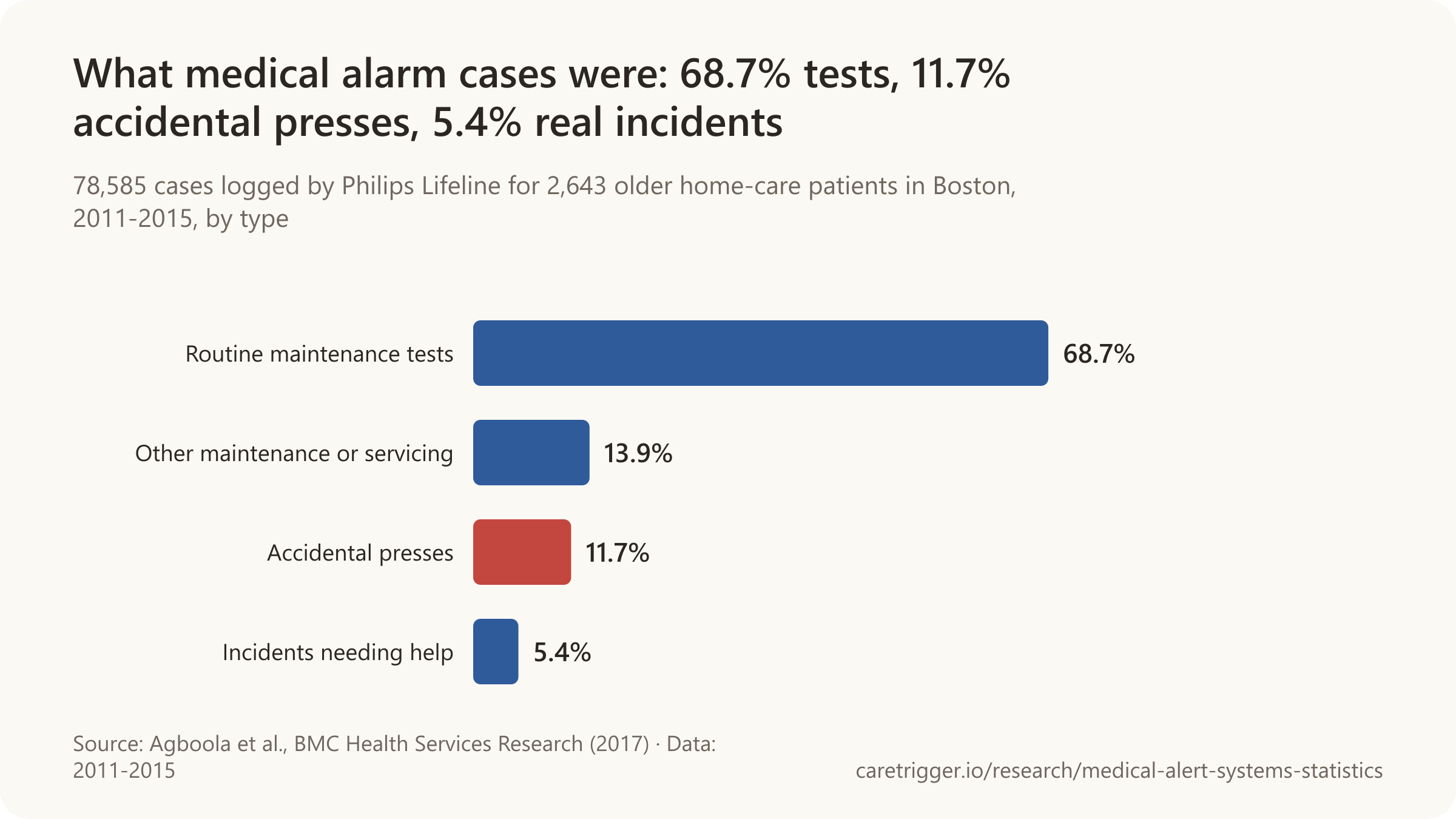
- 11.7% of medical alarm cases logged for older US home-care patients were accidental presses, about twice the 5.4% real incidents (2017).
- Thirteen published fall-detection algorithms caught on average 57% of real-world falls, against 91% of simulated ones (2012).
- In a home trial of a wearable fall detector, 8 of 12 falls happened while it was not being worn (2015).
- A large English telecare trial found no significant effect: 46.8% went to hospital within a year, against 49.2% on usual care (2013).
- In-home medical alert systems from 10 US brands had advertised starting prices of $23.78 to $39.99 a month in November 2026.
Sources: TheSeniorList.com; Centers for Medicare & Medicaid Services; BMJ; BMC Health Services Research; PLOS ONE; Journal of the American Geriatrics Society; Age and Ageing; CareTrigger
A medical alert system, also called a personal emergency response system, personal alarm or social alarm, lets an older person call for help by pressing a button; telecare adds sensors around the home, and some devices also detect falls. This page collects every published figure we could verify on who has one, whether they wear it and press it, how many calls are emergencies, how accurate fall detection is on real falls, how fast help comes, what the trials found, what it costs, and how countries with public alarm schemes compare. Industry figures and makers' claims are labelled as such.
01 / How many
What percentage of seniors use a medical alert system?
About 9% of Americans 65 and older use a medical alert system, unchanged since 2023, in an industry online panel (The Senior List, 2026).

- The medical alert industry's trade association puts the number of Americans using a medical alert at 5.9 million (2025).
- 17.4% of Americans 65 and older with a disability, about 1.7 million people, had a medical emergency call system at home (2011).
- Fewer than 10% of Americans aged 50 to 80 had a medical alert system in their home in early 2022.
- 24% of Americans 65 and older had a smartwatch in 2026, against 37% of all adults.
- In South Korea, 38.8% of people 65 and older said their home needed an emergency call device; 9.8% had one (2023).
| Who is counted | Estimate |
|---|---|
| North America, users of all ages (analyst estimate, end of 2025) | 6.5 million |
| North America, users as a share of people 65 and older (analyst estimate, end of 2025) | 9.1% |
| North America, subscribers (industry survey, 2021) | 5.1 million |
| US, older residents of residential care and nursing homes who used one (2015-2017) | 20.8% |
| US, 60 and older with disabilities (2005) | 16% |
| France, over 75 (industry survey, 2024) | 10% |
| England, 65 and older with mobility or daily-living difficulties (2014) | 6% |
Industry figures come from companies that sell or advise on these services and are labelled as such. Whether people wear the device and press it is covered in the sections below.
Sources: TheSeniorList.com; National Telecommunications and Information Administration; National Telecommunications and Information Administration, US Department of Commerce; Connected Health & Safety Association; Disability and Health Journal; University of Michigan Institute for Healthcare Policy and Innovation; Pew Research Center; Ministry of Health and Welfare, Korea; Berg Insight; The Edmonds Group; Seniors Housing & Care Journal; Assistive Technology; AFRATA, industry survey; Ageing & Society
More statistics (34)
9% of US adults aged 65+ currently use a medical alert system / PERS, unchanged from the same survey in 2023 (industry online-panel survey).
No US government survey asks every older adult whether they have a medical alert. The national figures come from the industry (a trade association, an analyst firm and a review site's online panel), from university polls, and from federal surveys of people with disabilities. Smartwatches with fall detection blur the count: in the industry panel, the Apple Watch was the device users named most.
- 5.9 million people in the United States use a personal emergency response system, according to the medical alert industry's trade association, citing L.E.K. Consulting (Connected Health & Safety Association, 2025).
- Fewer than 10% of US adults aged 50 to 80 reported having a personal emergency response system in their home in early 2022 (University of Michigan National Poll on Healthy Aging, 2022).
- 6.5 million people in North America used a medical alert service at the end of 2025, according to an analyst estimate (Berg Insight, 2026).
- 9.1% is the medical alert penetration rate an analyst estimates for North America at the end of 2025, counting users of all ages against the population aged 65 and older (Berg Insight, 2026).
- 10.1 million people in North America are forecast to use a medical alert service by the end of 2030, up from 6.5 million at the end of 2025, according to an analyst forecast (Berg Insight, 2026).
- 5.1 million subscribers used personal emergency response systems in North America in 2021, according to an industry survey by an M&A advisory firm (The Edmonds Group).
Surveys of older Americans
- 17.4% of community-dwelling Americans aged 65 and older with a disability, about 1.7 million people, had a medical emergency call system at home in 2011 (NHATS analysis, Al-Rousan et al., Disability and Health Journal, 2015).
- 16% of 606 Americans aged 60 and older with disabilities used a personal emergency response system (Mann et al., Assistive Technology, 2005).
- 14.5% of Americans aged 65 and older with a disability living in mobile homes, about 107,000 people, had a medical emergency call system at home in 2011 (NHATS analysis, Al-Rousan et al., Disability and Health Journal, 2015).
- 87.6% of older Americans living in residential care facilities and nursing homes had a medical emergency system to call for help available where they lived in 2015 to 2017 (NHATS analysis, Choi, Seniors Housing & Care Journal, 2019).
- 20.8% of older Americans living in residential care facilities and nursing homes reported using a medical emergency system to call for help, the least-used of 13 facility services, in 2015 to 2017 (NHATS analysis, Choi, Seniors Housing & Care Journal, 2019).
Smartphones, smartwatches and wearables
- 24% of US adults aged 65 and older had a smartwatch such as an Apple Watch or Google Pixel Watch in 2026, versus 37% of all US adults (Pew Research Center, 2026).
- 78% of US adults aged 65 and older own a smartphone (2025).
- 95% of US adults aged 65 and older own a cellphone of any kind (2025).
- 90% of US adults aged 50+ own a smartphone in 2025, up from 55% in 2016.
- 36% of US adults aged 50+ own a wearable device (2025), up from 11% in 2016; wearables are the one device category still owned more by adults 18-49.
- 36% of US Baby Boomers (ages 65-74) own a smartwatch or connected health device (2024), versus 66% of Millennials.
- 23% of Australians aged 75 and older had an internet-connected wearable device in 2024, up from 13% in 2023, versus 37% of all adults (ACMA, 2024).
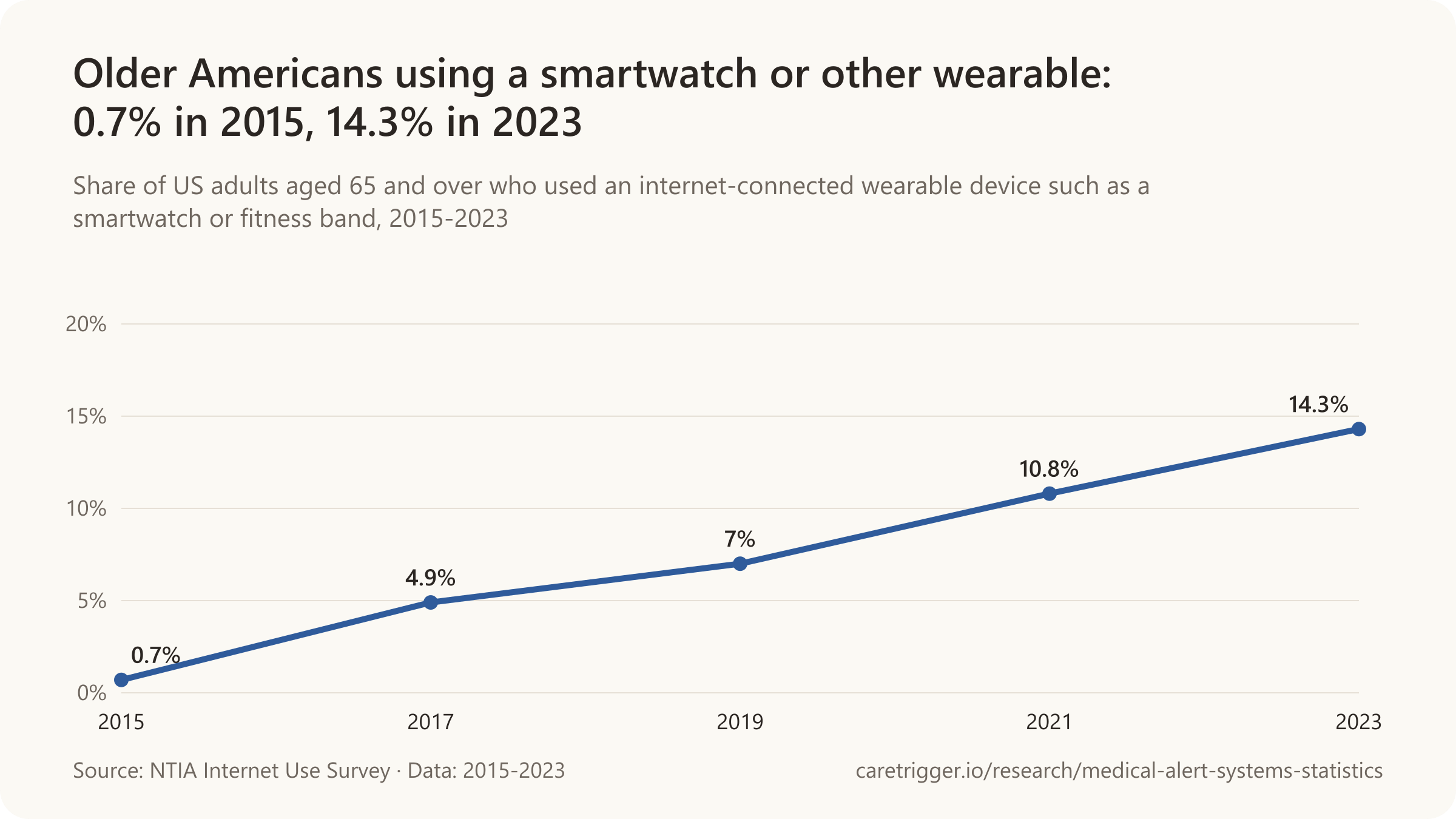
- 14.3% of US adults aged 65 and older used an internet-connected wearable device such as a smartwatch or fitness band in November 2023, versus 22.7% of all adults aged 15+ (NTIA, 2024).
- 2.1% of South Koreans aged 65 and older owned a smartwatch in 2023, against 76.6% who owned a smartphone (Ministry of Health and Welfare, National Survey of Older Koreans, 2024).
- 0.4% of people aged 60 and older in China used a smart wearable device in 2021 (0.5% in cities, 0.2% in rural areas), far fewer than used reading glasses (50.0%) or a cane (9.7%) (China Research Center on Aging, 2024).
- 0.7% of US adults aged 65 and older, about 0.3 million people, used an internet-connected wearable device such as a smartwatch or fitness band in July 2015 (NTIA Internet Use Survey).
- 4.9% of US adults aged 65 and older, about 2.5 million people, used an internet-connected wearable device such as a smartwatch or fitness band in November 2017 (NTIA Internet Use Survey).
- 7.0% of US adults aged 65 and older, about 3.7 million people, used an internet-connected wearable device such as a smartwatch or fitness band in November 2019 (NTIA Internet Use Survey).
- 10.8% of US adults aged 65 and older, about 6.1 million people, used an internet-connected wearable device such as a smartwatch or fitness band in November 2021 (NTIA Internet Use Survey).
- Apple Watch was the most commonly used medical alert device among current users aged 65 and older, ahead of every dedicated personal emergency response brand, in an industry online-panel survey (The Senior List, 2026).
Other countries
- 38.8% of South Koreans aged 65 and older said their home needed an emergency call device, rising to 49.5% of those with limitations in daily activities (Ministry of Health and Welfare, National Survey of Older Koreans, 2024).
- Only 6% of community-dwelling adults aged 65+ with mobility or daily-living difficulties in England reported using a personal call alarm.
- Only 10% of people aged over 75 in France had a téléassistance (personal alarm) service in 2024, according to the industry's own survey (AFRATA, 2025).
- Just under 40% of people over 50 in Germany knew that home emergency call systems (Hausnotruf) existed in 2009-2010 (aproxima for Initiative Hausnotruf, 2010).
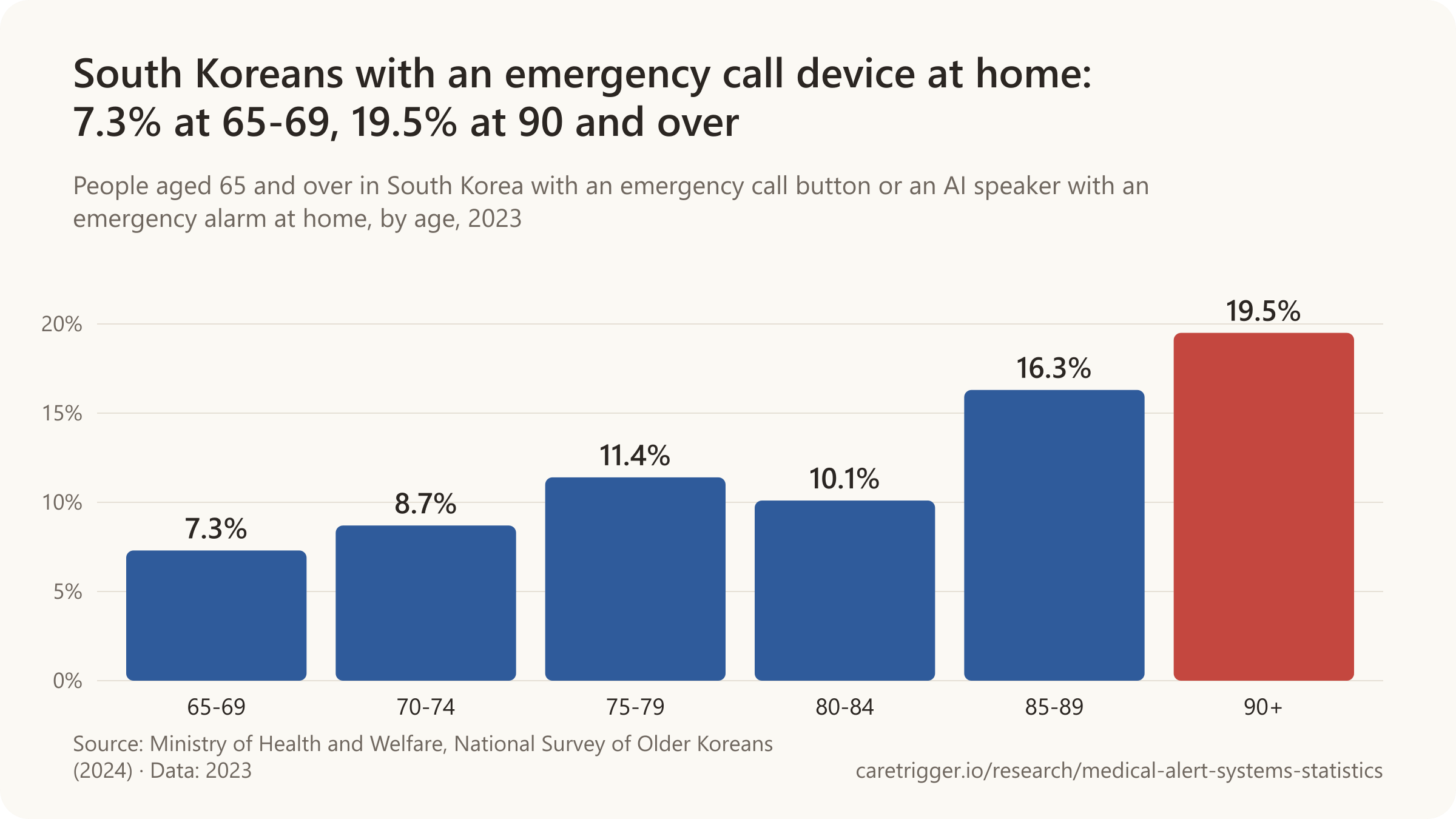
- 9.8% of South Koreans aged 65 and older had an emergency call button or an AI speaker with an emergency alarm installed at home in 2023 (Ministry of Health and Welfare, National Survey of Older Koreans, 2024).
- 9.3% of people aged 60 and older in China said their home needed an emergency call device fitted in 2021, 10.2% in cities and 8.2% in rural areas (China Research Center on Aging, 2024).
Numbers we will not publish. "10 million" and "7 million" medical alert users circulate as national totals; both are companies' cumulative counts of people "served" over the years, not people using a device today. The current industry estimates are the ones above, each named.
Sources: TheSeniorList.com; Connected Health & Safety Association; University of Michigan Institute for Healthcare Policy and Innovation; Berg Insight; The Edmonds Group; Disability and Health Journal; Assistive Technology; Seniors Housing & Care Journal; Pew Research Center (2025, 2026); AARP Research (2025); Rock Health; Australian Communications and Media Authority; National Telecommunications and Information Administration, US Department of Commerce; Ministry of Health and Welfare, Korea (2024); China Research Center on Aging, for the Ministry of Civil Affairs, National Working Commission on Aging, National Health Commission and others; National Telecommunications and Information Administration; Ageing & Society; AFRATA, industry survey; aproxima Gesellschaft für Markt- und Sozialforschung for Initiative Hausnotruf; Cabinet Office, Government of Japan
02 / Who
Who has a medical alert system, and why do others go without one?
80.85% of US Philips Lifeline medical alarm subscribers were women in 2014, and their average age was 81 (JMIR Medical Informatics, 2018).

- 93% of the 42,180 clients of Victoria's state-funded personal alarm programme in Australia lived alone; 80% were women (2021).
- 80% of US medical alert buyers bought one after they or someone they care for had a fall or medical emergency (2026).
- Among Americans 65 and older without a medical alert, 49% said they had no health concerns; 23% named cost (2026).
- In Western Australia, 77% of older people who decided against buying a personal alarm gave cost as a reason (2015).
- Only 26% of Americans with a parent 65 or older had talked with them about medical alert devices (2026).
| Service | Women |
|---|---|
| Uruguay, subsidised teleassistance users (2023) | 88.5% |
| Germany, insurer-funded home alarm users in three eastern states (2014) | 84.8% |
| France, téléassistance subscribers (2024) | 75% |
| US, patients seen by paramedics after a medical alarm call, Minnesota (2013-2022) | 72% |
| Ireland, Seniors Alert Scheme participants (2019) | 65% (all people over 65: 53%) |
| Sweden, municipal safety alarm holders 65 and older (2025) | 65% (144,775 women) |
Sources: JMIR Medical Informatics; Ministry of Health and Welfare, Korea; Australasian Journal on Ageing; AARP; TheSeniorList.com; BMC Geriatrics; Sistema Nacional Integrado de Cuidados, Ministerio de Desarrollo Social, Uruguay; Monitor Pflege; AFRATA, industry survey; Prehospital Emergency Care; Department of Rural and Community Development; Socialstyrelsen
More statistics (50)
80.85% of 290,434 US medical-alarm subscribers were women, and their average age was 81 (Op den Buijs et al., JMIR Medical Informatics, 2018).
In every country with data, medical alarm users are mostly women in their 80s, and most live alone. Most buy one after a fall or an emergency; those who go without most often say they do not need one yet, or name the cost.
- 93% of the 42,180 clients of Victoria's state-funded personal alarm programme lived alone; their mean age was 80 and 80% were women (Andrew et al., Australasian Journal on Ageing, 2021).
- 52% of Seniors Alert Scheme participants in Ireland were aged 80 or over at the end of 2020, and their average age was 81 (Department of Rural and Community Development, 2021).
- 65% of Seniors Alert Scheme participants in Ireland were women at the end of 2019, against 53% of all people over 65 (Department of Rural and Community Development, 2021).
- 57% of people who joined Ireland's Seniors Alert Scheme were living alone, and a further 7% lived alone for significant periods of the day (Department of Rural and Community Development, 2021).
- 144,775 women and 76,612 men aged 65 and over in Sweden had a municipal safety alarm on 31 October 2025, so 65% of alarm holders were women (Socialstyrelsen, 2026).
- 75% of téléassistance subscribers in France were women in 2024, and their average age was 84 (AFRATA industry survey, 2025).
- 84.8% of insurer-funded home emergency call users in an eastern German claims study were women in 2014 (14,040 of 16,553), and their average age was 85.4 (Zahn et al., Monitor Pflege, 2015).
- 62% of Personal Alert Victoria clients are aged 80 or older and 80% are women (Department of Health and Human Services, Victoria, 2019).
- 7.3% of South Koreans aged 65 to 69 had an emergency call button or an AI speaker with an emergency alarm at home in 2023 (Ministry of Health and Welfare, National Survey of Older Koreans, 2024).
- 8.7% of South Koreans aged 70 to 74 had an emergency call button or an AI speaker with an emergency alarm at home in 2023 (Ministry of Health and Welfare, National Survey of Older Koreans, 2024).
- 11.4% of South Koreans aged 75 to 79 had an emergency call button or an AI speaker with an emergency alarm at home in 2023 (Ministry of Health and Welfare, National Survey of Older Koreans, 2024).
- 10.1% of South Koreans aged 80 to 84 had an emergency call button or an AI speaker with an emergency alarm at home in 2023 (Ministry of Health and Welfare, National Survey of Older Koreans, 2024).
- 16.3% of South Koreans aged 85 to 89 had an emergency call button or an AI speaker with an emergency alarm at home in 2023 (Ministry of Health and Welfare, National Survey of Older Koreans, 2024).
- 19.5% of South Koreans aged 90 and older had an emergency call button or an AI speaker with an emergency alarm at home in 2023 (Ministry of Health and Welfare, National Survey of Older Koreans, 2024).
- 10.0% of South Koreans aged 65 and older who live alone had an emergency call button or an AI speaker with an emergency alarm at home in 2023, against 8.7% of older couples (Ministry of Health and Welfare, National Survey of Older Koreans, 2024).
- 11.8% of South Koreans aged 65 and older with a limitation in daily activities had an emergency call device at home in 2023, against 9.3% of those without (Ministry of Health and Welfare, National Survey of Older Koreans, 2024).
- 88.5% of users of Uruguay's subsidised home teleassistance service were women in December 2023, and 77% were aged 80 or older (Sistema Nacional Integrado de Cuidados, 2024).
- 72% of patients seen by paramedics after a medical alarm (PERS) activation in one Minnesota EMS system were women (2013-2022) (Boland et al., Prehospital Emergency Care, 2025).
- 42,180 older Victorians were enrolled in the state-funded Personal Alert Victoria program between 2014 and mid-2017 (Andrew et al., Australasian Journal on Ageing, 2021).
- 83.6 years was the average age of German medical alarm (Hausnotruf) subscribers in one service, against 81 years in the US (Op den Buijs et al., JMIR Medical Informatics, 2021).
Who buys one, and why
- 80% of 300 US medical alert buyers said they bought the system after they (37%) or someone they care for (42%) had a fall or medical emergency, in an April 2026 buyer survey (AARP Smart Picks, 2026).
- 26% of US adults with a parent aged 65 or older had talked with their parent about medical alert devices, in an industry online-panel survey (The Senior List, 2026).
- Among US adults 50+ who have provided caregiving, 12% currently use an emergency response system (physically or voice-activated) for the person they care for; 36% are interested.
- 40% of reasons older Americans with disabilities gave for using a personal emergency response system related to concern about falling (Mann et al., Assistive Technology, 2005).
- 75.6% of older American personal emergency response system users with disabilities said the device gave them an enhanced feeling of security (Mann et al., Assistive Technology, 2005).
- 9.7% of US family caregivers of people aged 50 and older already used alerting technologies that warn them when the person they care for needs urgent help, in late 2015 (AARP and HITLAB, 2016).
- 72.4% of US family caregivers of people aged 50 and older said they were likely to use technology that alerts them when the person they care for needs urgent care, the most wanted of 38 technology functions tested, in late 2015 (AARP and HITLAB, 2016).
- 25% of US family caregivers had checked on the person they care for using an app, video, wearable device or other remote monitoring in 2025, up from 13% in 2020 (AARP and National Alliance for Caregiving, 2025).
- 13% of US family caregivers had checked on the person they care for using an app, video, wearable device or other remote monitoring in 2020 (AARP and National Alliance for Caregiving, 2025).
- 56% of US medical alert users aged 65 and older picked their device themselves in 2026, versus 53% in 2023; 11% said their children chose it, in an industry online-panel survey (The Senior List, 2026).
- 22% of US adults with a parent aged 65 or older said they were likely to buy a medical alert device for that parent within 12 months in 2026, down from 39% in 2023, in an industry online-panel survey (The Senior List, 2026).
- 34% of US adult children whose parent already has a medical alert device said they were the ones who picked it out, in an industry online-panel survey (The Senior List, 2026).
- 39% of 300 US medical alert buyers said a doctor's recommendation was a reason for buying, the second most common after a fall or emergency, in an April 2026 buyer survey (AARP Smart Picks, 2026).
- 53% of 300 US medical alert buyers bought the system for themselves and 25% for a parent, in an April 2026 buyer survey (AARP Smart Picks, 2026).
- More than 95% of personal emergency response subscribers and their designated responders in a Canadian Lifeline service said they were satisfied with the service (Fallis et al., Home Health Care Services Quarterly, 2007).
- 89% of older Australians who bought a personal alarm rated fear of falling and not being able to get up as a most important reason (De San Miguel et al., BMC Geriatrics, 2015).
- 70% of older Australians who bought a personal alarm had family involved in the decision, against 39% of those who did not buy one (De San Miguel et al., BMC Geriatrics, 2015).
- 92.7% of older personal emergency response system users with disabilities were satisfied with their system, as summarised in an integrative review (Stokke, Journal of Medical Internet Research, 2016, summarising Mann et al., 2005).
Why people go without one

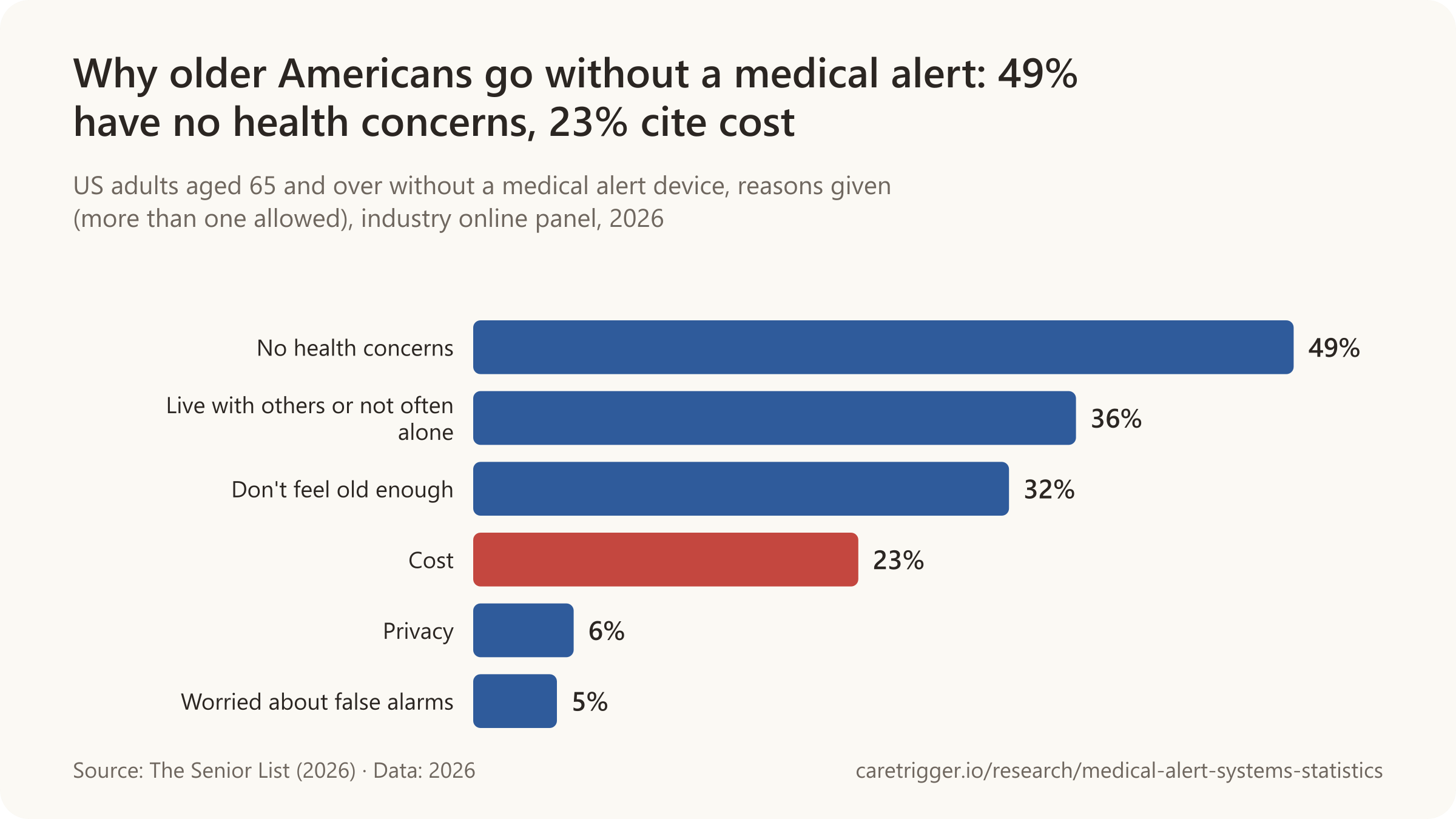
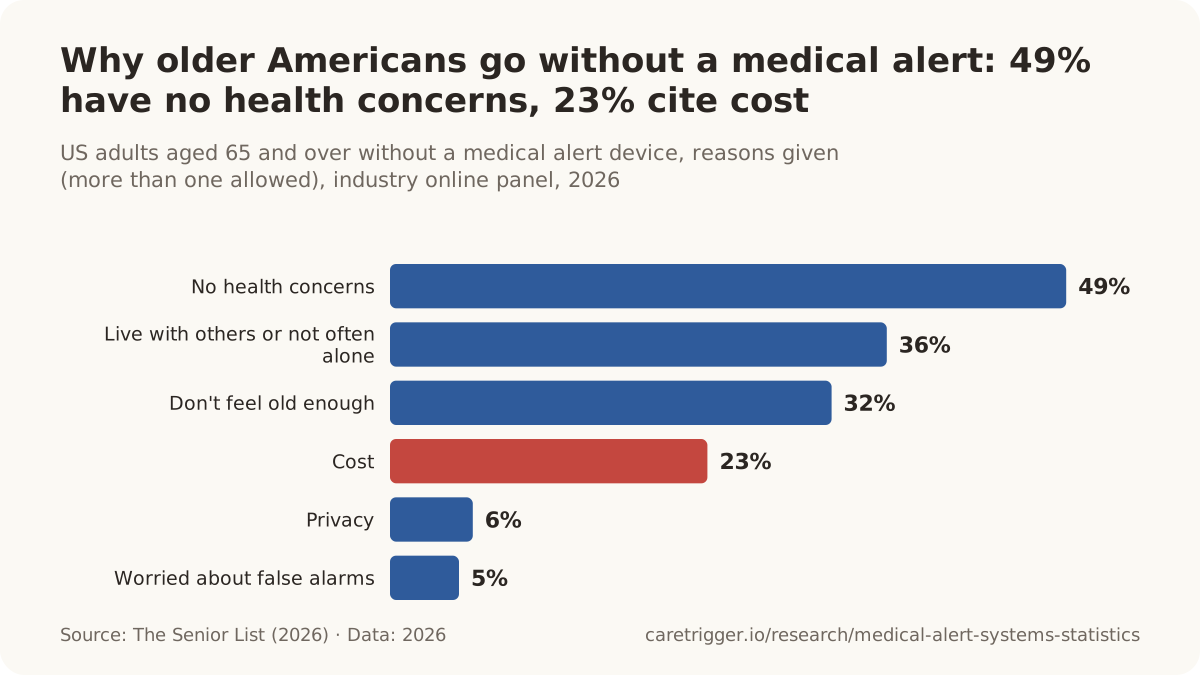
- 49% of US adults aged 65 and older without a medical alert device said it was because they had no health concerns, ahead of living with others (36%), not feeling old enough (32%) and cost (23%), in an industry online-panel survey (The Senior List, 2026).
- 77% of older Western Australians who decided not to buy a personal alarm gave cost as a reason, ahead of limited alarm range (51%) and feeling no need (39%) (De San Miguel et al., BMC Geriatrics, 2015).
- 57.0% of reasons older Americans with disabilities gave for not using a personal emergency response system were a lack of perceived need, ahead of cost (37.0%) and not knowing about the device (23.7%) (Mann et al., Assistive Technology, 2005).
- 74% of US adults aged 65 and older without a medical alert device said declining health or mobility would make them more likely to get one; 53% said a fall and 48% insurance coverage, in an industry online-panel survey (The Senior List, 2026).
- 9% of US adults aged 65 and older without a medical alert device said they were likely to buy one for themselves within 12 months, in an industry online-panel survey (The Senior List, 2026).
- 37.0% of responses from older people with disabilities who did not use a personal emergency response system named cost as the reason (Mann et al., Assistive Technology, 2005).
- 23.7% of responses from older people with disabilities who did not use a personal emergency response system named not knowing about the device (Mann et al., Assistive Technology, 2005).
- 51% of older Australians who decided not to buy a personal alarm said the alarm's limited range (about 50 metres from the console) was an important reason (De San Miguel et al., BMC Geriatrics, 2015).
- 39% of older Australians who decided not to buy a personal alarm said they did not think they needed one (De San Miguel et al., BMC Geriatrics, 2015).
- 30% of older Australians who decided not to buy a personal alarm said they had no family or friends to list as emergency contacts (De San Miguel et al., BMC Geriatrics, 2015).
- 48% of US adults aged 65 and older without a medical alert device said insurance coverage of the device or monitoring would make them more likely to get one, in an industry online-panel survey (The Senior List, 2026).
Sources: JMIR Medical Informatics (2018, 2021); Australasian Journal on Ageing; Department of Rural and Community Development; Socialstyrelsen; AFRATA, industry survey; Monitor Pflege; Department of Health, Victoria; Ministry of Health and Welfare, Korea; Sistema Nacional Integrado de Cuidados, Ministerio de Desarrollo Social, Uruguay; Prehospital Emergency Care; AARP (2016, 2026); TheSeniorList.com; AARP Research; Assistive Technology; AARP and National Alliance for Caregiving; Home Health Care Services Quarterly; BMC Geriatrics (2015); Journal of Medical Internet Research
03 / Medicare
Does Medicare cover medical alert systems?
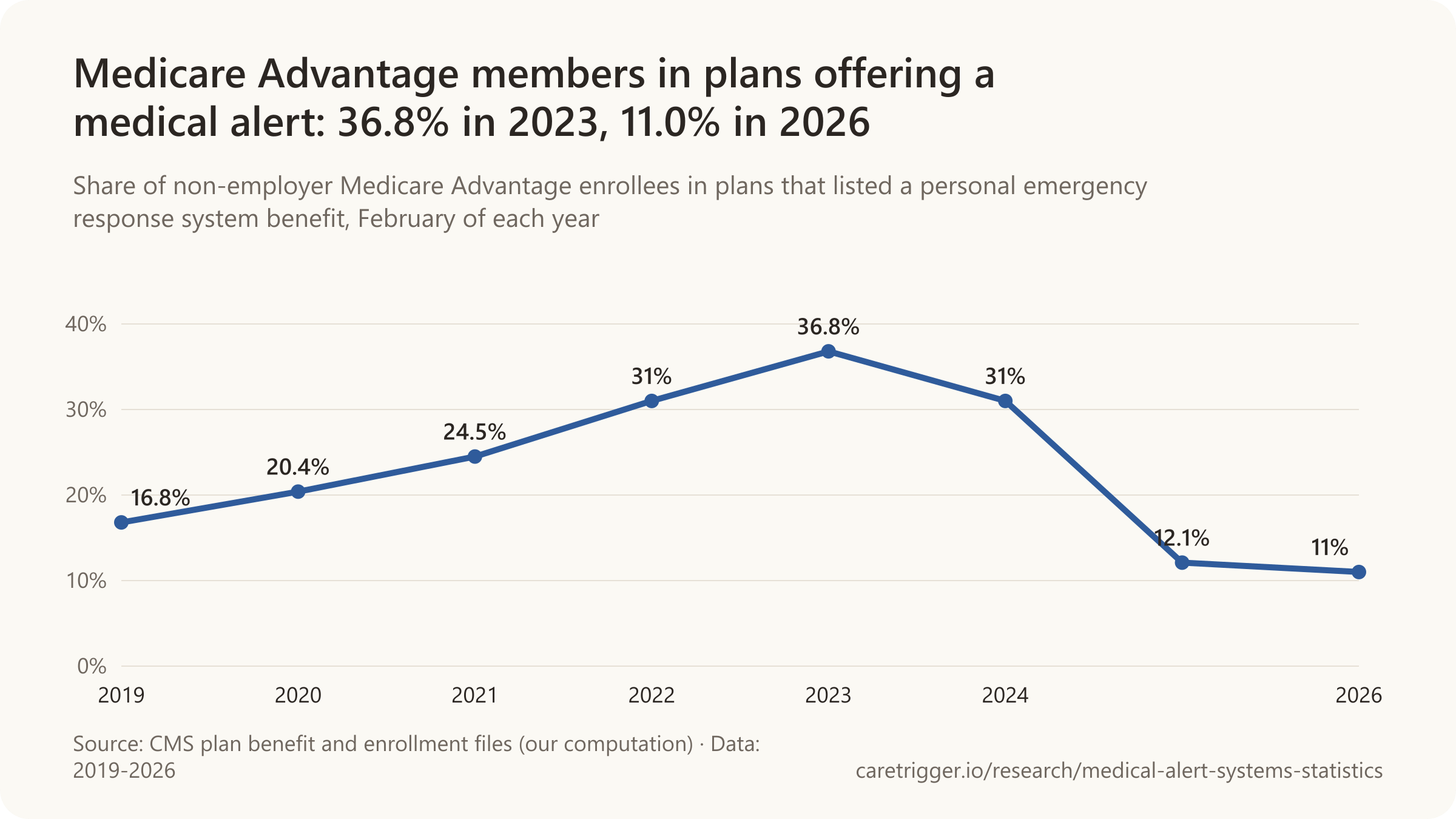
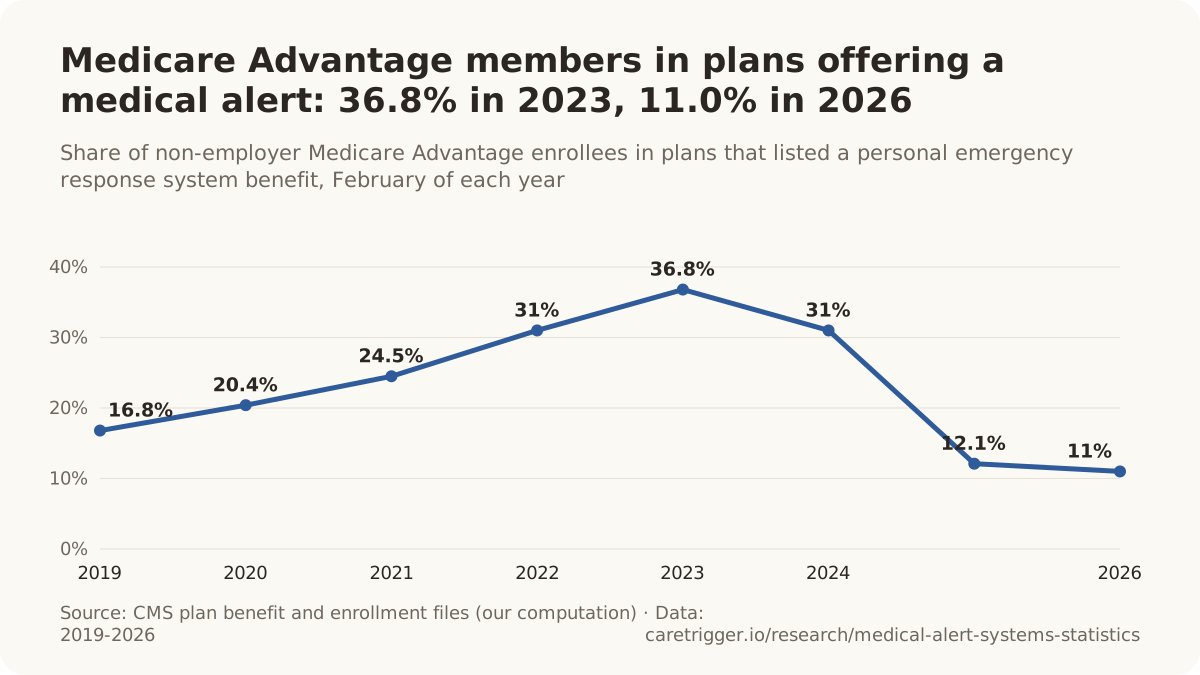
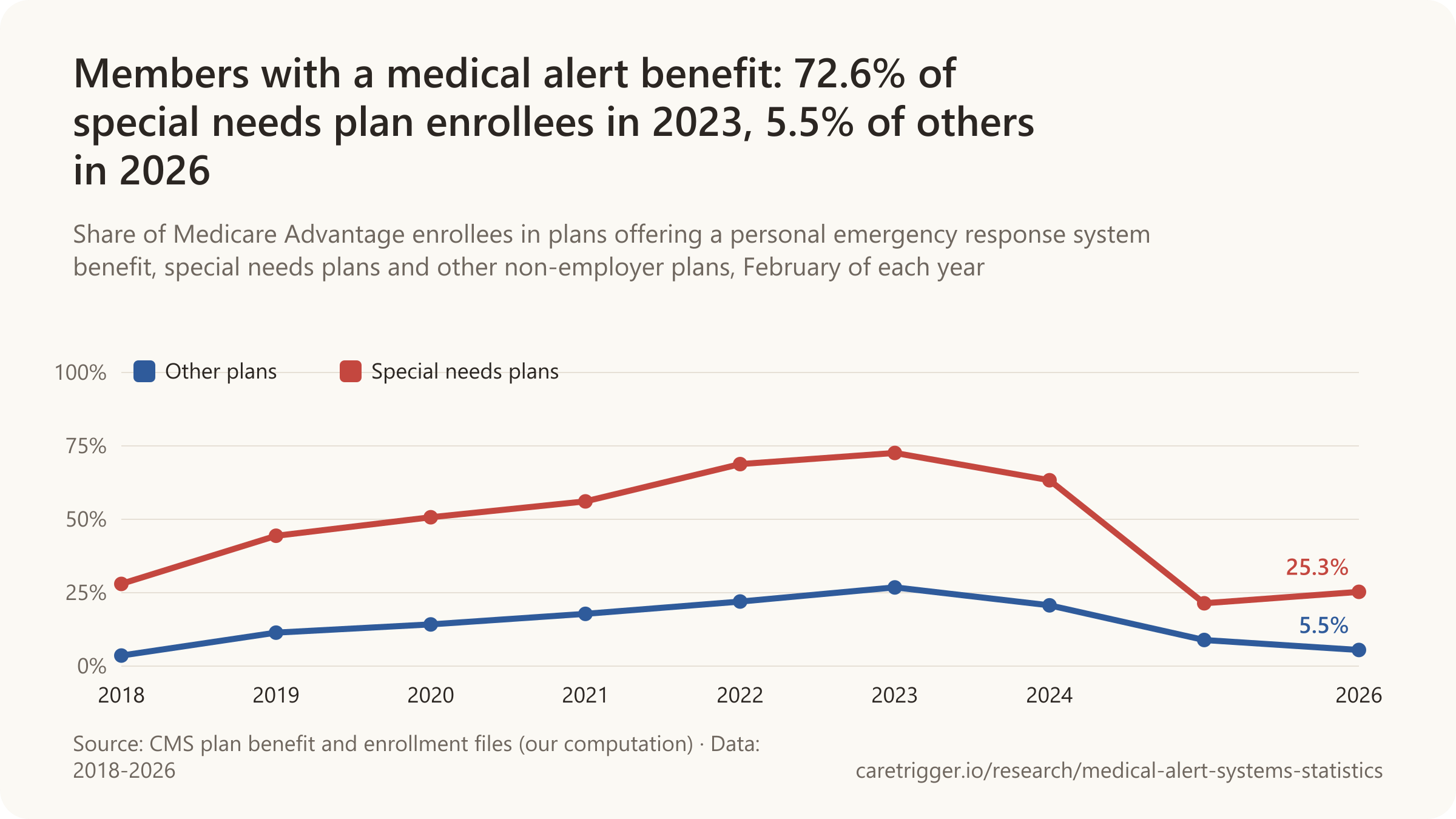
Medicare Advantage members whose plan offered a medical alert fell 65% between February 2023 and 2026, from 9.4 million to 3.3 million (CMS).

- For 2027, 11.0% of Medicare Advantage plans other than employer plans offer a medical alert benefit, down from 29.5% in 2023.
- Offered is not used: 3% of members of Medicare Advantage plans offering a medical alert had a record of using one (2021).
- UnitedHealth's Medicare Advantage plans offering a medical alert had about 4.4 million members in 2024 and 3,175 in 2025.
- Medicaid paid for medical alerts for about 300,000 Americans 65 and older enrolled in both Medicare and Medicaid (2021).
- Medicare Advantage plans spent about $0.1 billion on medical alerts in 2023, under 1% of their spending on extra benefits.
| Plan type and year | Plans offering it |
|---|---|
| Dual-eligible special needs plans, 2026 | 34.9% (379 of 1,085) |
| Chronic-condition special needs plans, 2026 | 24.0% (135 of 562) |
| Other plans (not special needs plans), 2026 | 6.3% (238 of 3,752) |
| Dual-eligible special needs plans, 2027 | 28.4% (299 of 1,052) |
| Chronic-condition special needs plans, 2027 | 18.4% (139 of 754) |
| Other plans (not special needs plans), 2027 | 4.6% (165 of 3,552) |
Original Medicare does not pay for medical alert systems; some Medicare Advantage plans add one as an extra benefit. The Medicare Advantage figures are our computation from CMS's plan benefit and enrollment files (see the methodology).
Sources: Centers for Medicare & Medicaid Services (2019-2026); Medicare Payment Advisory Commission (2026, 2025); Health Affairs Scholar
More statistics (34)
65% fewer Medicare Advantage enrollees were in plans offering a personal emergency response system benefit in February 2026 than in February 2023: about 3.3 million, down from 9.4 million (computed from CMS plan benefit and enrollment data).
Original Medicare does not cover medical alerts. Medicare Advantage plans may offer an in-home device as a supplemental benefit, and Medicaid home- and community-based services pay for one in many states. We counted, from CMS's own files, how many Medicare Advantage plans listed the benefit each year and how many people were enrolled in them: the share rose until 2023, then fell sharply as Humana and then UnitedHealth dropped the benefit from their plans.
- About 4.4 million people were enrolled in UnitedHealth Group's Medicare Advantage plans offering a personal emergency response system benefit in February 2024, but only 3,175 in February 2025, after its plans dropped the benefit (computed from CMS plan benefit and enrollment data).
- In 2025, 12% of Medicare Advantage enrollees were in plans offering a personal emergency response system (PERS) benefit, up from 7% in 2018.
- Medicare Advantage plans may offer in-home personal emergency response devices as a supplemental benefit if they are primarily health related, but a PERS benefit may not include cell phones (CMS, Medicare Managed Care Manual).
- Supplemental benefits such as personal emergency response systems are services Medicare Advantage plans may add that traditional Medicare does not cover (MedPAC, Report to the Congress, June 2025).
- 24% of Medicare Advantage enrollees were in plans that offered a personal emergency response system (PERS) benefit in 2021 (MedPAC, June 2025 report).
- 7.5% of non-employer Medicare Advantage enrollees, about 1.2 million people, were in plans offering a personal emergency response system benefit in February 2018 (computed from CMS plan benefit and enrollment data, 2018).
- 16.8% of non-employer Medicare Advantage enrollees, about 3.0 million people, were in plans offering a personal emergency response system benefit in February 2019 (computed from CMS plan benefit and enrollment data, 2019).
- 20.4% of non-employer Medicare Advantage enrollees, about 4.0 million people, were in plans offering a personal emergency response system benefit in February 2020 (computed from CMS plan benefit and enrollment data, 2020).
- 24.5% of non-employer Medicare Advantage enrollees, about 5.3 million people, were in plans offering a personal emergency response system benefit in February 2021 (computed from CMS plan benefit and enrollment data, 2021).
- 31.0% of non-employer Medicare Advantage enrollees, about 7.4 million people, were in plans offering a personal emergency response system benefit in February 2022 (computed from CMS plan benefit and enrollment data, 2022).
- 36.8% of non-employer Medicare Advantage enrollees, about 9.4 million people, were in plans offering a personal emergency response system benefit in February 2023 (computed from CMS plan benefit and enrollment data, 2023).
- 31.0% of non-employer Medicare Advantage enrollees, about 8.5 million people, were in plans offering a personal emergency response system benefit in February 2024 (computed from CMS plan benefit and enrollment data, 2024).
- 12.1% of non-employer Medicare Advantage enrollees, about 3.5 million people, were in plans offering a personal emergency response system benefit in February 2025 (computed from CMS plan benefit and enrollment data, 2025).
- 11.0% of non-employer Medicare Advantage enrollees, about 3.3 million people, were in plans offering a personal emergency response system benefit in February 2026 (computed from CMS plan benefit and enrollment data, 2026).
- About 1.8 million people were enrolled in Humana's Medicare Advantage plans offering a personal emergency response system benefit in February 2023; in 2024 none of its non-employer plans listed the benefit (computed from CMS plan benefit and enrollment data).
Plans offering the benefit

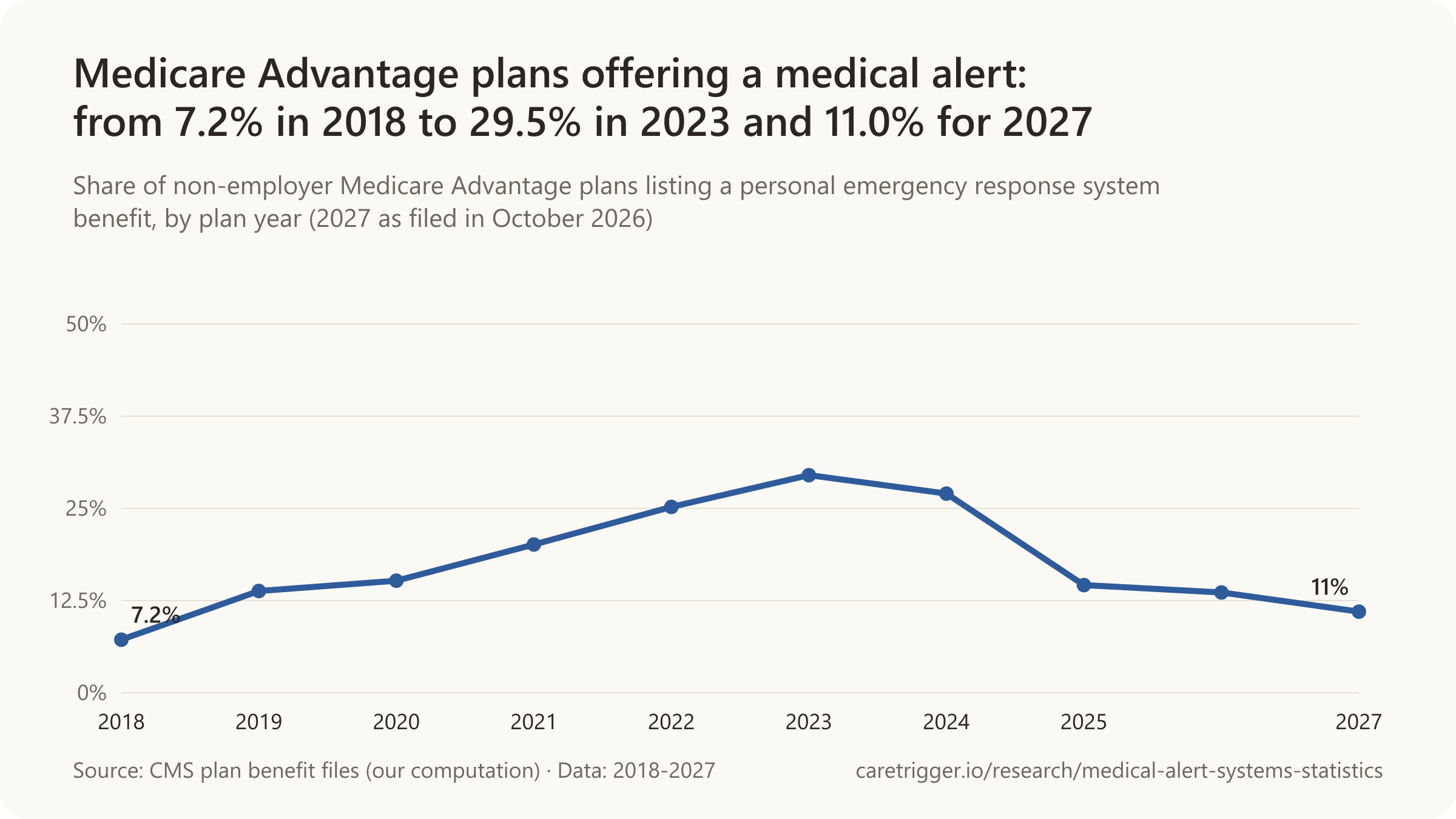
- 11.0% of non-employer Medicare Advantage plans (606 of 5,521) offer a personal emergency response system (medical alert) benefit for 2027, as filed with CMS in October 2026 (computed from CMS plan benefit data, 2027).
- 20.1% of Medicare Advantage HMO and PPO plans (994 of 4,945, excluding affinity and special needs plans) offered a personal emergency response benefit in 2022 to 2024 (Dorneo et al., Health Affairs Scholar, 2026).
- 34.9% of dual-eligible special needs plans (379 of 1,085) offered a personal emergency response system benefit in 2026 (computed from CMS plan benefit data, 2026).
- 24.0% of chronic-condition special needs plans (135 of 562) offered a personal emergency response system benefit in 2026 (computed from CMS plan benefit data, 2026).
- 6.3% of non-employer Medicare Advantage plans that are not special needs plans (238 of 3,752) offered a personal emergency response system benefit in 2026 (computed from CMS plan benefit data, 2026).
- 28.4% of dual-eligible special needs plans (299 of 1,052) offer a personal emergency response system benefit for 2027 (computed from CMS plan benefit data, 2027).
- 18.4% of chronic-condition special needs plans (139 of 754) offer a personal emergency response system benefit for 2027 (computed from CMS plan benefit data, 2027).
- 4.6% of non-employer Medicare Advantage plans that are not special needs plans (165 of 3,552) offer a personal emergency response system benefit for 2027 (computed from CMS plan benefit data, 2027).
Special needs plans and other plans

Offered, and used
- 3% of Medicare Advantage enrollees in plans offering a personal emergency response system benefit had an encounter record for a PERS service in 2021 (MedPAC, June 2025 report).
- About $0.1 billion, less than 1% of the $23.9 billion that Medicare Advantage organizations reported spending on supplemental benefits, went to personal emergency response systems in 2023 (MedPAC, March 2026 report).
Medicaid, the VA and who pays
- About 300,000 dual-eligible Americans aged 65 and older used a Medicaid-paid personal emergency response system in 2021 (computed from Shen et al., Health Affairs Scholar, 2026).
- 6 months is the longest initial authorization New York Medicaid allows for personal emergency response services, which also need a physician's order and an assessment (New York State Medicaid regulations).
- VA may pay for a medical alert system for a veteran who lives alone or is alone for long periods and cannot use a phone because of hand, vision or cognitive impairment, after the veteran's primary care provider asks for one (Minneapolis VA Health Care System guide, 2023).
- 15.1% of dual-eligible Medicare and Medicaid enrollees aged 65 and older who used Medicaid home- and community-based services had a Medicaid-paid personal emergency response system in 2021 (Shen et al., Health Affairs Scholar, 2026).
- 62.1% of Medicaid 1915(c) home- and community-based services waivers for older adults (41 of 66) described personal emergency response services that can include smart devices, the most common category to do so, in 2020 to 2026 (Zawada et al., Clinical Interventions in Aging, 2026).
- 46 personal emergency response system services were written into 57 Medicaid home- and community-based services waivers for people with physical disabilities in 38 states (Novario et al., Disability and Rehabilitation: Assistive Technology, 2026).
- 60% of the US personal emergency response system market is private pay, according to the industry's trade association, citing L.E.K. Consulting (Connected Health & Safety Association, 2025).
- 40% of the US personal emergency response system market is paid for through Medicaid home- and community-based services, Medicare Advantage and other healthcare partnerships, according to the industry's trade association (Connected Health & Safety Association, 2025).
Sources: Centers for Medicare & Medicaid Services (2016-2026); Medicare Payment Advisory Commission (2025, 2026); Health Affairs Scholar (2026); New York State Department of Health; US Department of Veterans Affairs, Minneapolis VA Health Care System; Clinical Interventions in Aging; Disability and Rehabilitation: Assistive Technology; Connected Health & Safety Association
04 / Wearing it
Do older people actually wear their medical alert?
Only 14% of German medical alarm subscribers wore the button around the clock; 24% never wore it (Zeitschrift für Gerontologie und Geriatrie, 2010).

- Only 18% of US medical alert users said they always wear or carry their device, in an industry online panel (2026).
- Older adults at risk of falls who were given a pendant wore it on a median 68% of days over six months (2025).
- 46% of Norwegians with dementia who had a social alarm were not wearing it when researchers visited (2023).
- Only 62% of older English alarm users given an automatic fall detector wore it even occasionally over about four months (2004).
- Fewer than 50% of New York medical alarm subscribers wore the button whenever they were alone at home (1995).
Whether people press the button after a fall is the next section; the falls a detector never sees because it is not being worn are in the fall detection section.
Sources: Zeitschrift für Gerontologie und Geriatrie; TheSeniorList.com; Innovation in Aging; Frontiers in Aging Neuroscience; Journal of Telemedicine and Telecare; The Mount Sinai Journal of Medicine
More statistics (38)
Only 14% of PERS subscribers wear the alarm button 24 hours a day.
A medical alert helps only when it is on the body. Studies since the 1990s find the same pattern: many users take it off at night, in the shower or around the house, and people with dementia often forget they have one.
- Only 18% of current medical-alert users say they wear or carry their device at all times (industry survey).
- In a six-month pilot of older adults at risk of falls given a PERS pendant, the median share of days the pendant was worn was 68.0% (IQR 56.1-84.4%).
- Only 62% of older community alarm users given an automatic fall detector wore it even occasionally over about four months; 38% did not wear it (Brownsell and Hawley, Journal of Telemedicine and Telecare, 2004).
- Fewer than 50% of personal emergency response system subscribers in New York wore the help button whenever they were alone at home (106 subscribers, average age 83) (Levine and Tideiksaar, Mount Sinai Journal of Medicine, 1995).
- 24% of community-dwelling PERS subscribers reported that they never wear the alarm button.
- Two of the 33 reviewed PERS studies found that about 25% of respondents never wore the pendant.
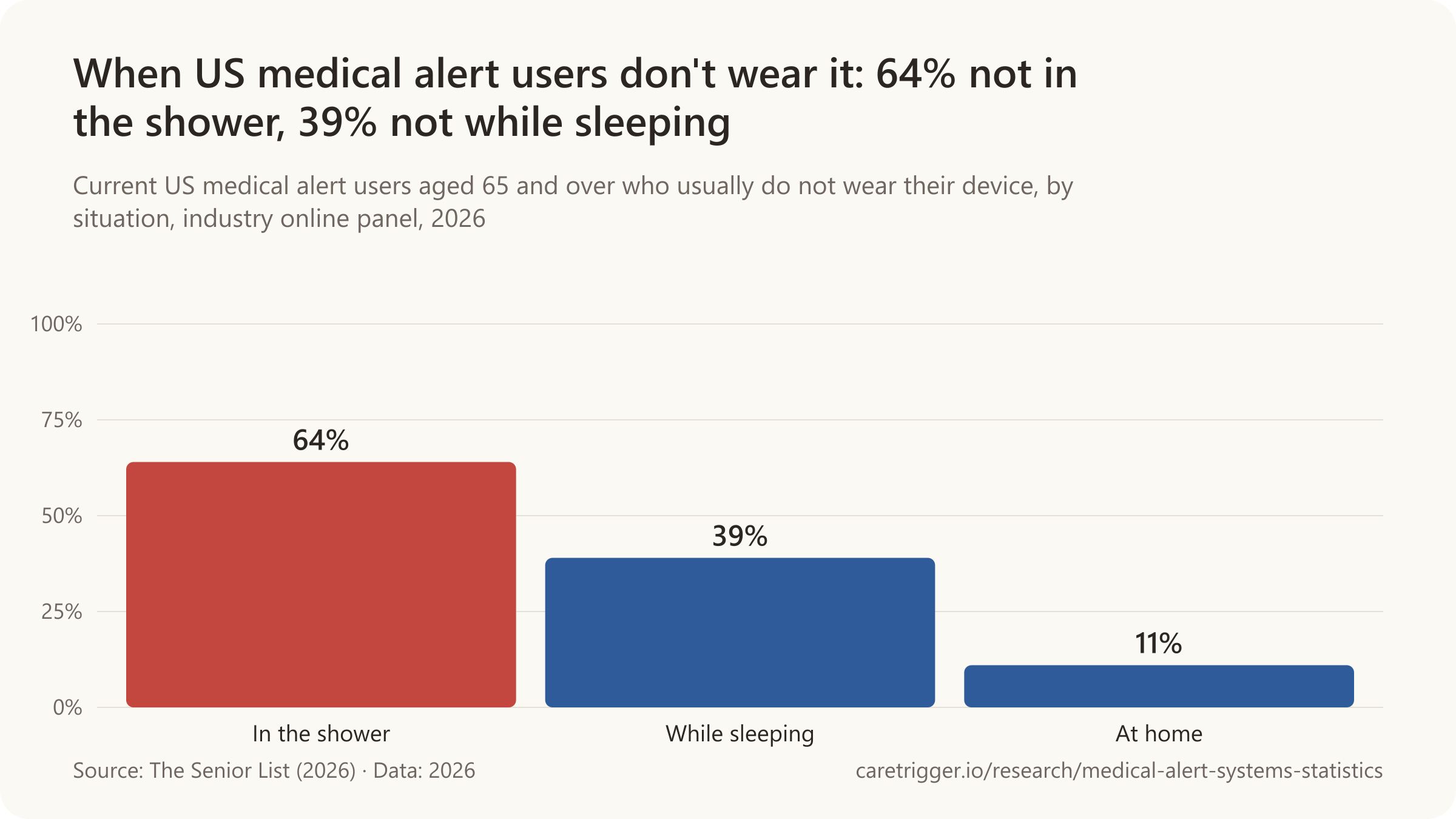
- 64% of medical-alert users report not wearing the device in the shower (industry survey).
- Personal emergency response system subscribers who had obtained the system at a family member's request were less likely to wear the button when alone than those who obtained it themselves (Levine and Tideiksaar, Mount Sinai Journal of Medicine, 1995).
- 45% of personal emergency response system subscribers in a New York study were fully compliant with wearing the button, as summarised in an integrative review (Stokke, Journal of Medical Internet Research, 2016, summarising Levine and Tideiksaar, 1995).
- 39% of current US medical alert users aged 65 and older said they usually do not wear their device while sleeping, in an industry online-panel survey (The Senior List, 2026).
- 11% of current US medical alert users aged 65 and older said they usually do not wear their device when at home, and 11% when outside the home, in an industry online-panel survey (The Senior List, 2026).
- 26 of 30 Canadian personal emergency response system subscribers aged 80 and over said they wore it every day, all the time, when at home (self-reported) (McKenna et al., BMC Geriatrics, 2015).
People with dementia
- 46% of people with dementia who had a social alarm were not wearing it on their body during the research interview (Norway, 18 months) (Puaschitz et al., Frontiers in Aging Neuroscience, 2023).
- 23.5% of family caregivers of people with dementia who had a social alarm said the alarm was not being used, against 13.7% of the people with dementia themselves (Norway, 24 months) (Puaschitz et al., Frontiers in Aging Neuroscience, 2023).
- Caregivers reported that 23.5% of people with dementia who had a social alarm were not using it at 24 months, up from 17.7% at 12 months, in a Norwegian trial (Puaschitz et al., Frontiers in Aging Neuroscience, 2023).
- 54% of people with dementia who had a social alarm were not aware they had one when asked in interviews (Norway, 18 months) (Puaschitz et al., Frontiers in Aging Neuroscience, 2023).
- 28.0% of people with dementia said their social alarm gave them a false sense of security, against 9.9% of their caregivers (Norway, 24 months) (Puaschitz et al., Frontiers in Aging Neuroscience, 2023).
- 31.4% of family caregivers of people with dementia said the social alarm offered no value or change, against 14.0% of the people with dementia (Norway, 24 months) (Puaschitz et al., Frontiers in Aging Neuroscience, 2023).
- 60.8% of people with dementia who had a social alarm said it contributed to their security, against 52.9% of their family caregivers (Norway, 24 months) (Puaschitz et al., Frontiers in Aging Neuroscience, 2023).
How long people keep the service
- 38% of 125 Australian personal alarm users in an early evaluation gave up the alarm, as summarised in an integrative review (Stokke, Journal of Medical Internet Research, 2016, summarising Farquhar et al., 1992).
- 3 years was the median time older US home-care patients kept using a medical alarm (PERS) within a five-year window (interquartile range 1-5; 2,555 users, 2011-2015) (Agboola et al., BMC Health Services Research, 2017).
- Death, moving into long-term care and financial reasons were the reasons recorded when US subscribers left the Philips Lifeline medical alarm service (Op den Buijs et al., JMIR Medical Informatics, 2018).
- 55.9% of German medical alarm (Hausnotruf) subscribers had been on the service for 2 years or less, against 44.4% of US subscribers (Op den Buijs et al., JMIR Medical Informatics, 2021).
- 31.7% of US Philips Lifeline medical alarm subscribers had been on the service for 4 years or more, against 23.0% in a German service (Op den Buijs et al., JMIR Medical Informatics, 2021).
- 239 of 1,505 people served by the municipal teleassistance service of Alcalá de Henares (Spain) in 2024 left the service during the year (16%) (Ayuntamiento de Alcalá de Henares, 2025).
- 38 account holders gave up the municipal teleassistance service of Alcalá de Henares (Spain) by their own choice in 2024 (Ayuntamiento de Alcalá de Henares, 2025).
- When North Lanarkshire reintroduced a charge for community alarms, a data cleanse found a significant number of listed users had died or moved into sheltered housing or a care home (North Lanarkshire Council, 2024).
- 69 council tenants in the Vale of Glamorgan chose not to have telecare once it became voluntary for council housing in 2019 (Vale of Glamorgan Council, 2021).
- 407 customers left the Vale of Glamorgan's council telecare service in a year while 542 joined, mostly because people moved to other care and possibly because of cost-of-living pressures (Vale of Glamorgan Council, 2024).
Stigma, and wanting fall detection
- 77% of community alarm users in three English tower blocks were interested in automatic fall detection (176 users, average age 76) (Brownsell et al., Journal of Telemedicine and Telecare, 2000).
- 5 of 33 studies reviewed (15%) recorded users describing the personal alarm pendant as stigmatising (Stokke, Journal of Medical Internet Research, 2016).
- Only 31% of older community alarm users approached agreed to try an automatic fall detector; the main reason for declining was being happy with the alarm they already had (Brownsell and Hawley, Journal of Telemedicine and Telecare, 2004).
Other figures
- 67% of Vale of Glamorgan telecare users who answered a 2019 survey were very satisfied with the service's response (Vale of Glamorgan Council, 2021).
Numbers we will not publish. "More than 70% of seniors don't wear their medical alert", "30% cancel in the first year" and "fewer than 20% ever activate it" appear on vendor and review sites without a source. The studies above measure wearing directly, from 14% of German subscribers wearing it around the clock to a median of 68% of days in a recent pilot.
Sources: Zeitschrift für Gerontologie und Geriatrie; TheSeniorList.com; Innovation in Aging; Journal of Telemedicine and Telecare (2000, 2004); The Mount Sinai Journal of Medicine; Journal of Medical Internet Research; BMC Geriatrics; Frontiers in Aging Neuroscience; BMC Health Services Research; JMIR Medical Informatics (2018, 2021); Ayuntamiento de Alcalá de Henares; North Lanarkshire Council; Vale of Glamorgan Council (2021, 2024)
05 / Pressing it
Do people press the button when they fall?
When people over 90 fell alone and could not get up, they did not use their call alarm in 80% of falls (BMJ, 2008).

- 83% of German alarm subscribers who fell alone and lay on the floor for over five minutes did not press their alarm (2010).
- Of 115 older fallers in a Paris emergency department who owned a personal alarm, only 18 used it after their fall (2017).
- Only 8 of 30 Canadian subscribers aged 80 and over had ever pressed their alarm in an emergency, after 3.3 years on average (2015).
- With an automatic fall-detection pendant, 70% of confirmed falls reached the response centre without a button press (2020).
- Among people over 90, 97% of long lies, an hour or more on the floor, happened with an alarm that was not used (2008).
Apps based on inactivity detection, such as CareTrigger, don't rely on a button press. How long people lie on the floor after a fall, and what follows, is on the long-lie page.
Sources: BMJ; Zeitschrift für Gerontologie und Geriatrie; Disability and Health Journal; BMC Geriatrics; Movement Disorders
More statistics (26)
In 80% of falls in which a person aged over 90 fell alone, could not get up, and had a call alarm available, the alarm was not used to summon help.
Having an alarm is not the same as using it. Studies of real falls find that people who have one often do not press it, even when they cannot get up.
- After falls, the PERS was not activated by 83% of subscribers who fell alone and lay on the floor for more than 5 minutes.
- 18 of 115 older fallers who owned a personal alarm used it to call for help after the fall that brought them to a French emergency department; those who did spent less time on the ground and had lower 6-month mortality (Bloch et al., Disability and Health Journal, 2017).
- 70% of confirmed falls among medical alert subscribers with an automatic fall-detection pendant reached the response centre without a button press, flagged only by the fall detector (Silva de Lima et al., Movement Disorders, 2020).
- In 97% of 'long lies' (an hour or more on the floor) that occurred despite an installed alarm, the person who fell alone did not use their alarm to summon help.
- Some form of call alarm was available in 99% of falls in which a person over 90 fell alone and could not get up.
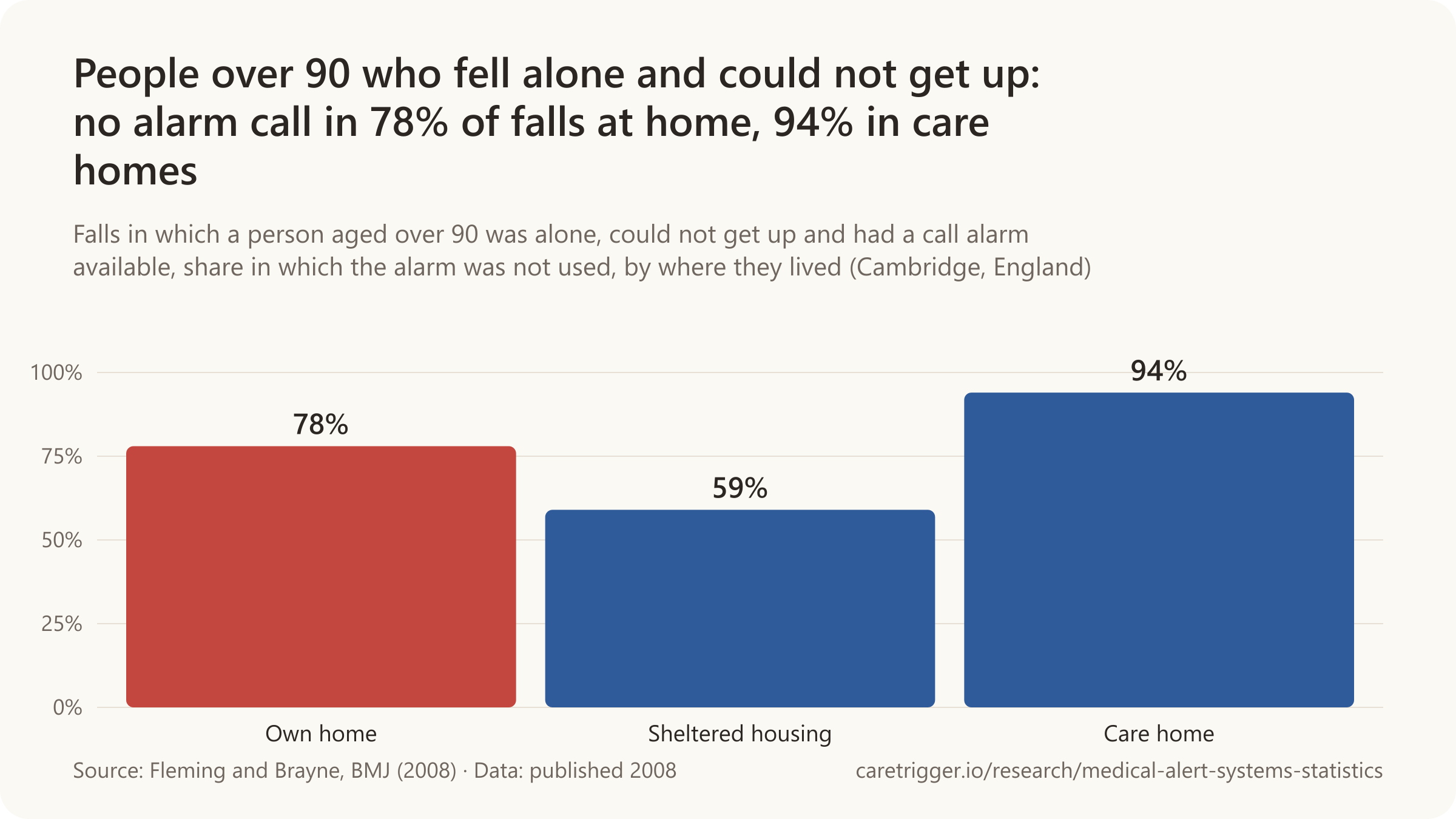
- In institutional (care-home) settings, 94% of falls where the person was alone, could not get up and had an alarm did not involve alarm use.
- Among people over 90 living in the community (own homes), 78% of falls where the person was alone, could not get up and had an alarm did not involve alarm use.
- When a call alarm was activated after a fall alone by someone unable to rise, lying on the floor for an hour or more occurred in only one, or perhaps two, of 28 such falls.
- Of 31 older people interviewed after calling an ambulance following a fall, 20 owned a personal alarm; the study identified a group who owned an alarm but did not use it effectively.
- 70% of people over 90 who lived alone in the community or in sheltered housing had some form of call alarm (57 of 81) (Fleming and Brayne, BMJ, 2008).
- 58% of community-dwelling people over 90 in the Cambridge cohort had a personal call alarm (36 of 62) (Fleming and Brayne, BMJ, 2008).
- 95% of falls that happened while a person over 90 was alone had some form of call alarm system available (209 of 219 falls) (Fleming and Brayne, BMJ, 2008).
- 59% of falls in sheltered housing in which a person over 90 was alone, could not get up and had an alarm did not involve alarm use (23 of 39 falls) (Fleming and Brayne, BMJ, 2008).
- 115 of 413 older fallers seen in a Paris emergency department (28%) had bought a personal emergency response system (Bloch et al., Disability and Health Journal, 2017).
How many users ever press it in an emergency
- Only 8 of 30 Canadian personal emergency response system subscribers aged 80 and over had ever pressed the button in an emergency, despite an average of 3.3 years with the service (McKenna et al., BMC Geriatrics, 2015).
- 23% of Personal Alert Victoria clients (4,275 of 18,421) pressed their alarm for a fall or medical emergency over one year in 2016-17, making 7,856 emergency activations (Wang et al., Australian Health Review, 2021; share derived).
- 40-50% of 38 alarm users interviewed in Oldham (UK) and Ottawa (Canada) had used their system in an emergency, as summarised in an integrative review (Stokke, Journal of Medical Internet Research, 2016, summarising Fisk, 1995).
- One-third of 117 home care patients with a personal emergency response system in New York requested emergency assistance through it within a year (60 calls), as summarised in an integrative review (Stokke, Journal of Medical Internet Research, 2016, summarising Hyer and Rudick, 1994).
- 32% of older Western Australians with a personal alarm had activated it in an emergency, as reported from a survey of 2,610 alarm users (De San Miguel and Lewin, 2008, as restated by Johnston et al., International Journal of General Medicine, 2010).
- 62% of 125 Australian personal alarm users in an early evaluation never used the alarm, though 84% felt they required it, as summarised in an integrative review (Stokke, Journal of Medical Internet Research, 2016, summarising Farquhar et al., 1992).
Who answers when the button is pressed
- 8% of current US medical alert users aged 65 and older did not know who is contacted when they press their button, in an industry online-panel survey (The Senior List, 2026).
Sources: BMJ; Zeitschrift für Gerontologie und Geriatrie; Disability and Health Journal; Movement Disorders; International Journal of General Medicine; BMC Geriatrics; Australian Health Review; Journal of Medical Internet Research; TheSeniorList.com
06 / Alarm calls
How many medical alert calls are real emergencies?
11.7% of medical alarm cases logged for older US home-care patients were accidental presses, about twice the 5.4% real incidents (BMC Health Services Research, 2017).

- In Ireland's national alarm scheme, 0.6% of calls led to an ambulance, the fire brigade or the police being sent (2019).
- 65.7% of subscribers to a Rotterdam personal alarm service made no genuine alarm call in a whole year (2018).
- Only 16.6% of alarms raised by older Czech users of GPS SOS alarms over two years needed action by the monitoring centre (2024).
- Fewer than 1% of users of Singapore's CareLine telecare service made 68.5% of the calls users placed to it (2016-2024).
| Service | Emergencies |
|---|---|
| France, calls to téléassistance platforms that were urgent (2024) | more than 11% |
| US, Philips Lifeline cases of older home-care patients in Boston (2011-2015) | 5.4% |
| Hong Kong, Personal Emergency Link assistance requests (2023-24) | 5.3% |
| England, Walsall council alarm centre: calls needing someone sent (2018) | 3.4% (about 170 of 5,000 a week) |
| Spain, Alcalá de Henares municipal teleassistance (2024) | 3.3% (2,955 of 89,071) |
| Germany, a Berlin home emergency system with fall sensors | 3% |
| Slovenia, Ljubljana social alarm centre: health-related calls over four years | 2.1% |
Sources: BMC Health Services Research; Ministry of Health and Welfare, Republic of Korea; Department of Rural and Community Development; Nivel; Healthcare; Frontiers in Public Health; AFRATA, industry survey; Senior Citizen Home Safety Association; Walsall Council; Ayuntamiento de Alcalá de Henares; BMC Geriatrics; Studies in Health Technology and Informatics
More statistics (75)
11.7% of logged medical alarm (PERS) cases among older US home-care patients were accidental button presses, about twice as many as real incidents (5.4%) (2011-2015) (Agboola et al., BMC Health Services Research, 2017).
Most calls to a medical alarm centre are not emergencies: automatic test signals, accidental presses, people checking that the system works, or calling for reassurance. Centres count in their own ways, so each figure below uses its service's own definitions.
- Only 16.6% of 4,409 alarms raised by 216 older Czech users of mobile GPS SOS alarms over two years needed action by the monitoring centre (Janovsky et al., Healthcare, 2024).
- 68.5% of all calls users placed to Singapore's CareLine telecare service came from fewer than 1% of its users (64 frequent callers) (2016-2024) (Lim et al., Frontiers in Public Health, 2025).
- One early PERS service evaluation cited in the review found that 40% of all alarm calls were false alarms.
- 43.2% of real medical-alarm incidents were falls and 42.7% were physical or psychological symptoms, among Philips Lifeline users of a Boston home-care programme (Agboola et al., BMC Health Services Research, 2017).
- 3% of 1,897 alarms from a Berlin home emergency system with fall sensors were real emergencies, while 50% were triggered by accident (Zoellick et al., BMC Geriatrics, 2025).
- 49% of the 154 home emergencies recorded over a year among older Australians who had or had considered a personal alarm were falls (De San Miguel et al., BMC Geriatrics, 2015).
- 68.7% of 78,585 logged medical alarm (PERS) cases among older US home-care patients were routine maintenance tests (2011-2015) (Agboola et al., BMC Health Services Research, 2017).
- 13.9% of logged medical alarm (PERS) cases among older US home-care patients were other maintenance or servicing of the system (2011-2015) (Agboola et al., BMC Health Services Research, 2017).
- 5.4% of logged medical alarm (PERS) cases among older US home-care patients were incidents in which the user needed help (about 4,231 of 78,585 cases, 2011-2015) (Agboola et al., BMC Health Services Research, 2017).
- 42.7% of medical alarm incidents among older US home-care patients were physical or psychological symptoms (breathing, pain, bleeding or injury, illness, dizziness, confusion, anxiety) (2011-2015) (Agboola et al., BMC Health Services Research, 2017).
- 6.5% of medical alarm incidents among older US home-care patients were requests for a responder, transport, nursing, medication or similar help (2011-2015) (Agboola et al., BMC Health Services Research, 2017).
- 9.67 alarms a year on average were raised by each of 216 older Czech users of mobile GPS SOS alarms in the year before COVID-19 (Janovsky et al., Healthcare, 2024).
- 300 of 4,409 alarms (6.8%) from older Czech users of mobile GPS alarms came from automatic fall detection; the rest were SOS button presses (2019-2021) (Janovsky et al., Healthcare, 2024).
- 34% of alarms from older Czech users of mobile GPS alarms were raised outside the home before COVID-19, falling to 29% during the restrictions (Janovsky et al., Healthcare, 2024).
- 19.7% of 9,512 older Singaporeans enrolled in the CareLine 24/7 telecare service never once called it themselves (2016-2024) (Lim et al., Frontiers in Public Health, 2025).
- Nearly half of current US medical alert users aged 65 and older said they had experienced a false alarm, in an industry online-panel survey (The Senior List, 2026).
- 6 of 30 Canadian personal emergency response system subscribers aged 80 and over said their device had gone off by accident at least once (McKenna et al., BMC Geriatrics, 2015).
Ireland
- 0.6% of 2019 alarm calls under Ireland's Seniors Alert Scheme, 3,130 calls, led to an ambulance, the fire brigade or the police being summoned (Department of Rural and Community Development, 2021).
- 34% of calls from Ireland's Seniors Alert Scheme alarm users in 2019 (about 62,000 calls) were made for reassurance or anxiety reasons (Department of Rural and Community Development, Focused Policy Assessment, 2021).
- 3,130 calls from Ireland's Seniors Alert Scheme alarm users in 2019 resulted in an ambulance, the fire brigade or the Gardaí being summoned, 0.6% of all calls logged (Department of Rural and Community Development, 2021).
- 65% of calls logged from Ireland's Seniors Alert Scheme alarms in 2019 appear to relate to the operation of the alarms, such as alarm testing (Department of Rural and Community Development, 2021).
- 2,053 of the 3,130 emergency calls from Ireland's Seniors Alert Scheme alarm users in 2019 required an ambulance (Department of Rural and Community Development, 2021).
Hong Kong

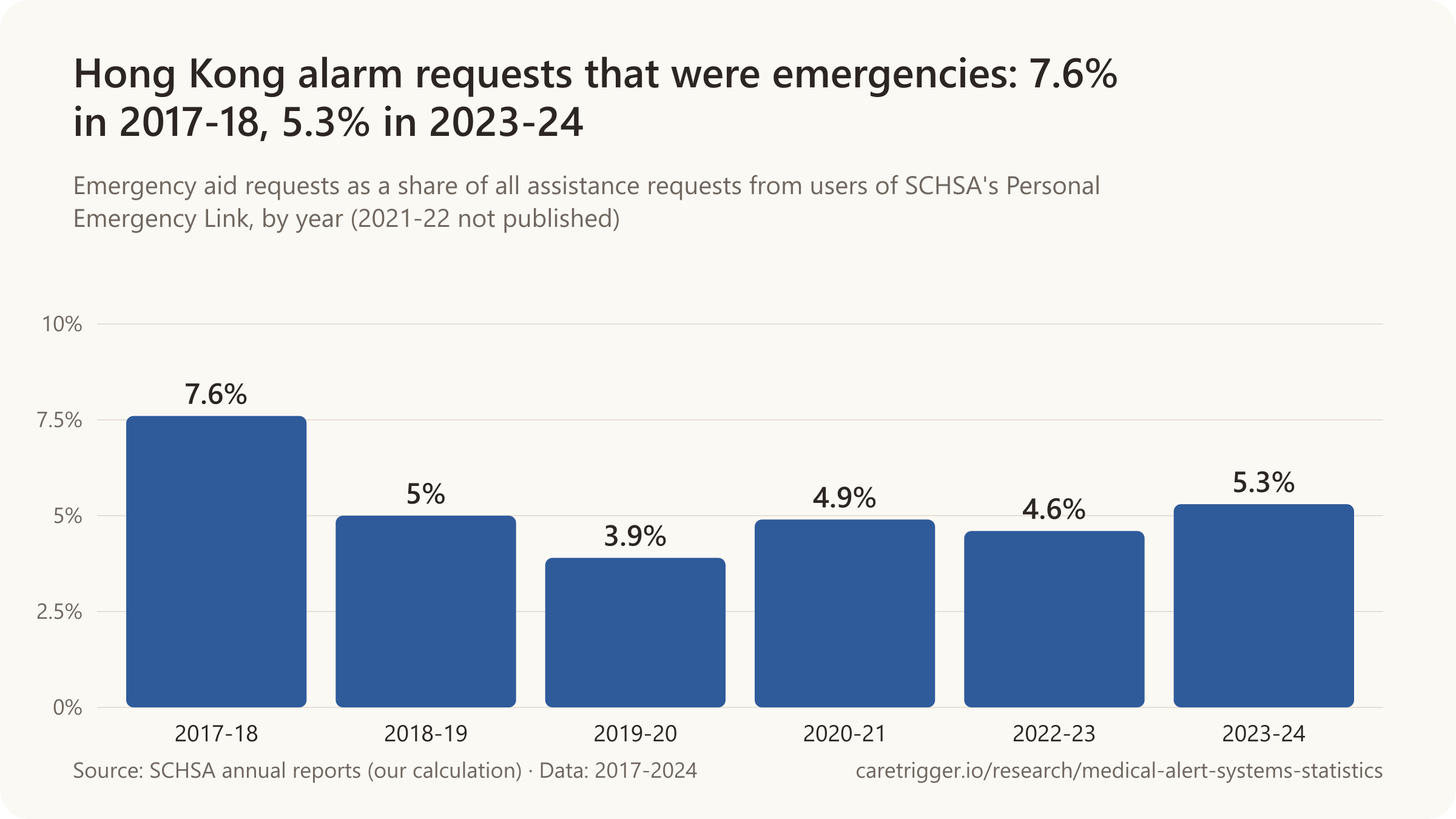
- 589,611 assistance requests from alarm users were handled by the Hong Kong Personal Emergency Link provider SCHSA in 2023-24 (SCHSA Annual Report, 2023-24).
- 31,334 emergency aid requests came from users of the Hong Kong Personal Emergency Link provider SCHSA in 2023-24 (SCHSA Annual Report, 2023-24).
- 5.3% of assistance requests from users of the Hong Kong Personal Emergency Link provider SCHSA in 2023-24 were emergencies (31,334 of 589,611; derived from SCHSA Annual Report, 2023-24).
- 657,428 assistance requests from alarm users were handled by the Hong Kong Personal Emergency Link provider SCHSA in 2022-23 (SCHSA Annual Report, 2022-23).
- 30,454 emergency aid requests came from users of the Hong Kong Personal Emergency Link provider SCHSA in 2022-23 (SCHSA Annual Report, 2022-23).
- 598,215 assistance requests from alarm users were handled by the Hong Kong Personal Emergency Link provider SCHSA in 2020-21 (SCHSA Annual Report, 2020-21).
- 29,163 emergency aid requests came from users of the Hong Kong Personal Emergency Link provider SCHSA in 2020-21 (SCHSA Annual Report, 2020-21).
- More than 768,865 calls for assistance from alarm users were handled by the Hong Kong Personal Emergency Link provider SCHSA in 2019-20 (SCHSA Annual Report, 2019-20).
- More than 30,092 calls for emergency aid came from users of the Hong Kong Personal Emergency Link provider SCHSA in 2019-20 (SCHSA Annual Report, 2019-20).
- More than 742,624 calls for assistance from alarm users were handled by the Hong Kong Personal Emergency Link provider SCHSA in 2018-19 (SCHSA Annual Report, 2018-19).
- More than 37,405 calls for emergency aid came from users of the Hong Kong Personal Emergency Link provider SCHSA in 2018-19 (SCHSA Annual Report, 2018-19).
- More than 500,000 calls for assistance from alarm users were handled by the Hong Kong Personal Emergency Link provider SCHSA in 2017-18 (SCHSA Annual Report, 2017-18).
- More than 38,000 calls for emergency aid came from users of the Hong Kong Personal Emergency Link provider SCHSA in 2017-18 (SCHSA Annual Report, 2017-18).
South Korea

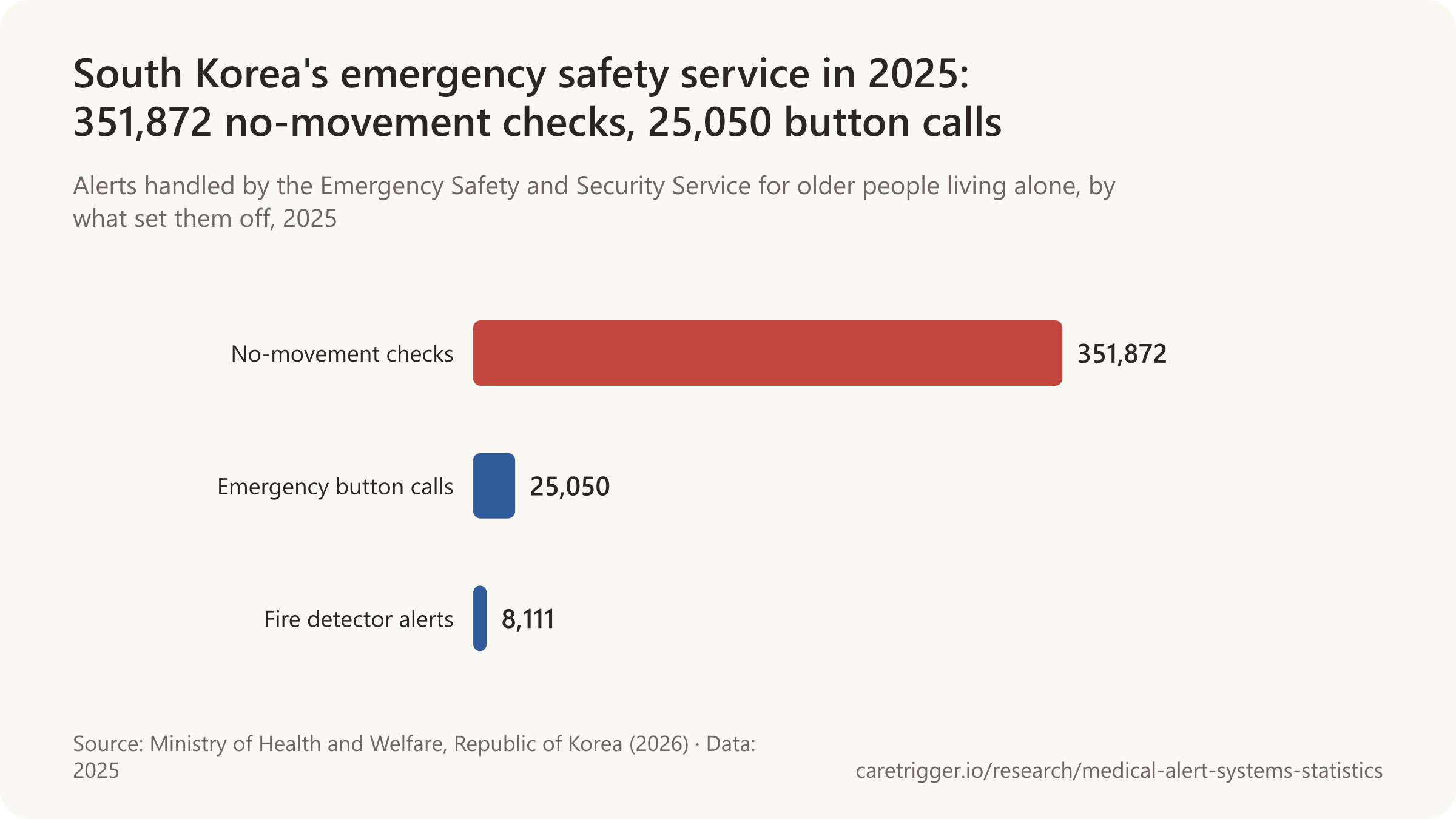
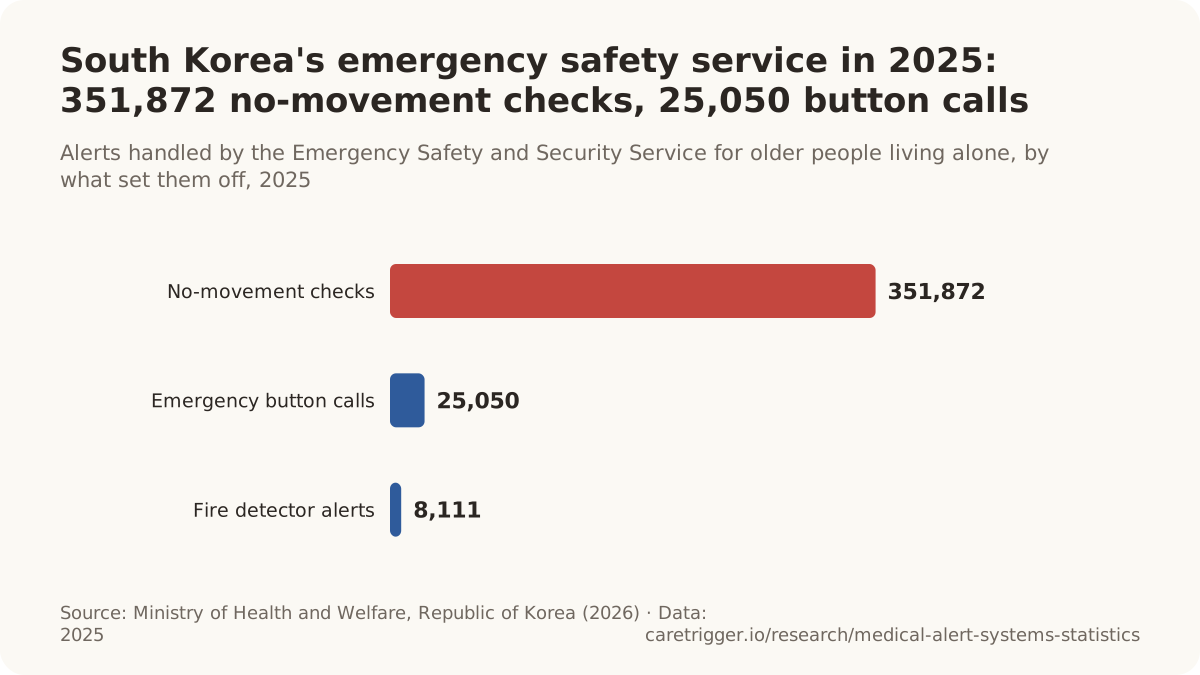
- 91% of the 385,033 alerts handled by South Korea's Emergency Safety and Security Service in 2025 came from activity sensors that detected no movement, against 6.5% from emergency button presses (Ministry of Health and Welfare, Korea, 2026; derived).
Netherlands
- 65.7% of personal-alarm subscribers in a Rotterdam service made no genuine alarm call in a whole year, and 55.7% in South-East Brabant (van der Gaag et al., Nivel, 2018).
- 35.8% of genuine alarm calls to a Rotterdam personal-alarm centre needed no follow-up, while 63.0% led the centre to send home-care staff (van der Gaag et al., Nivel, 2018).
- 41.8% of 3,470 calls to a Rotterdam-region personal alarm centre in a year were genuine calls for help (Nivel, Netherlands, 2018).
- 61.6% of 4,560 calls to a South-East Brabant personal alarm centre in a year were genuine calls for help (Nivel, Netherlands, 2018).
- About a quarter of calls to Dutch personal alarm centres were accidental alarms the user did not intend (27.6% in the Rotterdam region, 22.5% in South-East Brabant) (Nivel, Netherlands, 2018).
- 55.7% of personal alarm subscribers in a South-East Brabant service made no call for help in a whole year (Nivel, Netherlands, 2018).
- More than 90% of Dutch personal alarm subscribers in two regional services made between 0 and 5 calls for help in a year (92% Rotterdam, 93% Brabant) (Nivel, Netherlands, 2018).
- 21.1% of genuine personal alarm calls in the Rotterdam region (306 of 1,452) were recorded as falls or immobility, the most common recorded reason (Nivel, Netherlands, 2018).
- 62% of genuine personal alarm calls in the Rotterdam region had their reason recorded only as "other" (40.8%, mostly calls where the operator could not talk to the client) or not at all (21.4%) (Nivel, Netherlands, 2018; sum derived).
- 63.0% of genuine personal alarm calls in the Rotterdam region were followed up by a home-care nurse or carer going to the client (Nivel, Netherlands, 2018).
Spain
- 64% of the 89,071 alarms received by the municipal teleassistance service of Alcalá de Henares (Spain) in 2024 were technical signals (Ayuntamiento de Alcalá de Henares, 2025; derived).
- 2,955 of 89,071 alarms received by the municipal teleassistance service of Alcalá de Henares (Spain) in 2024 were emergencies, 3.3% of the total (Ayuntamiento de Alcalá de Henares, 2025).
- 17,731 alarms received by the municipal teleassistance service of Alcalá de Henares (Spain) in 2024 were non-emergency calls, six times the number of emergencies (Ayuntamiento de Alcalá de Henares, 2025).
- 241 automatic fall alerts reached the municipal teleassistance service of Alcalá de Henares (Spain) in 2024, out of 89,071 alarms (Ayuntamiento de Alcalá de Henares, 2025).
- 1,412 of 2,955 emergency alarms (48%) at the municipal teleassistance service of Alcalá de Henares (Spain) in 2024 were alarms where the user did not answer (Ayuntamiento de Alcalá de Henares, 2025).
- 1,043 of 2,955 emergency alarms (35%) at the municipal teleassistance service of Alcalá de Henares (Spain) in 2024 were health emergencies (Ayuntamiento de Alcalá de Henares, 2025).
Australia
- 7,856 activations of personal alarms for falls or medical emergencies came from 4,275 of 18,421 clients in Victoria in one year; 91.8% of those clients lived alone (Wang et al., Australian Health Review, 2021).
- About half of Personal Alert Victoria activations were for falls and about half for feeling unwell, the two reasons being "distributed equally" (2014-2017) (Andrew et al., Australasian Journal on Ageing, 2021).
- 44% of Personal Alert Victoria activations were because of a fall, the most common reason (2012-2014) (Soh et al., Health & Social Care in the Community, 2018).
Other countries
- 4 million alarm calls a year are handled by the monitoring centres of one of the UK's largest telecare suppliers alone (Department of Health and Social Care and DSIT, 2025).
- 7,531,806 calls were received by French téléassistance platforms in 2024, about 11.2 a year per subscriber (AFRATA industry survey, 2025).
- More than 11% of calls to French téléassistance platforms in 2024 were urgent, nearly 1 million calls that would otherwise have gone straight to emergency services, the industry says (AFRATA, 2025).
- 11,000 emergency calls a day reach German home emergency call (Hausnotruf) centres, and 3,600 a day lead to someone going out to the user, according to the trade association (Bundesverband Hausnotruf, 2026).
- 64.7 calls and alarms a year passed between the average telecare user and the monitoring centre in Northern Ireland (median 33), rising to 86 a year for users aged 85+ (Al-Obaidi et al., JMIR Formative Research, 2022).
- 542 of 611 consecutive calls to an English community alarm control centre (89%) were requests for help (Youssef et al., Journal of Accident & Emergency Medicine, 2000).
- Only 2.1% of 18,500 calls to the Ljubljana community social alarm centre over four years were health-related (395 calls) (Rudel et al., Studies in Health Technology and Informatics, 1999).
- 75-90% of safety alarm events handled by established Norwegian response centres were resolved by the centre itself without sending anyone out (Helsedirektoratet, 2016).
- About 10,000 calls a month from safety alarms reach the municipality of Borås (Sweden), which has about 3,500 people with a safety alarm in ordinary housing, and many need no call-out (Borås Stadsrevisionen, 2024).
- About 170 of 5,000 calls a week handled by Walsall Council's community alarm centre (3.4%) needed someone to be sent out; most were dealt with by advice and reassurance (Walsall Council, 2018).
- About 3,200 of 7,196 community alarm users in Walsall (44%) had no family member, friend or neighbour named as a responder (Walsall Council, 2018).
- More than 40,000 calls a month typically reach North Lanarkshire's alarm receiving centre, which serves about 7,700 community alarm users; most are calls to reassure people at home (North Lanarkshire Council, 2024).
Other figures
- An integrative review of research on personal emergency response systems from the users' perspective identified 33 peer-reviewed studies published 1987-2014.
- 38.2% of personal alarm purchasers and 41.5% of non-purchasers had at least one emergency in a year where an alarm could have helped (Western Australia) (De San Miguel et al., BMC Geriatrics, 2015).
- Only 5 of 33 studies on personal emergency response systems (15%) used data recorded by alarm centres; most asked users about their experiences (Stokke, Journal of Medical Internet Research, 2016).
Sources: BMC Health Services Research; Healthcare; Frontiers in Public Health; Journal of Medical Internet Research; BMC Geriatrics (2015, 2025); TheSeniorList.com; Department of Rural and Community Development; Department of Rural and Community Development, Finance and Evaluation Unit; Senior Citizen Home Safety Association (2017-2023); Ministry of Health and Welfare; Ministry of Health and Welfare, Republic of Korea; Nivel; Ayuntamiento de Alcalá de Henares; Australian Health Review; Australasian Journal on Ageing; Health & Social Care in the Community; Department of Health and Social Care; AFRATA, industry survey; Bundesverband Hausnotruf e.V.; Fire and Disaster Management Agency, Ministry of Internal Affairs and Communications, Japan; JMIR Formative Research; Journal of Accident & Emergency Medicine; Studies in Health Technology and Informatics; Helsedirektoratet; Borås Stad, Stadsrevisionen; Walsall Council; North Lanarkshire Council
07 / Fall detection
How accurate is fall detection?
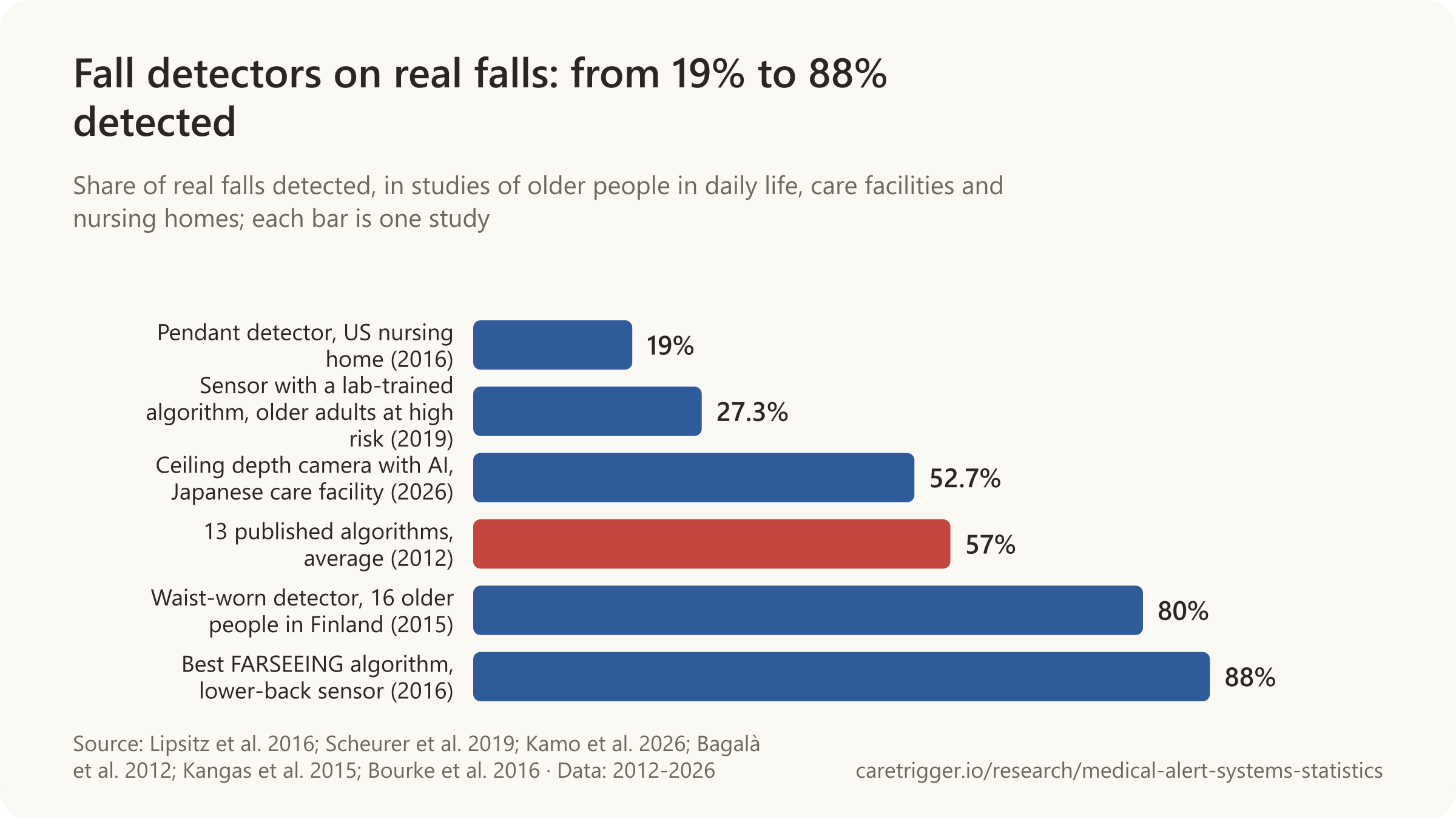
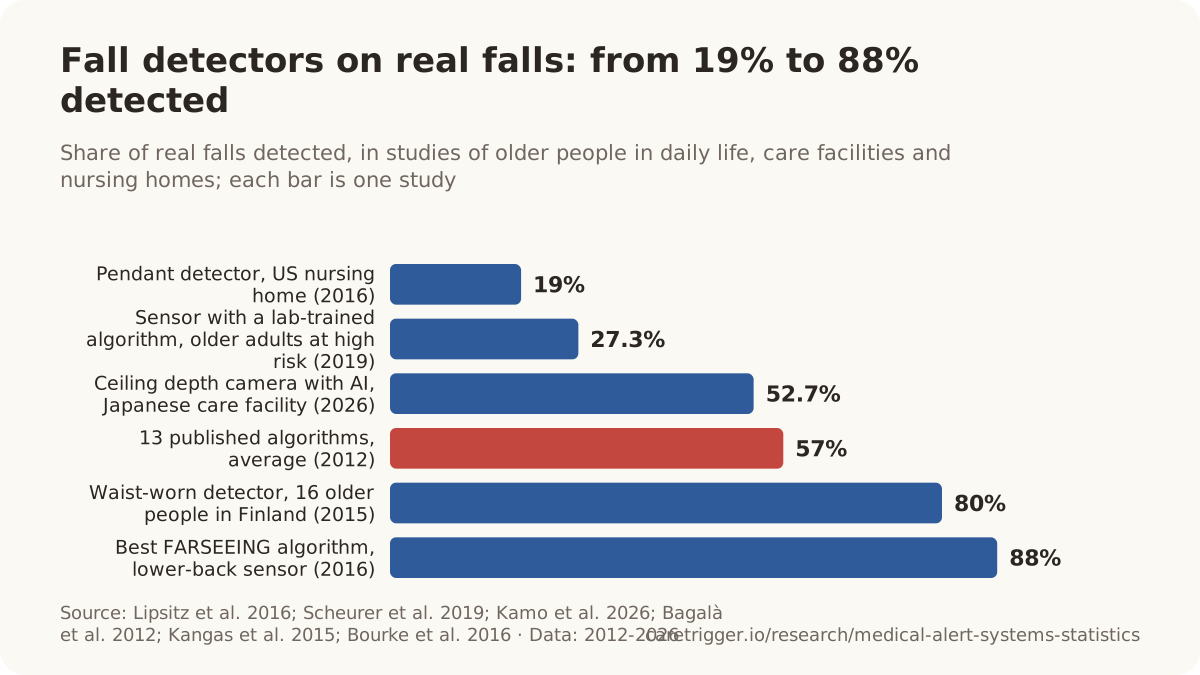
Thirteen published fall-detection algorithms caught on average 57% of real-world falls, against 91% of simulated ones (PLOS ONE, 2012).

- Only 8.6% of fall-detection and fall-prediction studies published from 2005 to 2025 were validated in real life with people 65 and older.
- Of 84 fall alarms in a real-world trial of a wearable detector with older adults, 83 were false (2015).
- 87% of the falls a pendant fall detector reported in a nursing home were false alarms (2016).
- Apple Watch fall detection caught 4.7% of 300 staged falls from a wheelchair by young adults (2022).
- In a home trial of a wearable fall detector, 8 of 12 falls happened while it was not being worn (2015).
Solutions based on inactivity detection, such as CareTrigger, may help cover some of those gaps.
| Device and study | False alarms |
|---|---|
| Commercial medical alert pendant, US subscribers (2020) | 0.36 a month per user |
| Research fall sensor re-tuned on real falls, older adults at high risk (2019) | 0.74 a month per user |
| Commercial wearable detector, older adults at home (2015) | 2.2 a month per device |
| Smartphone prototype, people at high risk of falling, mean age 48 (2021) | 1 every 46 days |
| Waist-worn detector, 16 older people in Finland (2015) | 0.049 an hour of use |
| Machine-learning detector with one accelerometer, older adults (2017) | up to 0.3 an hour |
| Best method tested on 143 real falls in the FARSEEING database (2020) | 0.56 an hour |
Sources: PLOS ONE (2017, 2012); Journal of the American Geriatrics Society (2016, 2015); Sensors (2020, 2019); Frontiers in Neurology; Gerontology; IEEE Engineering in Medicine and Biology Society; Frontiers in Public Health; Assistive Technology; Movement Disorders; Journal of NeuroEngineering and Rehabilitation
More statistics (110)
Thirteen published accelerometer fall-detection algorithms re-tested on 29 real-world falls achieved an average sensitivity of only 57.0% (SD 27.3; best 82.8%).
Fall detectors are tested mostly on falls staged by young volunteers in laboratories. Real falls by older people are hard to record and look different, and the studies that have measured them find lower detection and more false alarms. A detector also misses every fall that happens while it is off the body. No peer-reviewed study has measured how the Apple, Samsung or Google watches do on real falls by older adults; the one Apple Watch study here used staged falls from a wheelchair.
- In a real-world trial of a wearable automatic fall-detection device with community-dwelling older adults, 83 of 84 fall alarms recorded were false alarms.
- Of 128 fall events the automatic fall-detection pendant recorded, 111 (87%) were false positives.
- Apple Watch Series 5 Fall Detection recognised only 14 of 300 intentional falls from a wheelchair by able-bodied young adults (sensitivity 4.7%).
- 8 of 12 falls reported by older adults testing a wearable fall detector at home happened while they were not wearing it, half of them while the device sat in its charger (Chaudhuri et al., Journal of the American Geriatrics Society, 2015).
- Only one genuine fall was automatically detected; three further falls occurred while the device was worn but were not identified as falls.
- A pendant-worn automatic fall-detection device detected 17 of 89 falls recorded by nursing-home staff (sensitivity 19%) over six months.
- Half of the falls that happened while older adults were not wearing their fall detector occurred with the device on its charger, early in the morning or at night (Chaudhuri et al., Journal of the American Geriatrics Society, 2015).
- Two in three falls (8 of 12) reported in a four-month real-world trial of a wearable fall detector happened while the device was not being worn (Chaudhuri et al., Journal of the American Geriatrics Society, 2015; our calculation).
- 94.1% to 94.4% was the sensitivity the maker reported from laboratory testing of the fall detector that, in real homes, detected 1 of 4 falls that happened while it was worn (Chaudhuri et al., Journal of the American Geriatrics Society, 2015).
- 38% of community alarm users given an automatic fall detector did not wear it, even occasionally, during a monitoring period averaging 17 weeks (Brownsell and Hawley, Journal of Telemedicine and Telecare, 2004).
False alarms
- During one day of monitoring three representative fallers, the number of false alarms generated by the 13 fall-detection algorithms ranged from 3 to 85.
- 58 false alarms were recorded over 812 days of use by the participants who completed a four-month real-world trial of a wearable fall detector, while it detected 1 real fall (Chaudhuri et al., Journal of the American Geriatrics Society, 2015).
- 42.2% of the false fall alarms in a four-month real-world trial of a wearable fall detector with older adults happened during normal use of the device (Chaudhuri et al., Journal of the American Geriatrics Society, 2015).
- 16.9% of the false fall alarms in a four-month real-world trial of a wearable fall detector with older adults happened when the wearer dropped the device (Chaudhuri et al., Journal of the American Geriatrics Society, 2015).
- 10.8% of the false fall alarms in a four-month real-world trial of a wearable fall detector with older adults came from device misuse, and another 10.8% from putting the device down (Chaudhuri et al., Journal of the American Geriatrics Society, 2015).
- 19.3% of the false fall alarms in a four-month real-world trial of a wearable fall detector with older adults happened for unknown reasons (Chaudhuri et al., Journal of the American Geriatrics Society, 2015).
- 83.0% was the average specificity of 13 published fall-detection algorithms when re-tested on real-world fall data, with a sensitivity of only 57.0% (Bagalà et al., PLOS ONE, 2012).
- About 2 false alarms an hour would follow from a fall detector with a specificity of 0.96 measured on one-minute windows, a value that looks acceptable as a test statistic (Bagalà et al., PLOS ONE, 2012).
- 62.5% was the pooled specificity of wearable activity trackers for detecting falls in free-living conditions, meaning many false positives, in a 2024 meta-analysis (Singh et al., JMIR mHealth and uHealth, 2024).
- 0.049 false alarms per hour of use were raised by a real-life fall detector worn by 16 older people (Kangas et al., Gerontology, 2015).
- 40 hours of use passed per false fall alarm after the researchers modified the analysis of a real-life fall detector worn by 16 older people (Kangas et al., Gerontology, 2015).
- Up to 0.3 false alarms per hour were raised for individual older adults by a fall-detection system that produced none for young adults (Aziz et al., PLOS ONE, 2017).
- 0.56 false alarms per hour came with the best fall-detection result on 143 real-world falls in the FARSEEING database (Palmerini et al., Sensors, 2020).
- 0.17 false alarms per week per wearer were raised by a re-tuned fall sensor used by high-risk older adults, down from 0.43 (Scheurer et al., Sensors, 2019).
- 46 days passed on average between false alarms from one smartphone fall-detection prototype carried by 23 people at high risk of falling, yet only 37.5% of its alerts were real falls (Harari et al., Journal of NeuroEngineering and Rehabilitation, 2021).
- 4.36 false-positive fall events per person per year were logged by a medical alert service's automatic fall detection among 2,184 subscribers (Silva de Lima et al., Movement Disorders, 2020).
- 45.3% of the fall alerts raised by a depth-camera AI system in a Parkinson's care facility were real falls (positive predictive value), so most alerts were false (Kamo et al., Frontiers in Neurology, 2026).
- All 42 fall alerts raised over 833 hours of monitoring older adults wearing a fall-detection vest were false, as no actual fall occurred; 9 of them reached the caretaker (Bourke et al., IEEE EMBC, 2008).
- 0.36 false fall alarms per subscriber per month (4.36 a year) came from a commercial medical alert pendant's automatic fall detection (Silva de Lima et al., Movement Disorders, 2020; our calculation).
- 0.74 false alarms per wearer per month (0.17 a week) came from a re-tuned research fall sensor used by high-risk older adults (Scheurer et al., Sensors, 2019; our calculation).
- 2.2 false alarms per device per month (58 false alarms over 812 days of use) came from a commercial wearable fall detector used by older adults in a four-month real-world trial (Chaudhuri et al., Journal of the American Geriatrics Society, 2015; our calculation).
- Under 55% of real-world falls were detected by the fall-detection algorithms that raised the fewest false alarms (under 9 a day), showing the trade-off between missed falls and false alarms (Bagalà et al., PLOS ONE, 2012).
In the lab and on real falls

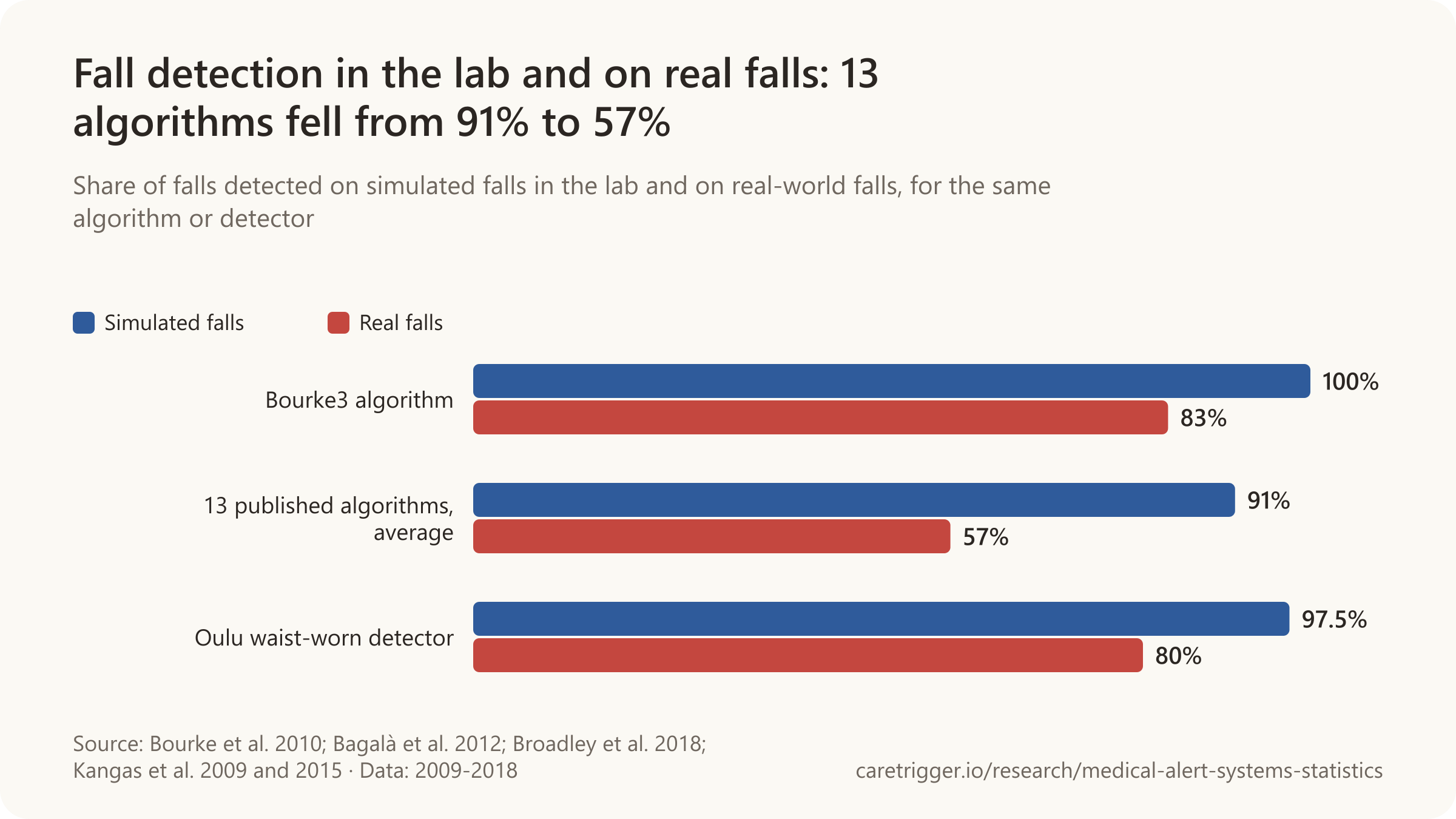
- A threshold-based smartwatch fall-detection app detected 77% of 226 induced falls (specificity 99%) in healthy adults aged 18-52.
- 97.5% was the median sensitivity of trunk-worn fall detectors (median specificity 96.9%) across the studies in a 2014 systematic review, most of them tested on falls simulated by young volunteers (Chaudhuri et al., Journal of Geriatric Physical Therapy, 2014).
- 93.4% was the median sensitivity of fall-detection systems combining several sensors (median specificity 99.8%) in a 2014 systematic review of mostly laboratory-tested projects (Chaudhuri et al., Journal of Geriatric Physical Therapy, 2014).
- 81.5% was the median sensitivity of fall detectors worn on the arm, hand, ear or foot (median specificity 83%), the lowest of the wearable placements in a 2014 systematic review (Chaudhuri et al., Journal of Geriatric Physical Therapy, 2014).
- 93% was the median sensitivity of camera and motion-sensor fall-detection systems (median specificity 98.5%) in a 2014 systematic review, none of them tested with older adults (Chaudhuri et al., Journal of Geriatric Physical Therapy, 2014).
- 95.4% was the median sensitivity and specificity of the 2 floor-sensor fall-detection projects in a 2014 systematic review (Chaudhuri et al., Journal of Geriatric Physical Therapy, 2014).
- 93.1% or more was the average sensitivity of wearable fall detectors reported by 3 systematic reviews in a 2021 umbrella review (specificity 86.4% or more), largely from laboratory testing (Warrington et al., BMC Public Health, 2021).
- 92.5% sensitivity was the best result among commercially available fall detectors tested in a living lab and a hospital, achieved with two Vayyar Home radar units in one room (Hrubý and Černý, Studies in Health Technology and Informatics, 2023).
- 97.9% accuracy was reached by a millimetre-wave radar system detecting falls performed by 10 participants in a large room with several people, though missed falls rose as more people were present (Chen et al., Scientific Reports, 2026).
- 91% sensitivity and 91% specificity were reached by a near-field floor sensor in a test of 650 events performed by 10 people (Rimminen et al., IEEE Transactions on Information Technology in Biomedicine, 2010).
- 87.49% was the average sensitivity of wearable fall-detection sensors across 80 studies in a 2025 systematic review, below non-wearable (89.19%) and hybrid systems (Gorce and Jacquier-Bret, Sensors, 2025).
- 89.19% was the average sensitivity of non-wearable (ambient) fall-detection sensors across 80 studies in a 2025 systematic review (Gorce and Jacquier-Bret, Sensors, 2025).
- 97.6% was the average sensitivity of hybrid fall-detection systems combining worn and ambient sensors, against 87.5% for wearables and 89.2% for ambient sensors, in a 2025 systematic review of 80 studies (Gorce and Jacquier-Bret, Sensors, 2025).
- 97.37% was the best fall-detection sensitivity a wrist sensor reached in a laboratory comparison of six body locations, against 99.96% at the waist (Özdemir, Sensors, 2016).
- 99.96% fall-detection sensitivity was reached with a single waist sensor, the best of six body locations in a laboratory comparison (Özdemir, Sensors, 2016).
Real-world studies
- 81.9% was the pooled sensitivity of consumer and research wearable activity trackers for detecting falls in free-living conditions, in a 2024 meta-analysis of 2 studies (Singh et al., JMIR mHealth and uHealth, 2024).
- 62.5% of real falls were detected (specificity 99.5%) by a stand-alone fall detector worn by patients over 75 on a geriatric ward (Bloch et al., Annals of Physical and Rehabilitation Medicine, 2011).
- 8 of 10 real falls by older adults were detected by a machine-learning fall-detection system using a single waist or sternum accelerometer (Aziz et al., PLOS ONE, 2017).
- Over 80% of 143 real-world falls were detected by the best machine-learning method trained and tested on the FARSEEING repository, at 0.56 false alarms per hour (Palmerini et al., Sensors, 2020).
- 88% of 89 real-world falls were classified correctly (specificity 87%) by the best machine-learning algorithm built on FARSEEING data from a lower-back sensor (Bourke et al., IEEE EMBC, 2016).
- More than 300 real-world falls were recorded with body-worn sensors between 2012 and 2015 for the FARSEEING repository, then the largest collection of its kind (Klenk et al., European Review of Aging and Physical Activity, 2016).
- 208 verified real-world falls were available for analysis in the FARSEEING repository by the end of 2015 (Klenk et al., European Review of Aging and Physical Activity, 2016).
- 27.3% of real falls were detected by a fall sensor whose algorithm had been developed on young people's lab data, when first used by high-risk older adults (Scheurer et al., Sensors, 2019).
- 80.0% of real falls were detected once the same fall sensor's algorithm was re-tuned on real-life data from high-risk older adults, up from 27.3% (Scheurer et al., Sensors, 2019).
- 73.0% of real-life falls (27 of 37) were detected by one smartphone fall-detection prototype carried by 23 people at high risk of falling (mean age 48) over 2,070 days (Harari et al., Journal of NeuroEngineering and Rehabilitation, 2021).
- 31 healthy volunteers, not people with Parkinson's disease, supplied the data on which the validity of the medical alert pendant's fall sensor was based (Silva de Lima et al., Movement Disorders, 2020).
- Over 80% of falls among memory care residents happened in bedrooms, and two-thirds happened overnight between 8 PM and 8 AM (Bayen et al., Journal of Medical Internet Research, 2021).
- 9 of 454 falls used to evaluate an in-home depth-camera fall detector were real resident falls; the other 445 were performed by trained stunt actors, across nine years of data from 13 apartments (Stone and Skubic, IEEE Journal of Biomedical and Health Informatics, 2015).
- 98% of falls were detected, with one false alarm per month, by depth-camera (Kinect) fall detection installed in older adults' apartments in senior housing (Rantz et al., The Gerontologist, 2015).
- Up to 4 false alarms an hour (and at best one every 3 days) came from floor-level Doppler radar fall detection in older adults' apartments, a rate the researchers called unacceptable (Rantz et al., The Gerontologist, 2015).
- 100% detection with fewer than 2 false alarms a day was achieved by ceiling-mounted Doppler radar fall detection when the resident was alone in the apartment (Rantz et al., The Gerontologist, 2015).
- 52.7% of 74 video-confirmed real falls were detected by a ceiling depth-camera AI system in a Parkinson's care facility, rising to 67.6% after a software update (Kamo et al., Frontiers in Neurology, 2026).
- 28.4% of video-confirmed falls appeared in the care facility's routine incident reporting, fewer than the 52.7% caught by a depth-camera AI system (Kamo et al., Frontiers in Neurology, 2026).
- More than 2,000 people contributed sensor data between 2012 and 2015 to build the FARSEEING repository of just over 300 real-world falls (Klenk et al., European Review of Aging and Physical Activity, 2016).
How few studies test real falls
- 8.6% of fall-detection and fall-prediction studies published from 2005 to 2025 were validated in the real world with adults aged 65 or over (21 of 243) (Chen and Yao, Frontiers in Public Health, 2026; our calculation).
- Of 57 wearable fall-detection projects in a systematic review, only 7.1% reported monitoring older adults in a real-world setting.
- About 19% of wearable fall-detection projects in a 2014 systematic review tested their device on older adults in a controlled setting, and 7.1% in real-world settings (Chaudhuri et al., Journal of Geriatric Physical Therapy, 2014).
- 0 of 35 non-wearable fall-detection projects (cameras, motion sensors, microphones, floor sensors) in a 2014 systematic review had used older adults as subjects, in the lab or in real life (Chaudhuri et al., Journal of Geriatric Physical Therapy, 2014).
- About 100,000 days of activity recording (300 person-years) would be needed to capture 100 real-world falls with body-worn sensors (Bagalà et al., PLOS ONE, 2012).
- 22 published studies had evaluated fall-detection technology on real-world data by 2018, and the review called the field 'in its infancy' (Broadley et al., Sensors, 2018).
- 17.5 falls was the median size of the real-world fall datasets used to evaluate fall detectors, in a 2018 scoping review of 22 studies (Broadley et al., Sensors, 2018).
- 9 participants was the median size of the real-world studies that evaluated fall detectors, in a 2018 scoping review of 22 studies (maximum 62) (Broadley et al., Sensors, 2018).
- Less than 7% of fall-detection algorithm studies had used fall data recorded from older people in real life, according to the FARSEEING group (Bourke et al., IEEE EMBC, 2016).
- 60.47% of wearable-sensor fall-detection studies (and 70% of ambient-sensor studies) were evaluated on data their own team had collected, in a 2025 systematic review of 80 studies (Gorce and Jacquier-Bret, Sensors, 2025).
- 21 of 243 fall-detection and fall-prediction studies published from 2005 to 2025 included real-world validation with adults aged 65 or over, in a 2026 scoping review (Chen and Yao, Frontiers in Public Health, 2026).
- More than half of 243 fall-detection and fall-prediction studies relied mainly on laboratory-simulated falls, in a 2026 scoping review (Chen and Yao, Frontiers in Public Health, 2026).
- 0 of 11 real-time camera-based fall-detection systems in a 2026 systematic review had been tested in the real world with older adults; all relied on falls simulated by young volunteers (Nabizade et al., Sensors, 2026).
- More than 500 fall-detection titles were indexed in 2024, up from fewer than 20 in 2004 (Nabizade et al., Sensors, 2026).
- 38 participants made up the largest dataset behind 15 smartphone fall-detection apps in a 2022 review (the smallest had 4), and every recorded fall was performed by young subjects (Stampfler et al., Frontiers in Public Health, 2022).
- Published evidence supporting commercially available fall-detection devices was still lacking, a 2013 FARSEEING systematic review of 96 publications on body-worn fall sensors concluded (Schwickert et al., Zeitschrift für Gerontologie und Geriatrie, 2013).
- 4 falls were all that one research team captured when it monitored 15 adults in real time for 300 days, illustrating how rare real falls are in detector testing (Chaudhuri et al., Journal of Geriatric Physical Therapy, 2014, citing Boyle and Karunanithi, 2008).
What the makers say
- Apple states that Apple Watch cannot detect all falls, and that high-impact activity can trigger Fall Detection in error.
- Apple Watch Fall Detection is turned on automatically for users aged 55 and over (if their age is set up in Medical ID / Health Profile).
- If Apple Watch senses immobility for 60 seconds after a fall notification, it automatically calls emergency services.
- Lifeline (formerly Philips Lifeline) states that its AutoAlert fall detection does not detect 100% of falls and that users should press their button when they need help.
- Google states that Pixel Watch fall detection may not detect all falls and may not be reliable for emergency communications (Google, 2023).
- About 30 seconds without movement after a hard fall triggers a Pixel Watch alarm and check-in, and if there is no answer for about a minute more, the watch tries to call emergency services, according to Google (Google, 2023).
- Several hundred people tested Pixel Watch fall detection for over a year before launch, Google says, to make sure it did not flood emergency services with false alarms (Google, 2023).
- Samsung states that Galaxy Watch cannot detect all falls and that intense physical activity can trigger its fall detection (Samsung Support Australia, 2026).
- 60 seconds without a response after a detected fall makes a Galaxy Watch send an SOS message to the wearer's emergency contacts, according to Samsung (Samsung Support Australia, 2026).
- About a minute of immobility after a hard fall starts a 30-second countdown on Apple Watch before it calls emergency services, according to Apple (Apple Support, 2026).
- 32 g-forces is the upper measuring range of the accelerometer and gyroscope Apple Watch uses, with custom algorithms, to identify hard falls, according to Apple (Apple, 2018).
- Medical Guardian states that its fall detection does not detect 100% of falls and that customers should press the help button if able (Medical Guardian website, accessed 2026-11-11).
- Medical Guardian states that its fall detection must be worn around the neck to detect falls adequately (Medical Guardian website, accessed 2026-11-11).
- Lively states that its Mobile2 fall detection does not detect 100% of falls and that users should push the button when they need help (Lively website, accessed 2026-11-11).
- Lively states that carrying its Mobile2 in a purse or on a belt clip instead of on the neck lanyard will cause real falls to go undetected (Lively website, accessed 2026-11-11).
- Bay Alarm Medical states that there is no such thing as a 100% accurate automatic fall-detection system (Bay Alarm Medical website, accessed 2026-11-11).
- A few seconds is all a Lively Mobile2 wearer has to cancel after the device announces a detected fall, before it automatically calls the Urgent Response centre, according to Lively (Lively website, accessed 2026-11-11).
- Lifeline states that after its pendant detects a fall a trained care specialist contacts the user immediately through the two-way speaker and dispatches help if needed (Lifeline website, accessed 2026-11-11).
Other studies
- 9 of 18 older adults voluntarily left a four-month real-world trial of a wearable fall detector before the end; only 8 completed it (Chaudhuri et al., Journal of the American Geriatrics Society, 2015).
- 80% fewer emergency department visits were recorded in 6 dementia care communities over 3 months after an AI-enabled video fall-detection system was introduced (Xiong et al., American Journal of Managed Care, 2019).
- Fear of falling differed by only 2.8 points on a 0-100 scale between community alarm users given automatic fall detectors and those without, not a significant difference (Brownsell and Hawley, Journal of Telemedicine and Telecare, 2004).
- Over 80% acceptance was reached by fall-detection systems in hospitals and long-term care, but they did not consistently reduce falls or injurious falls, across 20 systems in a 2025 systematic review (Lee et al., Medicina, 2025).
- 28% of care recipients aged 50 and over used fall alert wearables, according to their caregivers in a US online survey (Vollmer Dahlke et al., JMIR Aging, 2021).
- Current evidence does not support wearables for preventing falls, the 2022 World Guidelines for Falls Prevention concluded (conditional recommendation, grade 2C), a separate question from detecting falls (Montero-Odasso et al., Age and Ageing, 2022).
- No robust research evidence supports bed or chair alarms for preventing falls in hospitals, according to the 2022 World Guidelines for Falls Prevention (Montero-Odasso et al., Age and Ageing, 2022).
Numbers we will not publish. "Real-world fall detection is 73% to 98% accurate" is quoted from a medical journal, but its 73% is one smartphone prototype carried by 23 people at high risk of falling, with a mean age of 48, and its 98% a depth camera in older adults' apartments. Detection rates of "99%" and "95%" in medical alert advertising are not from published studies; Medical Guardian's "95%" is a member-satisfaction figure. Every maker on this page says its fall detection does not catch every fall.
Sources: PLOS ONE (2012, 2017); Journal of the American Geriatrics Society (2015, 2016); Assistive Technology; Journal of Telemedicine and Telecare; JMIR mHealth and uHealth; Gerontology; Sensors (2016-2026); Journal of NeuroEngineering and Rehabilitation; Movement Disorders; Frontiers in Neurology; IEEE Engineering in Medicine and Biology Society (2008, 2016); Journal of Biomechanics; Gait & Posture; JMIR Formative Research; Journal of Geriatric Physical Therapy; BMC Public Health; Studies in Health Technology and Informatics; Scientific Reports; IEEE Transactions on Information Technology in Biomedicine; Annals of Physical and Rehabilitation Medicine; European Review of Aging and Physical Activity; Journal of Medical Internet Research; IEEE Journal of Biomedical and Health Informatics; The Gerontologist; Frontiers in Public Health (2022, 2026); Zeitschrift fur Gerontologie und Geriatrie; Apple Inc. (2018, 2026); Lifeline Systems; Google (2023); Samsung Electronics; Medical Guardian LLC; MobileHelp; Lively; Bay Alarm Medical; American Journal of Managed Care; Medicina; JMIR Aging; Age and Ageing
08 / Response
How fast do medical alert companies respond, and who comes?
The UK's telecare quality standard asks monitoring centres to answer 97.5% of alarm calls within 60 seconds and 99% within 180 (TEC Quality).

- Medical Guardian states an average of 10 seconds or less to reach an operator, Bay Alarm Medical typically under 45 seconds: makers' own claims.
- In Bavaria, 18.6% of ambulance calls set off by home alarms ended with a hospital transport, against 71.1% of all ambulance calls (2018).
- In New Zealand, 31% of one provider's medical alarm activations were put through to an emergency ambulance (2024/25).
- 63% of the hours ambulances spent driving with lights and siren to medical alarm calls in one Minnesota system were for cancelled calls (2013-2022).
- A Welsh council's telecare falls responders took 27 minutes 38 seconds on average to reach people who had fallen (2024).
| Service and outcome | Share |
|---|---|
| Victoria (Australia), alarm calls for feeling unwell: ambulance attended | 81% |
| Victoria (Australia), alarm calls for falls: ambulance attended | 44% |
| US, Philips Lifeline fall incidents in a Boston home-care programme: taken to hospital (2011-2015) | 29% |
| Berlin home emergency system, emergencies: hospital stay | 14 of 55 |
| A UK community alarm centre, genuine alarms over six months: ambulance called | 91 of 542 |
| Vale of Glamorgan (Wales), falls attended by council responders: taken to hospital (2024) | 11.2% |
| Wolverhampton (England), non-emergency call-outs answered by fire crews: ambulance needed | about 10% |
| English community alarm with a mobile warden, requests for help: taken to A&E | 8.1% |
| West Wales, telecare response team call-outs: passed to emergency services (2025) | 6% |
A maker's response time measures how long until an operator answers, not how long until help arrives.
Sources: TEC Quality; Prehospital Emergency Care; Medical Guardian; Scandinavian Journal of Trauma, Resuscitation and Emergency Medicine; Hato Hone St John; Vale of Glamorgan Council; Australasian Journal on Ageing; BMC Health Services Research; BMC Geriatrics; Journal of Medical Internet Research; City of Wolverhampton Council; Journal of Accident & Emergency Medicine; Delta Wellbeing
More statistics (53)
97.5% of alarm calls answered within 60 seconds is the 'measure of excellence' set for UK telecare monitoring centres by the TEC Quality standards framework (TEC Quality, accessed 2026).
Two different clocks matter: how long a monitoring centre takes to answer, and how long it takes for someone to arrive. The first is published as a standard in the UK and as makers' claims in the US; the second appears only in a few local services' reports. When help is sent, it is often a relative, a neighbour or a responder rather than an ambulance.
- 10 seconds or less is the average time to reach an operator that Medical Guardian states for its medical alert systems, the maker's own claim (Medical Guardian website, accessed 2026-11-11).
- 99% of alarm calls answered within 180 seconds is the second call-answering target for UK telecare monitoring centres under the TEC Quality standards framework (TEC Quality, accessed 2026).
- As little as 10 seconds is the time MobileHelp states it takes to connect a button press to an operator at its monitoring centre, the maker's own claim (MobileHelp website, accessed 2026-11-11).
- Typically under 45 seconds is the time Bay Alarm Medical states it takes to answer an alert, the maker's own claim (Bay Alarm Medical website, accessed 2026-11-11).
- 13.7 seconds is the average emergency response time LifeStation's website quotes from a reviewer, presented by the maker without its own data (LifeStation website, accessed 2026-11-11).
When an ambulance is sent
- 18.6% of ambulance deployments triggered by home emergency alarms (Hausnotruf) in Bavaria ended with the patient taken to hospital, one of the lowest transport rates of any reason for dispatch (Dax et al., Scandinavian Journal of Trauma, Resuscitation and Emergency Medicine, 2023).
- 31% of St John medical alarm activations in New Zealand in 2024/25 led to the client being put through to emergency ambulance services (derived from Hato Hone St John, Annual Report 2024/25).
- 63% of the 1,734 hours of lights-and-siren driving to medical alarm (PERS) activations in one Minnesota EMS system were spent on calls cancelled before the crew reached a patient (2013-2022) (Boland et al., Prehospital Emergency Care, 2025).
- 2.22% of US medical-alarm subscribers had at least one emergency hospital transport in a 30-day window, among 289,426 Philips Lifeline subscribers (Op den Buijs et al., JMIR Medical Informatics, 2018).
- 1.4% of German home-alarm (Hausnotruf) subscribers had an emergency hospital transport in a 30-day window, against 2.2% of US subscribers of the same kind of service (Op den Buijs et al., JMIR Medical Informatics, 2021).
- 2.5% of all 9-1-1 calls involving adult patients in a large US emergency medical services system were triggered by medical alarms, 18,660 calls over ten years (Boland et al., Prehospital Emergency Care, 2025).
- 8,102 ambulance deployments in Bavaria in 2018 were dispatched for an activated home emergency alarm, and 6,592 of them ended without a hospital transport (Dax et al., Scandinavian Journal of Trauma, Resuscitation and Emergency Medicine, 2023).
- 10.6 minutes was the median time ambulance crews spent on scene at home-alarm deployments that ended without a transport in Bavaria, against 20.8 minutes for all non-transport calls (Dax et al., Scandinavian Journal of Trauma, Resuscitation and Emergency Medicine, 2023).
- 78.6% of 1,156 emergency calls to Singapore's CareLine telephone service for seniors living alone were requests for an ambulance, out of 318,950 calls in seven years (Lim et al., Frontiers in Public Health, 2025).
- About 22,000 of 71,350 St John medical alarm activations in New Zealand in 2024/25 ended with the client put through to emergency ambulance services (Hato Hone St John, Annual Report 2024/25).
- 71.1% of all ambulance deployments in Bavaria in 2018 ended with a transport to hospital, against 18.6% of those triggered by a home emergency alarm (Dax et al., Scandinavian Journal of Trauma, Resuscitation and Emergency Medicine, 2023).
- 36% of ambulance responses to medical alarm (PERS) activations in one Minnesota EMS system made contact with a patient (2013-2022) (Boland et al., Prehospital Emergency Care, 2025).
- 25% of ambulance responses to medical alarm (PERS) activations in one Minnesota EMS system ended with the patient taken to hospital (2013-2022) (Boland et al., Prehospital Emergency Care, 2025).
- 96% of ambulance responses to medical alarm (PERS) activations in one Minnesota EMS system were driven with lights and siren (2013-2022) (Boland et al., Prehospital Emergency Care, 2025).
- 0.9% of 9-1-1 responses to medical alarm (PERS) activations in one Minnesota EMS system ended in a lights-and-siren transport, both before and after the agency stopped sending crews with lights and siren by default (3,262 calls, 2023-2024) (Boland et al., Prehospital Emergency Care, 2026).
- 12% of 9-1-1 responses to medical alarm (PERS) activations in one Minnesota EMS system used lights and siren after a dispatch-priority change, down from 98% before it (2023 vs 2024) (Boland et al., Prehospital Emergency Care, 2026).
Who goes, and what happens next
- 27.6 minutes (27 minutes 38 seconds) was the average response time of the Vale of Glamorgan telecare falls response service, which attended 1,246 falls in the 12 months to August 2024 (Vale of Glamorgan Council, 2024).
- 29% of fall incidents reported through a medical alarm ended in an emergency transport to hospital, among Philips Lifeline users of a Boston home-care programme (Agboola et al., BMC Health Services Research, 2017).
- 44% of fall-related alarm events in Victoria's state-funded Personal Alert Victoria programme were attended by an ambulance, against 81% of events coded as feeling unwell (Andrew et al., Australasian Journal on Ageing, 2021).
- 81% of alarm events coded as feeling unwell in Victoria's Personal Alert Victoria programme were attended by an ambulance (Andrew et al., Australasian Journal on Ageing, 2021).
- 86% of hospital admissions that followed a personal alarm call came after calls coded as feeling unwell rather than falls, in a hospital audit of Personal Alert Victoria clients (Andrew et al., Australasian Journal on Ageing, 2021).
- About one third of ambulance attendances were estimated to be avoided by a triage-based personal alarm service in Victoria, compared with a simulated group calling 000 without an alarm (modelling study; Wang et al., Australian Health Review, 2021).
- A$76.8 per client per year was the estimated ambulance cost saving of a triage-based personal alarm service in Victoria, A$1.41 million a year across 18,421 clients (modelling study; Wang et al., Australian Health Review, 2021).
- 14 of 55 emergencies raised by a Berlin home emergency system led to a hospital stay; most others resolved after a relative or locksmith checked (Zoellick et al., BMC Geriatrics, 2025).
- 91 of 542 genuine alarms to a UK community alarm control centre over 6 months led to an ambulance being called, and 29 to a hospital admission; carers solved most problems (study summarised by Stokke, Journal of Medical Internet Research, 2016).
- 11.2% of 1,246 people who fell at home and were attended by the Vale of Glamorgan telecare service's falls responders were taken to hospital, in the 12 months to August 2024 (Vale of Glamorgan Council, 2024).
- £750,000 in ambulance and NHS costs was estimated to have been avoided in a year by the Vale of Glamorgan's telecare falls response service (council estimate, 12 months to August 2024; Vale of Glamorgan Council, 2024).
- Barely 10% of non-emergency telecare call-outs, mostly minor falls, needed an ambulance once West Midlands Fire Service crews began responding for Wolverhampton's telecare service (City of Wolverhampton Council, 2016).
- 6% of 20,191 call-outs by Delta Wellbeing's telecare response team in west Wales needed escalation to emergency services (Delta Wellbeing, 2025).
- 12 hours a day, 8am to 8pm, 7 days a week, is the community falls response coverage NHS England required of every integrated care board from winter 2022, with telecare (pendant alarm) responder services among the named providers (NHS England, 2022).
- 29.19% of the resources mobilised by Madrid city's home telecare service in 2023 were the regional emergency medical service (SUMMA 112), twice the 2022 number (Ayuntamiento de Madrid, 2024).
- 30.5% of resource mobilisations by Madrid city's home telecare service in 2023 sent its own home support staff, and 7.5% its nurses (Ayuntamiento de Madrid, 2024).
- 14.34% of resource mobilisations by Madrid city's home telecare service in 2023 called on the user's own contacts, such as family or neighbours (Ayuntamiento de Madrid, 2024).
- 12.27% of resource mobilisations by Madrid city's home telecare service in 2023 involved local health centres (Ayuntamiento de Madrid, 2024).
- 28% of the 160 people whose doors Madrid's home telecare service opened with kept keys in 2023 were found needing help; 35% were found without needing any other service (Ayuntamiento de Madrid, 2024).
- 16.6% of 1,353 carers of Madrid home telecare users screened for caregiver overload in 2023 screened positive (Ayuntamiento de Madrid, 2024).
- Over 500 falls were attended in the first six months of the Vale of Glamorgan's round-the-clock falls response for telecare customers, October 2022 to March 2023 (Vale of Glamorgan Council, 2023).
- 25.5 minutes (25 minutes 29 seconds) was the average time from alert to falls responder on scene in the first six months of the Vale of Glamorgan's telecare falls response service (Vale of Glamorgan Council, 2023).
- 440 attendances at A&E were avoided in the first six months of the Vale of Glamorgan's telecare falls response service, by the council's estimate, with an estimated £547,026 saving to the health board (Vale of Glamorgan Council, 2023).
- £662,744 in ambulance and NHS costs was estimated by the Vale of Glamorgan to have been avoided by its telecare falls response from October 2022 to August 2023 (council estimate; Vale of Glamorgan Council, 2023).
- 8.1% of requests for help from community alarm users led to transport to accident and emergency (44 of 542), when a mobile warden worked alongside the alarm control centre (Youssef et al., Journal of Accident & Emergency Medicine, 2000).
- 5.3% of requests for help from community alarm users led to a hospital admission (29 of 542) (Youssef et al., Journal of Accident & Emergency Medicine, 2000).
- 70% of medical alarm incidents involving physical or psychological symptoms ended in emergency transport, against 29% of fall incidents (risk ratio 2.41), among older US home-care patients (2011-2015) (Agboola et al., BMC Health Services Research, 2017).
Real-time fall alerts in care homes
- 29.6 minutes less time on the ground after falls was recorded once staff in 6 California memory care facilities received real-time alerts from video fall detection, compared with the baseline period (observational; Bayen et al., Journal of Medical Internet Research, 2021).
- 31% of fallers in 6 California memory care facilities lay on the floor for over an hour before real-time video fall alerts, and none did once alerts were in place (observational; Bayen et al., Journal of Medical Internet Research, 2021).
- 76.6% of fallers in 6 California memory care facilities got staff help within 10 minutes once real-time video fall alerts were in place (observational; Bayen et al., Journal of Medical Internet Research, 2021).
Other figures
- 2 of 33 studies of personal alarms (6%) looked mainly at how alarm use affects emergency admissions, response time and costs, in a review of the research (Stokke, Journal of Medical Internet Research, 2016).
A number we will not publish. "The average medical alert response time is 15 to 30 seconds" comes from single reviewers' tests of a few calls, not from data across companies. Makers' own figures are shown above as claims.
Sources: TEC Quality; Medical Guardian; MobileHelp; Bay Alarm Medical; LifeStation; Scandinavian Journal of Trauma, Resuscitation and Emergency Medicine; Hato Hone St John; Prehospital Emergency Care (2025, 2026); JMIR Medical Informatics (2018, 2021); Frontiers in Public Health; Vale of Glamorgan Council (2023, 2024); BMC Health Services Research; Australasian Journal on Ageing; Australian Health Review; BMC Geriatrics; Journal of Medical Internet Research (2016, 2021); City of Wolverhampton Council; Delta Wellbeing; NHS England; Ayuntamiento de Madrid; Journal of Accident & Emergency Medicine
09 / Outcomes
Do medical alert systems reduce hospital visits or save lives?
A large English telecare trial found no significant effect: 46.8% went to hospital within a year, against 49.2% on usual care (Age and Ageing, 2013).
- In England's Whole System Demonstrator trial, telecare cost an estimated £297,000 per quality-adjusted life year gained, ten times the usual threshold (2014).
- In England's Whole System Demonstrator trial, 8.7% of telecare users died within a year, against 8.9% on usual care (2013).
- In a trial, 8 of 43 older fallers given a medical alarm returned to emergency within 60 days, the same as without one (2007).
- In a UK trial with people with dementia, 200 of 495 moved into a care home during follow-up, whatever telecare package they had (2021).
- Telecare services in Italian municipalities were associated with 4% lower mortality among older people (2026).
These are trial results and associations for groups of people, not a promise for any one person.
Sources: Age and Ageing (2021, 2014, 2013); Academic Emergency Medicine; Economics & Human Biology
More statistics (40)
46.8% of people given telecare in the Whole System Demonstrator trial were admitted to hospital within 12 months, against 49.2% of those on usual care, a difference that was not statistically significant (Steventon et al., Age and Ageing, 2013).
Few trials have tested whether alarms and telecare change what happens to people. The largest, England's Whole System Demonstrator, compared second-generation telecare (a base unit, a pendant and sensors) with usual care, which could include a basic pendant alarm; smaller trials looked at older fallers and at people with dementia. Other studies compare people before and after they got an alarm, or areas with and without a service, and show associations, not effects.

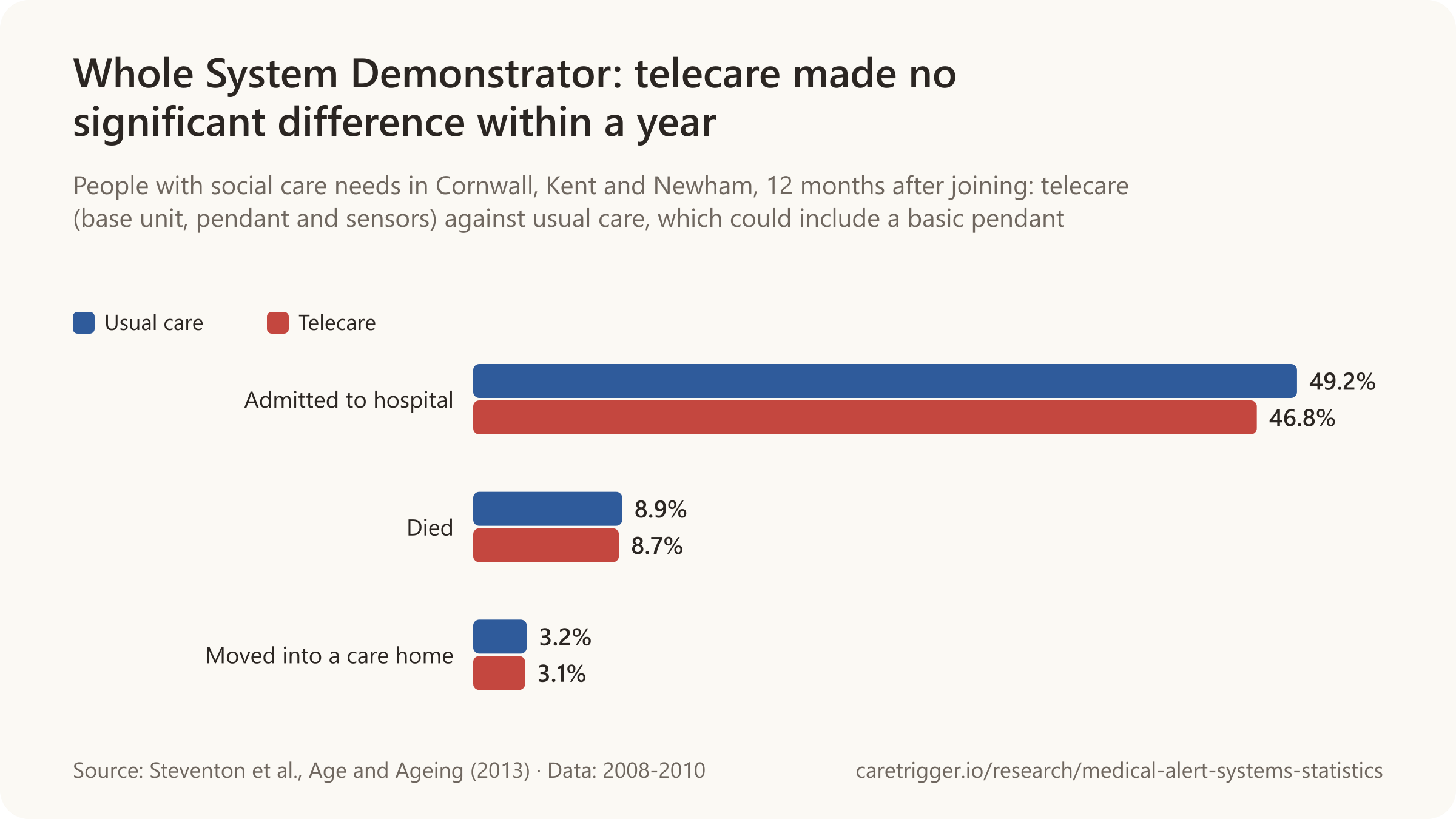
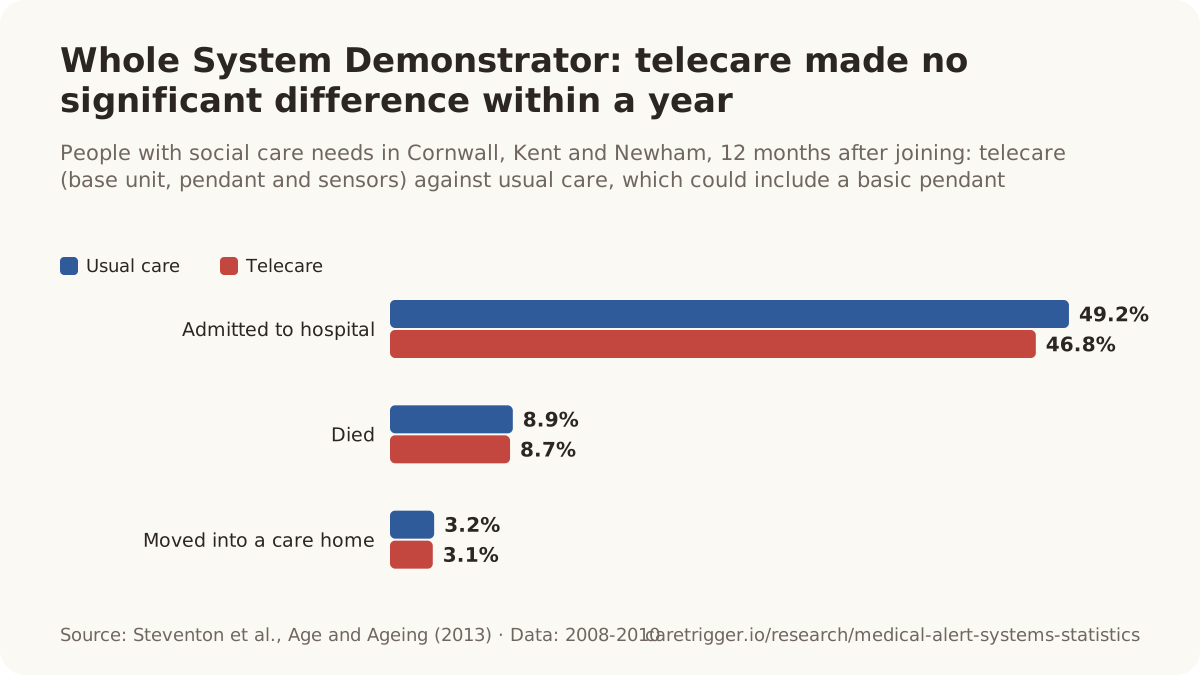
- £297,000 per quality-adjusted life year gained was the cost-effectiveness ratio of telecare in the Whole System Demonstrator trial, ten times the £30,000 threshold usually accepted in England (Henderson et al., Age and Ageing, 2014).
- 8.7% of people given telecare in the Whole System Demonstrator trial died within 12 months, against 8.9% of those on usual care, a difference that was not statistically significant (Steventon et al., Age and Ageing, 2013).
- 0.14 hospital admissions for falls per person were recorded in the telecare group of the Whole System Demonstrator trial over 12 months, against 0.11 in the usual-care group, a difference that was not statistically significant (Steventon et al., Age and Ageing, 2013).
- 22.8% of people in the telecare arm of the Whole System Demonstrator trial received a falls detector; participants received 4.2 extra devices on average (Steventon et al., Age and Ageing, 2013).
- 2,600 people with social care needs took part in the Whole System Demonstrator telecare trial, recruited from 217 general practices in Cornwall, Kent and Newham; its authors said no randomised study of telecare existed on a comparable scale (Steventon et al., Age and Ageing, 2013).
- 16% was the probability that the Whole System Demonstrator's telecare package was cost-effective at the usual £30,000 per QALY threshold (Henderson et al., Age and Ageing, 2014).
- £791 a year was the cost of the telecare equipment and support package per person in the Whole System Demonstrator trial, about 9% of total health and social care costs per person (Henderson et al., Age and Ageing, 2014).
- £161,000 per quality-adjusted life year was the most favourable cost-effectiveness ratio for Whole System Demonstrator telecare, assuming half-price equipment and cheaper support (Henderson et al., Age and Ageing, 2014).
- 43.69 against 40.52: adjusted SF-12 mental health scores of telecare users and usual-care participants at the end of the Whole System Demonstrator's year of follow-up, a small statistically significant difference in favour of telecare (Hirani et al., Age and Ageing, 2014).
- 0.65 emergency hospital admissions per person were recorded in the telecare group of the Whole System Demonstrator trial over 12 months, against 0.57 in the usual-care group, a difference that was not statistically significant (Steventon et al., Age and Ageing, 2013).
Other trials
- 8 of 43 older fallers given a medical alarm after an emergency department visit returned to the emergency department within 60 days, exactly as many as in the group without one (randomised trial; Lee et al., Academic Emergency Medicine, 2007).
- 200 of 495 people with dementia in the ATTILA telecare trial moved into a care home during follow-up and 89 died at home, whatever the telecare package they had (Howard et al., Age and Ageing, 2021).
- 0.84 was the hazard ratio for moving into residential care among people with dementia given a full telecare package rather than a basic pendant-alarm package, a difference that was not statistically significant (ATTILA trial; Gathercole et al., Health Technology Assessment, 2021).
- No difference in carers' burden, anxiety or depression was found over 6 months between carers of people with dementia given a full telecare package and those given a basic pendant-alarm package (ATTILA; Davies et al., Alzheimer's & Dementia: TRCI, 2020).
- 15% fewer emergency encounters, not statistically significant, was the primary result of a trial adding alarm-data risk prediction and nurse follow-up for 370 older medical-alarm users (Golas et al., npj Digital Medicine, 2021).
- 49% fewer ambulance (EMS) encounters were recorded among older medical-alarm users whose alarm data fed a risk-prediction and nurse follow-up programme, against usual care (secondary outcome of a randomised trial; Golas et al., npj Digital Medicine, 2021).
- 20% lower annual health care costs per patient were recorded in older medical-alarm users given alarm-data risk prediction and tailored nurse interventions, against usual care ($14.2K vs $17.7K; randomised trial; Nikolova-Simons et al., npj Digital Medicine, 2021).
- 3 of 43 older fallers given a medical alarm were admitted to hospital within 60 days, against 6 of 43 without one, a difference that was not statistically significant (randomised trial; Lee et al., Academic Emergency Medicine, 2007).
- +0.35 points on an anxiety scale was the difference a month after randomisation between older fallers given a medical alarm and those without one, no important difference in anxiety or fear of falling (Lee et al., Academic Emergency Medicine, 2007).
- 41 people with dementia given a full telecare package died while still living at home, against 48 given a basic pendant-alarm package, a difference that was not statistically significant (ATTILA trial; Howard et al., Age and Ageing, 2021).
Before-and-after and area studies
- 4% lower elderly mortality was associated with telecare services in Italian municipalities, relative to the average rate in those municipalities (Matteucci et al., Economics & Human Biology, 2026).
- In a 12-month prospective cohort of 295 community-dwelling older adults, outcomes after an emergency were similar for personal-alarm purchasers and non-purchasers, with no difference in time spent on the floor or hospitalisations.
- 40 of 88 frail older people living alone in Italy who had a health emergency (mostly falls) in the previous three years said they used a mobile phone to call for help, while only 3 reported using a remote alarm (IN-AGE study, 2019 interviews; Melchiorre et al., International Journal of Environmental Research and Public Health, 2022).
- Only one of the 367 people found helpless or dead at home in the San Francisco study possessed a commercially available device to summon help (Gurley et al., NEJM, 1996).
- Deaths among people aged 65 and over were 1.7 per 1,000 lower, about 4% of their mortality rate, where Italian municipalities introduced telecare services (an association, from a difference-in-differences study; Matteucci et al., Economics & Human Biology, 2026).
- 1.23 was the rate ratio for hospital stays among Berliners aged 75+ given a home emergency system with fall-detecting pendant, motion sensors and social service, against matched controls, a difference that was not statistically significant (Zoellick et al., BMC Geriatrics, 2025).
- 1.0 emergency hospital admissions a year per person were recorded after telecare was installed in Northern Ireland, against 0.5 a year before, reflecting rising needs rather than an effect of telecare (before-and-after cohort; Al-Obaidi et al., JMIR Formative Research, 2022).
- 106 subscribers to a 24-hour medical alarm service in Texas had significantly fewer hospital admissions and inpatient days in the year after enrolling than in the year before, with no change in emergency visits (uncontrolled before-and-after study; Roush et al., Southern Medical Journal, 1995).
- 16% of older people given night light paths plus a medical alarm had functional decline after a year, against 43% of those without, in a French cohort (observational; Lachal et al., SAGE Open Medicine, 2016).
- Twice as often: older people with a medical alarm used emergency departments twice as often as those without, in a survey of 267 older people (Roush and Teasdale 2011, as summarised by Stokke, Journal of Medical Internet Research, 2016).
- 8,700 admissions to hospital as emergencies were estimated to have been avoided by Scotland's Telecare Development Programme in 2006-2011, which brought telecare to about 44,000 people (programme evaluation estimates; Scottish Government, 2012).
- Over 3,800 admissions to care homes were estimated to have been avoided by Scotland's Telecare Development Programme in 2006-2011 (programme evaluation estimates; Scottish Government, 2012).
- 2,500 hospital discharges were estimated to have been speeded up by Scotland's Telecare Development Programme in 2006-2011 (programme evaluation estimates; Scottish Government, 2012).
- £78.6 million was the estimated gross value of efficiencies from Scotland's 2006-2011 telecare programme, at 2011 prices, a figure that counts care and bed days avoided rather than cash saved (Scottish Government, 2018).
Other studies
- 4.6% against 8.3%: the 12-month death rates of patients given telehealth (remote vital-sign monitoring for diabetes, COPD or heart failure) and of their controls in the Whole System Demonstrator, a result often wrongly credited to telecare alarms (Steventon et al., BMJ, 2012).
- 14.2% of hospital stays among older medical-alarm users of a Boston home-care programme were followed by a readmission within 30 days, 34.4% within 90 days and 42.2% within 180 days (Agboola et al., BMC Health Services Research, 2017).
- 43.8% of telecare users in Northern Ireland had a falls detector, the most common sensor installed (Al-Obaidi et al., JMIR Formative Research, 2022).
- 97.6% of falls among memory-care residents with dementia left the person unable to stand up alone, although only 8.1% were moderate or severe (Bayen et al., Journal of Medical Internet Research, 2021).
- 68 randomised trials and 30 observational studies of home telecare were reviewed, and the evidence on home safety and security alert systems was judged insufficient (Barlow et al., Journal of Telemedicine and Telecare, 2007).
Numbers we will not publish. "Medical alert systems cut hospital use by 59% and deaths fourfold" goes back to a 2000 trade article by an employee of an alarm company, not a study we could verify. The large drop in deaths often credited to the Whole System Demonstrator came from its telehealth arm (remote checks of vital signs for diabetes, lung disease or heart failure), not from telecare. Scotland's estimates of admissions avoided by its telecare programme are the programme's own calculations, not a comparison with people who went without.
Sources: Age and Ageing (2013, 2014, 2021); Academic Emergency Medicine; Health Technology Assessment; Alzheimer's & Dementia: Translational Research & Clinical Interventions; npj Digital Medicine (2021); Economics & Human Biology; Home Health Care Services Quarterly; International Journal of Environmental Research and Public Health; New England Journal of Medicine; BMC Geriatrics; JMIR Formative Research; Southern Medical Journal; SAGE Open Medicine; Journal of Medical Internet Research (2016, 2021); Scottish Government, COSLA and NHS Scotland; Scottish Government; BMJ; BMC Health Services Research; Journal of Telemedicine and Telecare
10 / Cost
How much does a medical alert system cost?
In-home medical alert systems from 10 US brands had advertised starting prices of $23.78 to $39.99 a month in November 2026 (brands' websites).

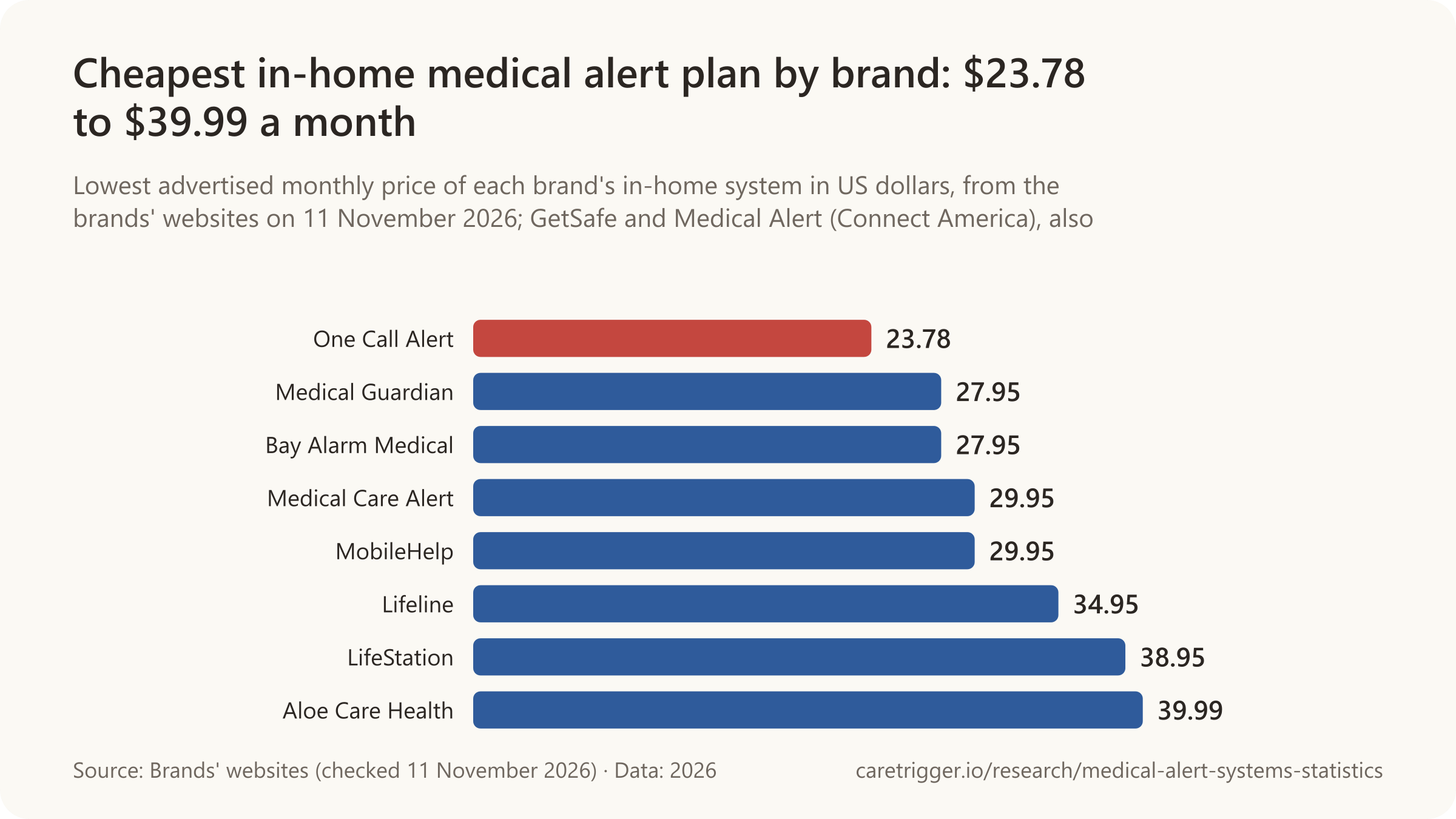
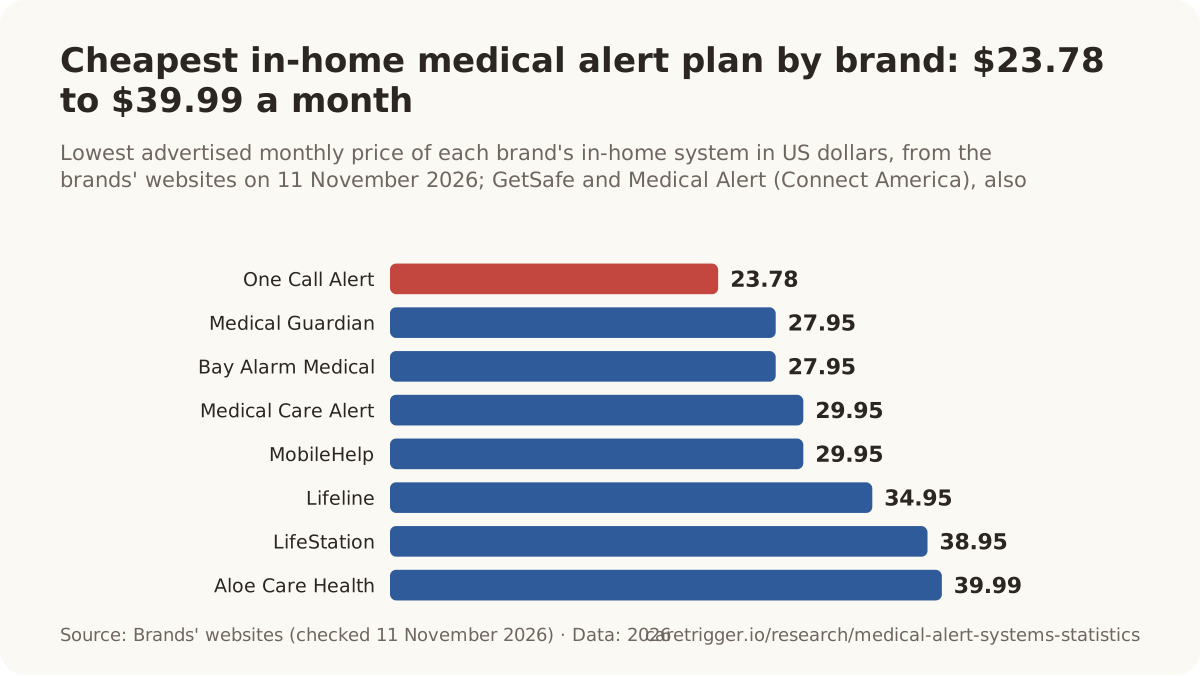
- Automatic fall detection added $7.95 to $15 a month to the plans of seven US brands in November 2026.
- Mobile medical alerts and alert watches from 11 US brands started at $24.99 to $84.95 a month (November 2026).
- In Ireland, the national alarm scheme charges about €70 a year for monitoring after a free first year.
- Swedish municipalities charged from nothing to 573 kronor a month for a safety alarm in 2024.
- UK councils we checked charged £3.24 to £9.99 a week for a community alarm in 2025 and 2026.
| Programme | Rate |
|---|---|
| Washington, WA Cares long-term care benefit (maximum) | $85 a month |
| Iowa Medicaid home- and community-based services (upper limit) | $45.48 a month |
| Illinois Community Care Program, with fall detection | $37 a month |
| Virginia Medicaid, Northern Virginia | $35.05 a month |
| Illinois Community Care Program, basic | $28 a month |
There are also phone apps, such as CareTrigger, that provide a basic layer of safety for free.
Sources: CareTrigger (2026a, 2026b, 2026c); One Call Alert; Medical Guardian; Bay Alarm Medical; Medical Care Alert; MobileHelp; Lifeline; LifeStation; Aloe Care Health; Citizens Information Board; SKPF Pensionärerna; Fife Council; WA Cares Fund; Iowa Department of Health and Human Services; Illinois Department on Aging; Virginia Department of Medical Assistance Services
More statistics (117)
$23.78 to $39.99 a month: the range of advertised starting prices for in-home medical alert systems across 10 US brands whose websites we checked on 11 November 2026 (our compilation).
US prices below are what each brand advertised on its own website on the date shown; most add a device or setup fee, and fall detection usually costs extra. Life Alert publishes no prices. Public schemes abroad charge far less, or nothing, and in the US some Medicaid programmes and state benefits pay for a device.
United States: in-home systems
- Medical Guardian's MGHome Landline in-home system costs from $27.95 a month (base unit on a phone line or modem, help button; fall detection extra $10 a month), as listed on its website on 11 November 2026.
- Medical Guardian's MGHome Cellular in-home system costs from $34.95 a month (cellular base unit, help button; fall detection extra $10 a month), as listed on its website on 11 November 2026.
- Bay Alarm Medical's SOS Home landline in-home system costs $27.95 a month (base console leased free and returned on cancellation; fall detection available), as listed on its website on 11 November 2026.
- Bay Alarm Medical's SOS Home cellular in-home system costs $34.95 a month (base console leased free), as listed on its website on 11 November 2026.
- LifeStation's Sidekick Home in-home system costs from $38.95 a month (equipment use included; fall detection extra $7.95 a month), as listed on its website on 11 November 2026.
- Aloe Care Health's Essentials in-home plan costs $39.99 a month plus a one-time $199.99 hardware cost (voice-activated 4G hub and care button), as listed on its website on 11 November 2026.
- Lifeline's HomeSafe cellular in-home system costs from $34.95 a month on an annual plan (fall detection extra $15 a month; setup fee $99.95), as listed on its website on 11 November 2026.
- Medical Care Alert's HOME in-home system costs $29.95 a month (no equipment cost or activation fee; fall-detection pendant extra $10 a month), as listed on its website on 11 November 2026.
- Medical Care Alert's HOME Assure 4G cellular in-home system costs $34.95 a month, as listed on its website on 11 November 2026.
- Medical Care Alert states that it charges no equipment cost or activation fee and requires no long-term contract, as listed on its website on 11 November 2026.
- GetSafe's wall-button home system costs $29.95 a month for monitoring plus equipment listed at $79 to $307 depending on home size (on sale at half price), as listed on its website on 11 November 2026.
- MobileHelp's classic cellular in-home system costs from $29.95 a month, as listed on its website on 11 November 2026.
- Medical Alert (Connect America) says its systems start at $29.95 a month, as listed on its website on 11 November 2026.
- One Call Alert's Wired Home and Classic in-home systems cost from $23.78 a month and its Elite mobile device from $37.95 a month, as listed on its website on 11 November 2026.
- Life Alert publishes no prices on its website: its cost page asks visitors to call for a free quote (checked 11 November 2026).
United States: mobile devices and watches
- $24.99 to $84.95 a month: the range of advertised starting prices for mobile GPS medical alert devices and alert watches across 11 US brands whose websites we checked on 11 November 2026, often plus a device fee of up to $299 (our compilation).
- Medical Guardian's Guardian Flex mobile GPS device costs $39.95 a month on an annual plan (device listed at $149.95, on sale for $37.49), as listed on its website on 11 November 2026.
- Medical Guardian lists its Guardian Flex mobile device at $149.95 (on sale for $37.49), on top of the monthly fee, on its website on 11 November 2026.
- Medical Guardian's MGMove medical alert smartwatch costs from $44.95 a month (GPS watch; fall detection is an add-on), as listed on its website on 11 November 2026.
- Bay Alarm Medical's SOS All-In-One 2 mobile GPS device costs $34.95 a month plus a device purchase listed at $149 (on sale for $89.40); with fall detection it is $44.95 a month, as listed on its website on 11 November 2026.
- Bay Alarm Medical's SOS Micro mobile device costs $34.95 a month and requires a device purchase listed at $149 (on sale for $104.30), as listed on its website on 11 November 2026.
- Bay Alarm Medical's SOS Smartwatch costs $39.95 a month plus a watch purchase listed at $199 (on sale for $159.20); with fall detection it is $49.95 a month, as listed on its website on 11 November 2026.
- LifeStation's Pearl mobile GPS pendant and Sidekick Smart watch cost from $42.95 a month, as listed on its website on 11 November 2026.
- Aloe Care Health's Mobile Companion 2 plan costs $44.99 a month with fall detection included, plus a one-time $149.99 hardware cost, as listed on its website on 11 November 2026.
- Lifeline's On the Go mobile GPS pendant costs from $39.95 a month on an annual plan, as listed on its website on 11 November 2026.
- Lifeline's On the Go Mini mobile device costs from $44.95 a month on an annual plan, as listed on its website on 11 November 2026.
- Lifeline's Smartwatch costs from $34.95 a month on an annual plan, as listed on its website on 11 November 2026.
- Medical Care Alert's HOME & AWAY FLEX mobile GPS system costs $39.95 a month (fall detection extra $10 a month), as listed on its website on 11 November 2026.
- UnaliWear's Kanega watch costs $84.95 a month on a monthly plan (list price $99.95) or $779.40 a year, plus $299 for the watch, as listed on its website on 11 November 2026.
- MobileHelp's Elite mobile GPS device costs from $37.95 a month, as listed on its website on 11 November 2026.
- Lively's Basic medical alert plan for the Lively Mobile2 costs $24.99 a month and its Premium plan $34.99 a month, including a $5 paperless-billing discount and before taxes and fees, as listed on its website on 11 November 2026.
- Lively lists its Mobile2 medical alert device at $119.99 (on sale for $89.99), plus a service plan, on its website on 11 November 2026.
- Lively states that its Mobile2 medical alert device is FSA and HSA eligible, on its website on 11 November 2026.
- Life Protect 24/7's mobile monitoring unit costs $59.99 a month with equipment included, as listed on its website on 11 November 2026.
- Amazon's Alexa Emergency Assist (voice-activated 24/7 urgent-response agents via Echo devices) costs $5.99 a month or $59 a year, as listed on its website on 11 November 2026.
- Apple uses a $399 purchase price for the Apple Watch Series 12 (42mm) in its financing example; Apple Watch fall detection calls emergency services directly with no monitoring subscription, as listed on its website on 11 November 2026.
United States: fall detection and fees
- $7.95 to $15 a month: what automatic fall detection added to a medical alert plan across 7 US brands whose websites we checked on 11 November 2026 (our compilation).
- Medical Guardian's fall-detection pendant for its MGHome systems costs an extra $10 a month, as listed on its website on 11 November 2026.
- Bay Alarm Medical's SOS Home cellular system with fall detection costs $44.95 a month plus a $30 device fee for the fall-detection button, as listed on its website on 11 November 2026.
- LifeStation's fall detection costs an extra $7.95 a month, as listed on its website on 11 November 2026.
- LifeStation's Sidekick Home costs $54.85 a month on its top 'Supreme' service level (monitoring plus fall detection and device coverage), against $38.95 for monitoring only, as listed on its website on 11 November 2026.
- Aloe Care Health's Essentials Plus plan (in-home hub plus mobile device) costs $59.99 a month plus a one-time $349.99 hardware cost, as listed on its website on 11 November 2026.
- Lifeline's fall detection (AutoAlert) costs an extra $15 a month on any Lifeline plan, as listed on its website on 11 November 2026.
- Lifeline charges a setup fee of $99.95 (a $50 activation fee plus a $49.95 programming fee, our sum), as listed on its website on 11 November 2026.
- Medical Care Alert's fall-detection pendant costs an extra $10 a month, as listed on its website on 11 November 2026.
- Lively's fall detection for the Mobile2 costs an extra $9.99 a month, as listed on its website on 11 November 2026.
US public programmes
- $45.48 a month is the most Iowa Medicaid's home and community-based waivers pay for a personal emergency response system, plus a one-time $58.48 installation fee, for providers with no rate in effect on 30 June 2024 (Iowa HHS, 2026).
- $35.05 a month is what Virginia Medicaid pays for personal emergency response system monitoring in Northern Virginia ($29.70 in the rest of the state), with installation paid at $58.41 and $49.50 (Virginia DMAS, rates from 1 July 2026).
- $58.41 is what Virginia Medicaid pays once for personal emergency response system installation in Northern Virginia ($49.50 elsewhere) (Virginia DMAS, rates from 1 July 2026).
- $28 a month is what Illinois's Community Care Program pays for emergency home response monitoring (basic or GPS), with $37 for monitoring with fall detection and $40 for installation (Illinois Department on Aging, fee schedule from 1 January 2026).
- $37 a month is what Illinois's Community Care Program pays for emergency home response monitoring with fall detection, $9 more than basic monitoring (Illinois Department on Aging, fee schedule from 1 January 2026).
- $85 a month is the most Washington's WA Cares long-term care benefit pays for a personal emergency response system, including add-ons such as a fall detector, plus up to $103 for installation (WA Cares Fund, 2026).
United Kingdom
- £3.24 a week was Fife Council's charge for a community alarm in 2025-26 (Fife Cabinet Committee papers, April 2026).
- £3.40 a week (£176.80 a year) is Fife's community alarm charge from April 2026 under a proposed 5% rise (Fife Cabinet Committee papers, April 2026).
- 38% of the cost of Fife's community alarm service is subsidised, about £546,365 a year, because the weekly charge does not cover it (Fife Cabinet Committee papers, April 2026).
- £5.47 a week (£284.44 a year) is what a community alarm would cost in Fife if the charge covered the full cost of the service (Fife Cabinet Committee papers, April 2026).
- 7,766 community alarms were in people's homes in Fife in 2025-26, up from 7,481 in 2024-25, excluding sheltered housing (Fife Cabinet Committee papers, April 2026).
- 4,575 alarm call-outs were answered by Fife's mobile emergency care response team from 1 January to 20 March 2026, up from 3,553 in the same weeks of 2025 (Fife Cabinet Committee papers, April 2026).
- £72.61 a quarter is Carmarthenshire County Council's flat charge for Lifeline monitoring with a pendant (Carmarthenshire County Council, checked November 2026).
- £100 a week is the most anyone in Wales can be asked to pay for assessed non-residential social care (Carmarthenshire County Council, 2025/26).
- LifeConnect24's UK personal alarm with fall detection costs from £30 a month (£36 crossed out; £360 for 12 months), as listed on its website on 11 November 2026.
- Careline sells its UK home alarm, GPS watch and GPS pendant for £99 one-off plus monitoring 'from less than £1 a day', as listed on its website on 11 November 2026.
| Council | Charge | Scope |
|---|---|---|
| Fife (2025-26) | £3.24 a week | people who self-fund a council community alarm / telecare service · UK (Scotland: Fife Council) · 2025-26 |
| Moray (2025-26) | £48 a quarter (about £4 a week) | people who self-fund a council community alarm / telecare service · UK (Scotland: Moray Council) · 2025/26 |
| Birmingham (installation and monitoring included) | £5.01 a week | people who self-fund a council community alarm / telecare service · UK (England: Birmingham City Council) · page last updated 2026-06-11 |
| Barnsley (alarm unit; £3.46 with the user's own mobile phone) | £5.03 a week | people who self-fund a council community alarm / telecare service · UK (England: Barnsley Council) · current at 2026-11-11 |
| Crawley (from April 2026; fall detector £2.40 extra) | £5.39 a week | people who self-fund a council community alarm / telecare service · UK (England: Crawley Borough Council) · from April 2026 |
| Wrexham (2026-27; £25 installation) | £5.65 a week | people who self-fund a council community alarm / telecare service · UK (Wales: Wrexham County Borough Council) · 2026-27 |
| Gwynedd (2026-27) | £5.74 a week | people who self-fund a council community alarm / telecare service · UK (Wales: Gwynedd Council) · 2026/27 |
| East Lothian (from April 2026) | £5.80 a week | people who self-fund a council community alarm / telecare service · UK (Scotland: East Lothian Council) · from April 2026 |
| Redbridge (£19.99 installation) | £6.50 a week | people who self-fund a council community alarm / telecare service · UK (England: London Borough of Redbridge) · current at 2026-11-11 |
| North Ayrshire (mainland, 2026-27; islands £3.60) | £7.19 a week | people who self-fund a council community alarm / telecare service · UK (Scotland: North Ayrshire HSCP) · 2026-27 |
| West Dunbartonshire | £8.95 a week | people who self-fund a council community alarm / telecare service · UK (Scotland: West Dunbartonshire Council) · current at 2026-11-11 (year not stated) |
| Leeds (with mobile response; £27 first-year set-up) | £9.99 a week | people who self-fund a council community alarm / telecare service · UK (England: Leeds City Council) · current at 2026-11-11 |
Other countries
- About €70 a year is the monitoring fee Seniors Alert Scheme users in Ireland pay after the first free year (Citizens Information, Ireland).
- Swedish municipalities' safety-alarm fees ranged from nothing to 573 kronor a month in 2024, with a mean and median of about 300 kronor (SKPF Pensionärerna survey of 280 municipalities, 2024).
- 1 year of free monitoring, with free alarm equipment and installation, is what Ireland's Seniors Alert Scheme gives people aged 65 and over with limited means (Citizens Information, Ireland).
- Over 80, Andalusia's public teleassistance (personal alarm) service is free for everyone, whatever their income (Junta de Andalucía).
- 50% of what French households pay for a personal alarm (téléassistance) service comes back as an income-tax credit, even when it is the only home service they buy (Service-Public.fr, 2026).
- The standard spending ceiling for France's tax credit on home services, which covers téléassistance, is €12,000 a year (Service-Public.fr, 2026).
- Malteser's basic home emergency call package (Hausnotruf Grundsicherheit) costs €27.00 a month with no one-off service fee, as listed on its website on 11 November 2026.
- €27.00 a month is what German long-term care insurers can cover for a home emergency call system for anyone with care grade 1 or higher, according to provider Malteser (2026).
- No statutory co-payment applies when German care insurer AOK PLUS pays for a home emergency call system for a member with a care grade who lives alone and cannot use an ordinary phone (AOK PLUS, 2024).
- 321 kroner a month is Oslo's 2026 safety-alarm charge for households with income above three times the national insurance base amount; lower-income households pay nothing a month (Oslo kommune).
- Over 75, everyone in Oslo has the right to an indoor safety alarm if they want one (Oslo kommune, 2026).
- Norwegian municipalities may not charge for a safety alarm that replaces services residents should get free, such as necessary supervision, the county governor for Oslo and Akershus advised in September 2026 (Statsforvalteren, 2026).
- 177 kronor a month is Stockholm's charge for a safety alarm, with no extra charge for people who also get home care (Stockholms stad, 2026).
- 268 kronor a month is Lidingö's charge for a safety alarm or meal delivery at its lowest fee level (Lidingö stad, checked November 2026).
- About 30% of Swedish municipalities (at least 84) also charged a one-off installation fee for a safety alarm in 2024, of 111 to 1,433 kronor (SKPF Pensionärerna survey, 2024).
- NZ$19.14 a week is VitalCall (Chubb New Zealand)'s price for one MSD-accredited in-home medical alarm in New Zealand (Work and Income, Ministry of Social Development, 2026).
- NZ$16.39 a week is Freedom Medical Alarms' price for one MSD-accredited in-home medical alarm in New Zealand (Work and Income, Ministry of Social Development, 2026).
- NZ$17.27 a week is St John Medical Alarms' price for one MSD-accredited in-home medical alarm in New Zealand (Work and Income, Ministry of Social Development, 2026).
- NZ$26.50 a week is ADT Security's price for one MSD-accredited anywhere (mobile) medical alarm in New Zealand (Work and Income, Ministry of Social Development, 2026).
- NZ$27.65 a week is VitalCall (Chubb New Zealand)'s price for one MSD-accredited anywhere (mobile) medical alarm in New Zealand (Work and Income, Ministry of Social Development, 2026).
- NZ$28.99 a week is Freedom Medical Alarms' price for one MSD-accredited anywhere (mobile) medical alarm in New Zealand (Work and Income, Ministry of Social Development, 2026).
- Free of charge: Victoria's Personal Alert Victoria service provides a monitored personal alarm to eligible frail, isolated older people and people with disabilities (Better Health Channel, Victorian Government, 2026).
- 6 months is the look-back for one qualifying criterion for Victoria's free Personal Alert Victoria alarm: a fall that needed medical attention, alongside other criteria (Victorian Department of Health).
- 65 and over: the age from which Hong Kong Housing Society pays its tenants' monthly emergency alarm (careline) charge, while the Social Welfare Department subsidises the service for social security (CSSA) recipients (Hong Kong Housing Society, 2023).
- €229 was the average cost to Ireland's Seniors Alert Scheme of a mobile-network (GSM) alarm unit, against €179 for a landline unit, with monitoring averaging €53 (Department of Rural and Community Development, 2021).
- NZ$16.22 to NZ$19.14 a week is what New Zealand's four government-accredited suppliers charge for an in-home medical alarm, prices the Ministry of Social Development can help pay through the Disability Allowance (Work and Income, 2026).
- NZ$25.57 to NZ$28.99 a week is what New Zealand's four government-accredited suppliers charge for an 'anywhere' (mobile) medical alarm that also works outside the home (Work and Income, 2026).
- NZ$82.85 a week is the most New Zealand's Disability Allowance pays toward disability costs such as a medical alarm, for people on low incomes whose doctor confirms they need one (Work and Income, 2026).
- C$480 a year is the most Nova Scotia's Personal Alert Assistance Program pays toward a personal alert device for eligible low-income seniors, one of the few provincial alarm subsidies in Canada (Government of Nova Scotia, 2011).
- 1,080 pesos a month was the fee for Uruguay's home teleassistance service for users with the highest incomes in 2019, while those earning under 12,462 pesos paid nothing (Presidency of Uruguay, 2019).
What buyers weigh
- 41% of the weight in 300 German adults' choices between AI smart-home emergency detection systems went to cost, the most important feature, ahead of detection rate (19%) (Jagemann et al., JMIR AI, 2026).
- 68.3% of 300 German adults preferred no AI smart-home emergency detection system even at its most preferred configuration (Jagemann et al., JMIR AI, 2026).
Sources: CareTrigger (2026); Medical Guardian (2026); Bay Alarm Medical; LifeStation (2026); Aloe Care Health; Lifeline (2026); Medical Care Alert (2026); GetSafe; MobileHelp; Medical Alert; One Call Alert; Life Alert; UnaliWear; Lively; Life Protect 24/7; Amazon; Apple; Iowa Department of Health and Human Services; Virginia Department of Medical Assistance Services; Illinois Department on Aging; WA Cares Fund; Fife Council; Carmarthenshire County Council; LifeConnect24; Careline; Moray Council; Birmingham City Council; Barnsley Council; Crawley Borough Council; Wrexham County Borough Council; Gwynedd Council; East Lothian Council; London Borough of Redbridge; North Ayrshire HSCP; West Dunbartonshire Council; Leeds City Council; Citizens Information Board; SKPF Pensionärerna; Junta de Andalucía; Service-Public.fr; Malteser Hilfsdienst; AOK PLUS; Oslo kommune; Statsforvalteren i Østfold, Buskerud, Oslo og Akershus; Stockholms stad; Lidingö stad; Ministry of Social Development, New Zealand; Victorian Department of Health (2026); Itabashi City; Koto City; Shibuya City; Suginami City; Hong Kong Housing Society; Department of Rural and Community Development; Socialstyrelsen; Kanazawa City; Matsuyama City; Shinjuku City; Work and Income, Ministry of Social Development, New Zealand; Government of Nova Scotia; Presidencia de la República, Uruguay; JMIR AI
11 / Other countries
How many people use personal alarms and telecare in other countries?
About 10% of Swedes 65 and older had a municipal safety alarm in October 2025, 221,387 people (Socialstyrelsen).

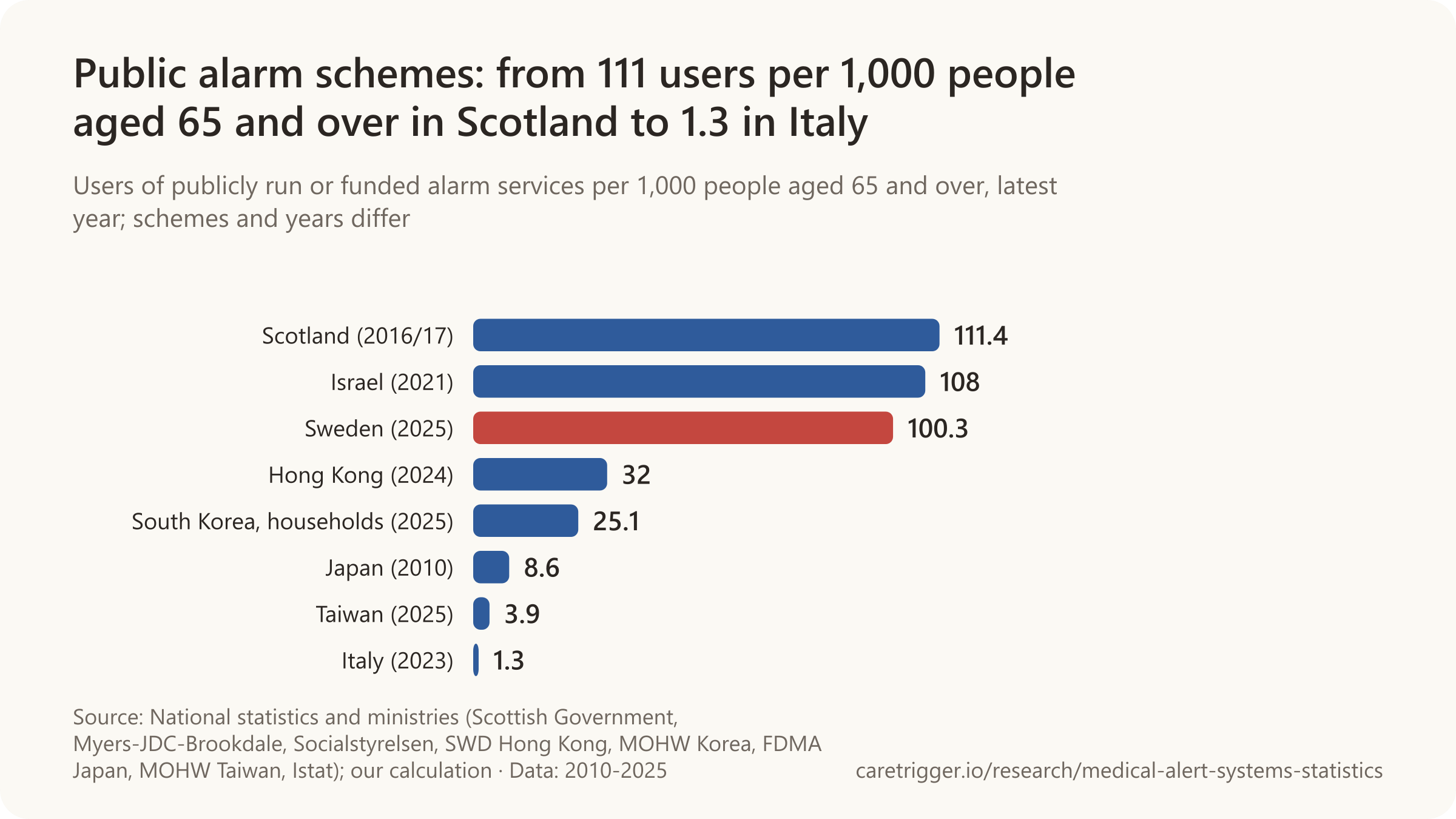
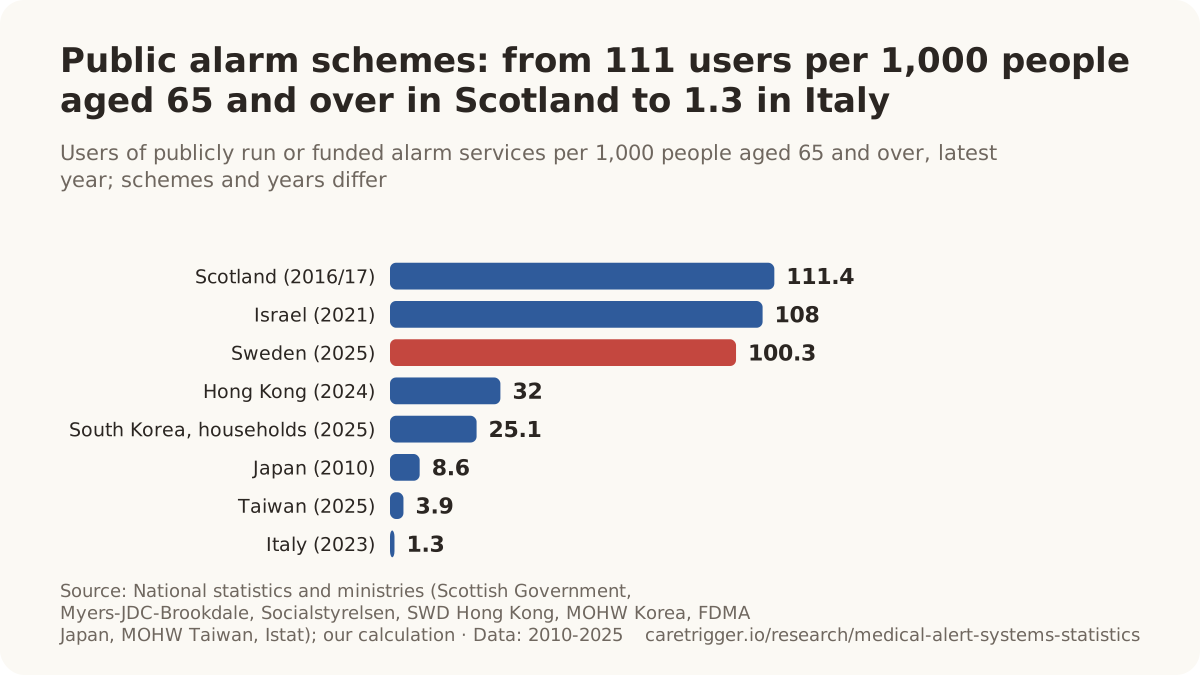
- In Norway, 486 of every 1,000 people aged 90 and over had a municipal safety alarm at the end of 2025.
- 12% of people 65 and older in Ireland had joined the government's Seniors Alert Scheme by 2020.
- Users 65 and older of Italian municipalities' emergency alarm services fell from 65,230 in 2011 to 18,473 in 2023.
- Over 1.2 million people in Germany use a home emergency call system, according to the providers' trade association (2026).
- About 9.7 million people in Europe used a telecare or social alarm service at the end of 2025, by one analyst's estimate.
| Country and service | Users |
|---|---|
| France, téléassistance subscribers (2024) | about 750,000 |
| Spain, teleassistance under the dependency system, all ages | 524,561 services |
| South Korea, older households on the emergency safety service (2025) | 264,274 households |
| Japan, users of fire-department emergency call systems (2010) | 251,444 |
| Netherlands, older people with a personal alarm (2018) | 250,000 to 280,000 |
| Israel, emergency button users (2021) | about 118,000 |
| Norway, municipal safety alarm users of all ages (2025) | 105,066 |
| Poland, public telecare in some form | 90,000 to 100,000 |
| Wales, telecare users (2021) | about 77,000 |
| Hungary, alarm-based home assistance, all ages (2025) | 13,596 |
Sources: Socialstyrelsen; Scottish Government; Myers-JDC-Brookdale Institute; Census and Statistics Department; Statistics Korea; Statistics Bureau, Ministry of Internal Affairs and Communications; Ministry of Health and Welfare, Taiwan, statistics compiled; ISTAT; Statistics Norway; Department of Rural and Community Development; Bundesverband Hausnotruf e.V.; Berg Insight; AFRATA, industry survey; European Social Network (2025, 2024); Ministry of Health and Welfare, Republic of Korea; Fire and Disaster Management Agency, Ministry of Internal Affairs and Communications, Japan; Nivel; TEC Cymru; KSH
More statistics (174)
About 10% of people aged 65 and over in Sweden had a municipal safety alarm in October 2025, 100 per 1,000 (our calculation from Socialstyrelsen and Eurostat data).
Many countries run alarms as a public or council service, so their counts come from official statistics rather than industry estimates. Definitions differ: some count people of all ages, some households, some only alarms that are publicly funded.
Sweden

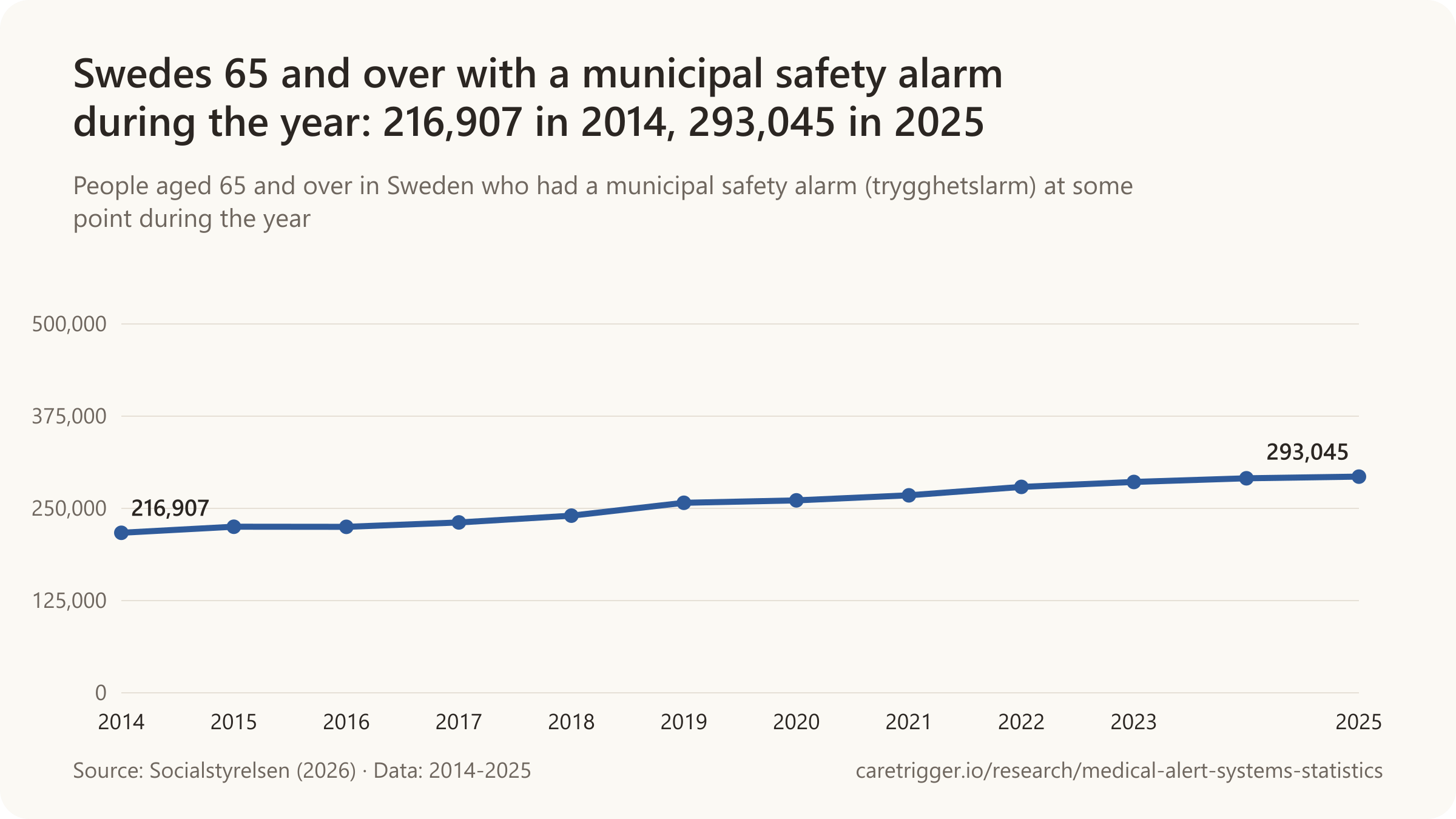
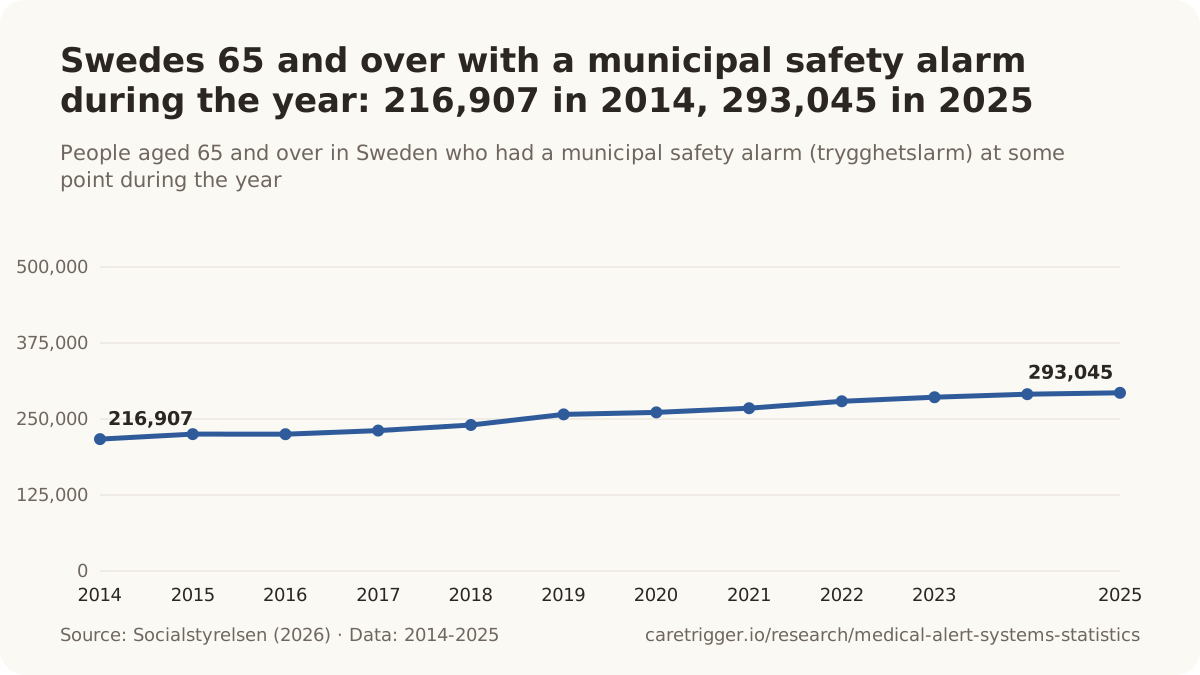
- About 26% of people aged 80 and over in Sweden had a municipal safety alarm in October 2025 (our calculation from Socialstyrelsen and Eurostat data).
- About 37% of people aged 85 and over in Sweden had a municipal safety alarm in October 2025 (our calculation from Socialstyrelsen and Eurostat data).
Norway

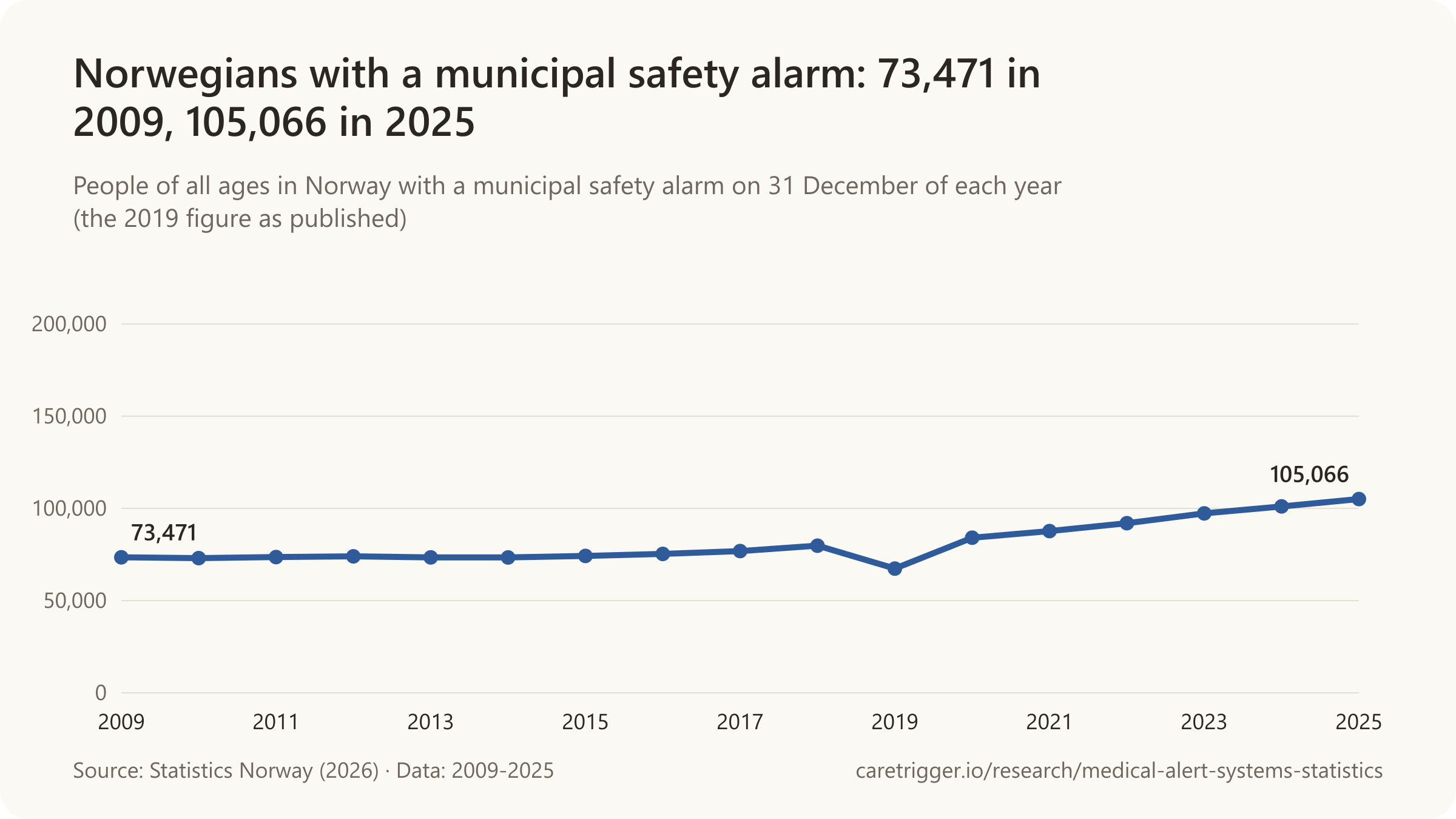
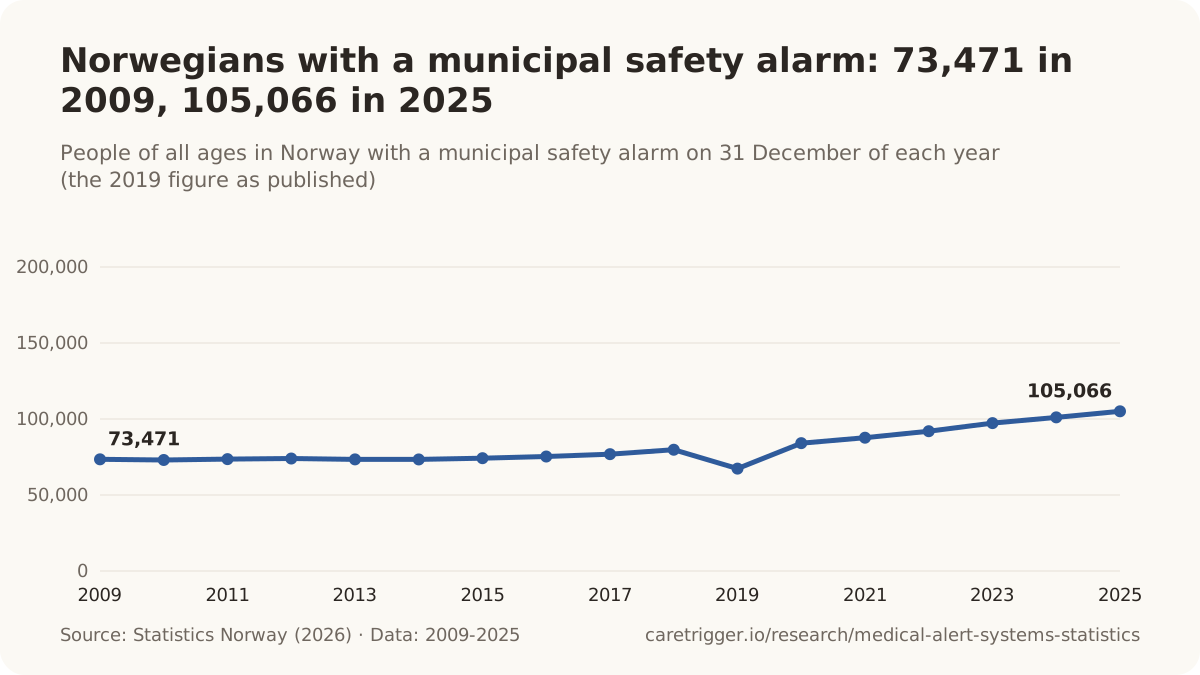
- 486 per 1,000 people aged 90 and over in Norway had a municipal safety alarm on 31 December 2025 (Statistics Norway).
- 105,066 people in Norway had a municipal safety alarm on 31 December 2025 (Statistics Norway).
- 205.2 per 1,000 people aged 80 to 89 in Norway had a municipal safety alarm on 31 December 2025 (Statistics Norway).
- 37.9 per 1,000 people aged 67 to 79 in Norway had a municipal safety alarm on 31 December 2025 (Statistics Norway).
- 218 per 1,000 people aged 80 to 89 in Norway had a municipal safety alarm on 31 December 2009 (Statistics Norway).
- 381 per 1,000 people aged 90 and over in Norway had a municipal safety alarm on 31 December 2009 (Statistics Norway).
- 14,516 people in Norway received municipal digital supervision (sensors or cameras at home) on 31 December 2025, against 105,066 with a safety alarm (Statistics Norway).
- 3,400 people in Norway had municipal alarm and location (GPS) technology on 31 December 2025 (Statistics Norway).
Scotland and Wales
- 86.9% of the 125,685 people in Scotland receiving council-funded technology-enabled care (a community alarm and/or telecare) in 2024/25 were aged 65 or older, including 37.9% aged 85 and over (Public Health Scotland, 2026).
- 37% of people aged 85 and over in Scotland received a council-funded technology-enabled care package (community alarm and/or telecare) in 2022/23 (Public Health Scotland, 2024).
- 126,790 people in Scotland received a council-funded community alarm and/or telecare package in 2015/16 (Public Health Scotland, 2026).
- 123,020 people in Scotland received a council-funded community alarm and/or telecare package in 2023/24 (Public Health Scotland, 2026).
- 125,685 people in Scotland received a council-funded community alarm and/or telecare package in 2024/25, about 2% more than in 2023/24 (Public Health Scotland, 2026).
- 90,380 people in Scotland had a council-funded community alarm only (no other telecare) in 2015/16 (Public Health Scotland, 2026).
- 72,035 people in Scotland had a council-funded community alarm only in 2017/18, the low point of the series (Public Health Scotland, 2026).
- 79,775 people in Scotland had a council-funded community alarm only (no other telecare) in 2024/25 (Public Health Scotland, 2026).
- 6,920 people in Scotland had council-funded telecare without a community alarm in 2015/16 (Public Health Scotland, 2026).
- 4,710 people in Scotland had council-funded telecare without a community alarm in 2016/17 (Public Health Scotland, 2026).
- 16,215 people in Scotland had council-funded telecare without a community alarm in 2017/18 (Public Health Scotland, 2026).
- 15,755 people in Scotland had council-funded telecare without a community alarm in 2022/23 (Public Health Scotland, 2026).
- 19,545 people in Scotland had council-funded telecare without a community alarm in 2023/24, the highest in the series (Public Health Scotland, 2026).
- 15,105 people in Scotland had council-funded telecare without a community alarm in 2024/25 (Public Health Scotland, 2026).
- 29,490 people in Scotland had both a council-funded community alarm and telecare in 2015/16 (Public Health Scotland, 2026).
- 37,705 people in Scotland had both a council-funded community alarm and telecare in 2018/19, the peak of the series (Public Health Scotland, 2026).
- 31,100 people in Scotland had both a council-funded community alarm and telecare in 2020/21 (Public Health Scotland, 2026).
- 30,805 people in Scotland had both a council-funded community alarm and telecare in 2024/25 (Public Health Scotland, 2026).
- 41.9% of people receiving council-funded technology-enabled care (community alarm and/or telecare) in Scotland also received care at home in 2024/25 (Public Health Scotland, 2026).
- Nearly 28,000 people in Scotland's most deprived fifth of areas received council-funded technology-enabled care in 2024/25, against just over 19,500 in the least deprived fifth (Public Health Scotland, 2026).
- 111,270 people aged 65 and over in Scotland used a community alarm and/or other telecare service in 2016/17, and 70% of them had a community alarm only (Scottish Government, 2017).
- 92,910 people aged 65 and over in Scotland received a council community alarm and/or telecare service in March 2011 census week (Scottish Government, 2017).
- 93,292 people aged 65 and over in Scotland received a council community alarm and/or telecare service in March 2012 census week (Scottish Government, 2017).
- 96,920 people aged 65 and over in Scotland received a council community alarm and/or telecare service in March 2013 census week (Scottish Government, 2017).
- 94,680 people aged 65 and over in Scotland received a council community alarm and/or telecare service in March 2014 census week (Scottish Government, 2017).
- 106,034 people aged 65 and over in Scotland received a council community alarm and/or telecare service in financial year 2014-15 (Scottish Government, 2017).
- 109,311 people aged 65 and over in Scotland received a council community alarm and/or telecare service in financial year 2015-16 (Scottish Government, 2017).
- About 111 per 1,000 people aged 65 and over in Scotland received a council community alarm and/or telecare service in 2016-17 (our calculation from Scottish Government data).
- About 77,000 people in Wales used a telecare service in 2021 (TEC Cymru, 2021).
- 91% of telecare users in Wales were aged over 65, and 38% were over 85 (TEC Cymru, 2021).
- 34% of the entire population aged over 85 in Wales used telecare in 2021 (TEC Cymru, 2021).
- Telecare use in Wales ranged from 43 users per 1,000 people over 65 in Monmouthshire to 164 per 1,000 in Wrexham in 2021 (TEC Cymru, 2021).
- About 3% of telecare users in Wales joined or left their service each month (TEC Cymru, 2021).
Rest of the UK
- About 1.8 million people across the UK relied on technology-enabled care and telecare in 2022 (FarrPoint for NHSX/DHSC, 2022).
- Around 1.8 million vulnerable people in the UK were connected by technology-enabled care to an operator when their alarm was raised in 2023 (Department of Health and Social Care, 2023).
- 60% of telecare service users were self-funders on average among English telecare providers surveyed in 2022, with a range from 7% to 100% (FarrPoint for NHSX/DHSC, 2022).
- 70% of telecare service providers in England are local authorities (Department of Health and Social Care, 2023).
- About 0.5 million telecare devices were installed in care homes, supported housing and sheltered housing in 2023, and 25,000 specialist housing developments had hardwired systems (Department of Health and Social Care, 2023).
- About half a million people, roughly a quarter of all UK telecare users, use grouped-living (sheltered housing) telecare or warden call alarms (Department of Health and Social Care, 2026).
Ireland
- 12% of all people aged 65 and over in Ireland had joined the Seniors Alert Scheme by 2020 (Department of Rural and Community Development, 2021).
- 79,082 people aged 65 and over were approved for a free monitored alarm under Ireland's Seniors Alert Scheme between 2015 and 2020, while only 820 were recorded as having left it (Department of Rural and Community Development, 2021).
- 19% of over-65s in Offaly had joined Ireland's Seniors Alert Scheme by 2020, the highest county rate, against 8% in Louth, the lowest (Department of Rural and Community Development, 2021).
- 28% of over-65s living alone in Ireland had joined the Seniors Alert Scheme by the end of 2020, 43,444 people (Department of Rural and Community Development, 2021).
- About 18,000 Seniors Alert Scheme alarms were installed each year in Ireland in 2018-2020 (Department of Rural and Community Development, 2021).
- Less than 1% of Seniors Alert Scheme installations in 2017-2020 reused equipment returned by people no longer using it (Department of Rural and Community Development, 2021).
- Over €19 million was allocated to Ireland's Seniors Alert Scheme between 2015 and 2020 (Department of Rural and Community Development, 2021).
- 85% more demand for Ireland's Seniors Alert Scheme by 2036 was projected in 2021, and 42% more by 2026 (Department of Rural and Community Development, 2021).
- Over 153,000 people aged 65 and over had been approved for a monitored alarm under Ireland's Seniors Alert Scheme since 2015, by September 2025 (Department of Rural and Community Development and the Gaeltacht, 2025).
- Over 18,200 people aged 65 and over were approved for a monitored alarm under Ireland's Seniors Alert Scheme in 2024 (Department of Rural and Community Development and the Gaeltacht, 2025).
- Almost 122,000 older people had been approved for Ireland's Seniors Alert Scheme between 2016 and November 2023 (Irish Government, Dáil written answer, 2024).
Italy

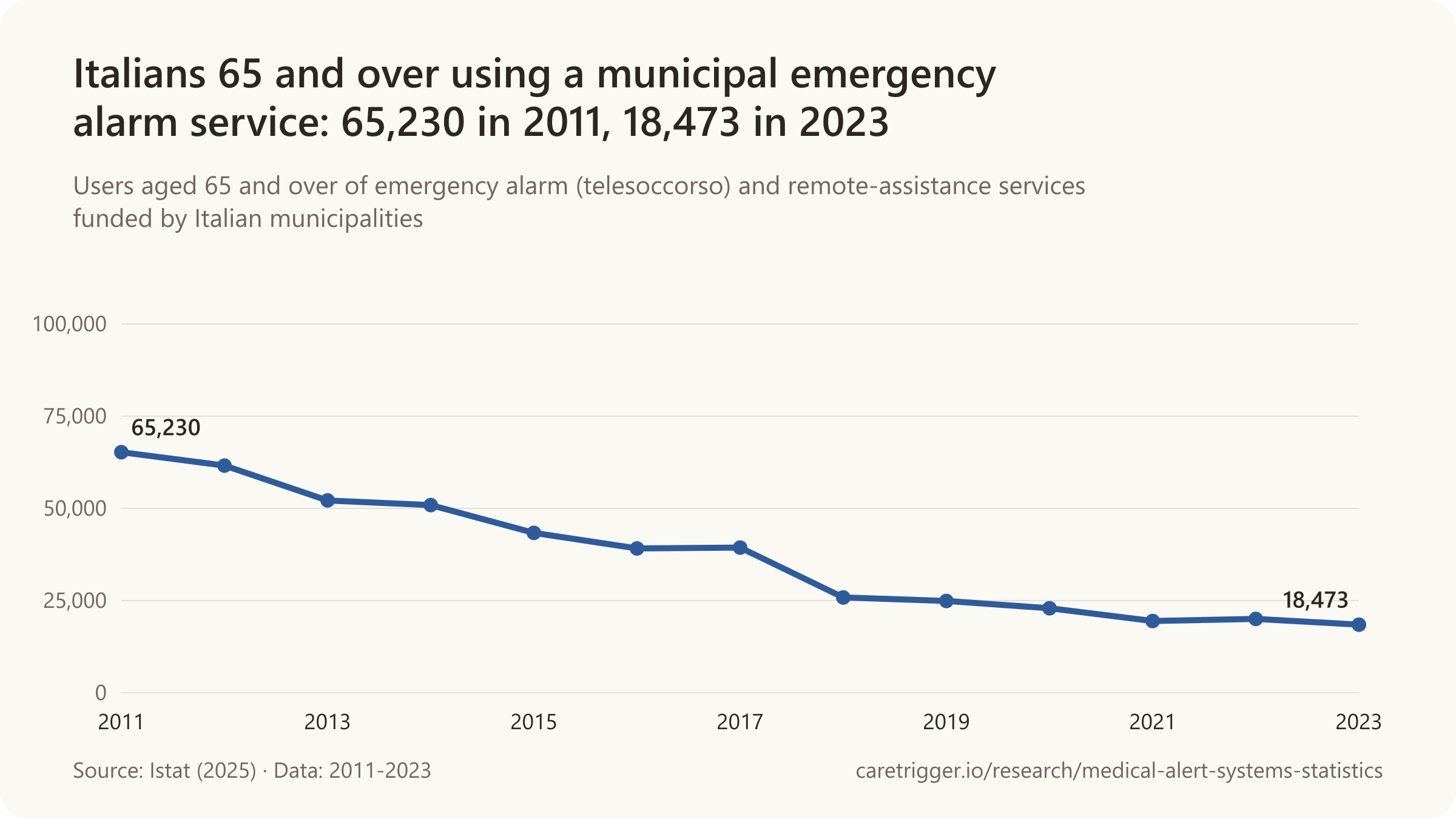
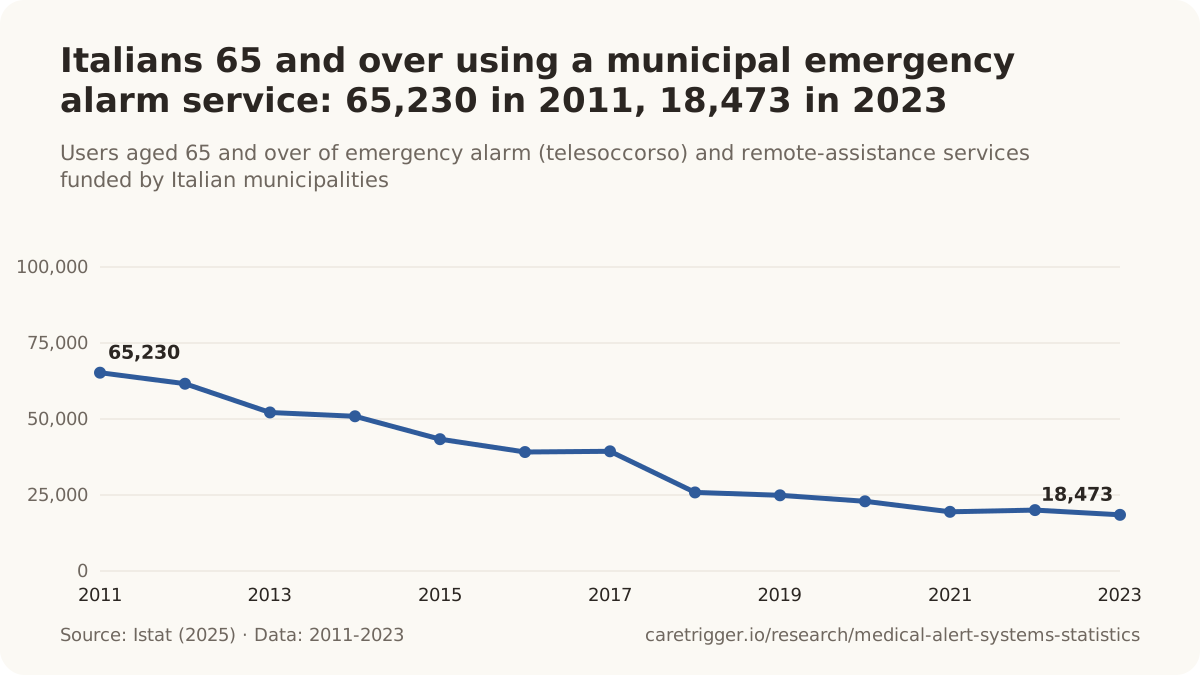
- 18,473 people aged 65 and over in Italy used a municipally funded emergency alarm (telesoccorso) or remote-assistance service in 2023 (ISTAT).
- €3.74 million was spent by Italian municipalities on emergency alarm (telesoccorso) and remote-assistance services for older people in 2023, down from €11.55 million in 2011 (ISTAT).
- About 1.3 per 1,000 people aged 65 and over in Italy used a municipally funded emergency alarm service in 2023 (our calculation from ISTAT and Eurostat data).
Hungary and the Czech Republic

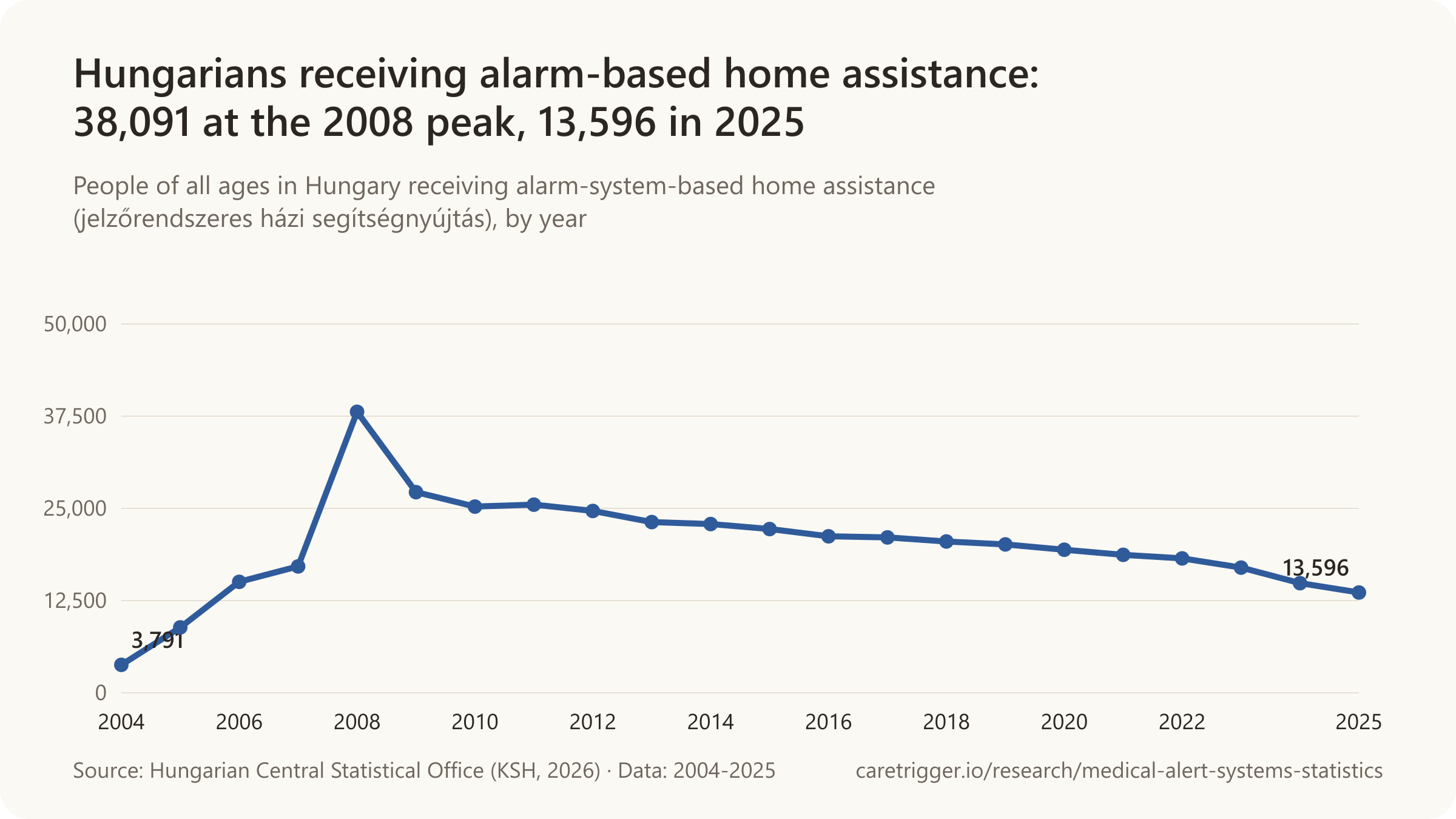
- 13,596 people in Hungary received alarm-system-based home assistance (jelzőrendszeres házi segítségnyújtás) in 2025 (KSH).
- About 6.8 per 1,000 people aged 65 and over in Hungary received alarm-system-based home assistance in 2025, counting all recipients (our calculation from KSH and Eurostat data).
- 4,771 people in the Czech Republic were clients of the 19 registered emergency-alarm social services (tísňová péče) on 31 December 2022 (Czech Ministry of Labour and Social Affairs, 2023).
- About 2.2 per 1,000 people aged 65 and over in the Czech Republic used a registered emergency-alarm social service at the end of 2022 (our calculation from MPSV and Eurostat data).
France, Germany, Spain and the Netherlands
- Over 1.2 million people in Germany use a home emergency call system (Hausnotruf), according to the providers' trade association (Bundesverband Hausnotruf, 2026).
- 635,100 people with a disability living at home in Spain used a remote alarm service (teleasistencia) in 2020 (INE, EDAD 2020).
- 419,800 people aged 80 and over with a disability living at home in Spain used a remote alarm service (teleasistencia) in 2020 (INE, EDAD 2020).
- About 750,000 people in France had a téléassistance (personal alarm) subscription in 2024, up 4% on 2023 (AFRATA industry survey, 2025).
- 313,282 falls were detected or handled by téléassistance services in France in 2024, 6% more than in 2023 (AFRATA industry survey, 2025).
- 43,441 new fall detectors and 37,117 new mobile téléassistance devices were installed in France in 2024 (AFRATA industry survey, 2025).
- Nearly 50% of new téléassistance subscribers in France in 2024 were equipped with automatic fall detection (AFRATA industry survey, 2025).
- About 400,000 people in Germany used a home emergency call system (Hausnotruf) in 2009, according to the providers' association (aproxima for Initiative Hausnotruf, 2010).
- 11.0% of care-dependent people aged 70 and over living at home used an insurer-funded home emergency call system in 2014, up from 6.8% in 2010, in three eastern German states (Zahn et al., Monitor Pflege, 2015).
- 250,000 to 280,000 older people in the Netherlands used a personal alarm (personenalarmering) in 2018, by Nivel's estimate (van der Gaag et al., Nivel, 2018).
- 524,561 remote alarm (teleasistencia) services were being provided to people of all ages with recognised long-term care needs in Spain on 31 December 2024 (IMSERSO data via European Social Network, 2025).
Other European countries
- About 9.7 million people in Europe used a telecare (social alarm) service at the end of 2025, by one analyst firm's estimate (Berg Insight, 2026).
- More than 14.1 million people in Europe are forecast to use telecare by the end of 2030, up from 9.7 million in 2025 (Berg Insight, 2026).
- 4,052 older people in Malta used the state Telecare personal alarm pendant in 2024, and 38 used the GPS 'Telecare on the Move' device for people with dementia (Active Ageing and Community Care data via European Social Network, 2025).
- 650 older people in Croatia received publicly funded telecare in 2024, 466 through the Labour Ministry and 184 through local authorities (Croatian Ministry of Labour data via European Social Network, 2025).
- 90,000 to 100,000 people in Poland were covered by public telecare in some form (pilots, local and regional programmes) in 2024-2025, by an academic estimate (European Social Network, 2025).
South Korea
- About 25 households per 1,000 South Koreans aged 65 and older were on the government's Emergency Safety and Security Service in 2025 (264,274 older households; 10.51 million people aged 65+; Ministry of Health and Welfare and Statistics Korea; derived).
- 159,602 households of older people in South Korea were covered by the government's Emergency Safety and Security Service in 2022, which installs an emergency call button and fire and activity sensors linked to the 119 emergency number (Ministry of Health and Welfare, Korea, 2026).
- 110,228 safety checks were made in 2022 after activity sensors in South Korean homes on the Emergency Safety and Security Service detected no movement for several hours (Ministry of Health and Welfare, Korea, 2026).
- 5,319 fire alerts were sent automatically to 119 by the smoke and heat detectors of South Korea's Emergency Safety and Security Service in 2022 (Ministry of Health and Welfare, Korea, 2026).
- 227,328 households of older people in South Korea were covered by the government's Emergency Safety and Security Service in 2023, which installs an emergency call button and fire and activity sensors linked to the 119 emergency number (Ministry of Health and Welfare, Korea, 2026).
- 157,281 safety checks were made in 2023 after activity sensors in South Korean homes on the Emergency Safety and Security Service detected no movement for several hours (Ministry of Health and Welfare, Korea, 2026).
- 6,836 fire alerts were sent automatically to 119 by the smoke and heat detectors of South Korea's Emergency Safety and Security Service in 2023 (Ministry of Health and Welfare, Korea, 2026).
- 256,105 households of older people in South Korea were covered by the government's Emergency Safety and Security Service in 2024, which installs an emergency call button and fire and activity sensors linked to the 119 emergency number (Ministry of Health and Welfare, Korea, 2026).
- 305,433 safety checks were made in 2024 after activity sensors in South Korean homes on the Emergency Safety and Security Service detected no movement for several hours (Ministry of Health and Welfare, Korea, 2026).
- 9,106 fire alerts were sent automatically to 119 by the smoke and heat detectors of South Korea's Emergency Safety and Security Service in 2024 (Ministry of Health and Welfare, Korea, 2026).
- 264,274 households of older people in South Korea were covered by the government's Emergency Safety and Security Service in 2025, which installs an emergency call button and fire and activity sensors linked to the 119 emergency number (Ministry of Health and Welfare, Korea, 2026).
- About 300,000 households of older people living alone have been served by South Korea's Emergency Safety and Security Service since its current programme began in 2020 (Ministry of Health and Welfare, Korea, 2026).
- 385,033 alerts were responded to by South Korea's Emergency Safety and Security Service in 2025: button calls, fire alerts and no-movement checks combined (Ministry of Health and Welfare, Korea, 2026).
- 4 hours or more without detected movement triggers a safety check by a local emergency manager under South Korea's Emergency Safety and Security Service, which treats it as a sign the person may have fallen or lost consciousness (Ministry of Health and Welfare, Korea, 2026).
- 84.6 billion won over five years is the budget of South Korea's tender, announced in 2026, to replace about 90,000 Emergency Safety and Security Service home kits installed in 2020 (Ministry of Health and Welfare, Korea, 2026).
- 2,336,000 households in South Korea in 2025 were one-person households headed by someone aged 65 or older, 37.8% of all older-headed households (Statistics Korea, 2025, household projections).
- About 11% of South Korea's one-person households aged 65 or older had the government's Emergency Safety and Security Service in 2025 (264,274 enrolled older households against 2.34 million projected; Ministry of Health and Welfare and Statistics Korea; derived).
- 82,912 households of older people in South Korea were covered by the Emergency Safety and Security Service in 2020, as reported in 2023 (Ministry of Health and Welfare, Korea, 2023).
- 121,707 households of older people in South Korea were covered by the Emergency Safety and Security Service in 2021, as reported in 2023 (Ministry of Health and Welfare, Korea, 2023).
- 193,861 households of older people in South Korea were covered by the Emergency Safety and Security Service in 2022, as reported in 2023 (Ministry of Health and Welfare, Korea, 2023).
- 65 is the minimum age for South Korea's Emergency Safety and Security Service, open to older people actually living alone who receive basic livelihood, near-poverty or basic pension support, or whom their local government judges to need constant protection (Ministry of Health and Welfare, Korea, 2023).
- 22.4% of South Koreans aged 65 and older said they knew the government's Emergency Safety and Security Service for people living alone well in 2023, and 28.9% had never heard of it (Ministry of Health and Welfare, National Survey of Older Koreans, 2024).
- 217 regional centres run South Korea's Emergency Safety and Security Service for older people living alone, employing local emergency managers who check on alerts (Ministry of Health and Welfare, Korea, 2025).
- 6 hours is the longest no-movement period South Korea's districts may set before the Emergency Safety and Security Service flags an older person for a safety check, chosen locally in 1-hour steps (Ministry of Health and Welfare, Korea, 2025).
Japan
- 251,444 people were registered with emergency call systems run through 420 of Japan's fire departments in fiscal 2010, systems open broadly to older people (Fire and Disaster Management Agency, 2017).
Taiwan, Hong Kong, China and Singapore

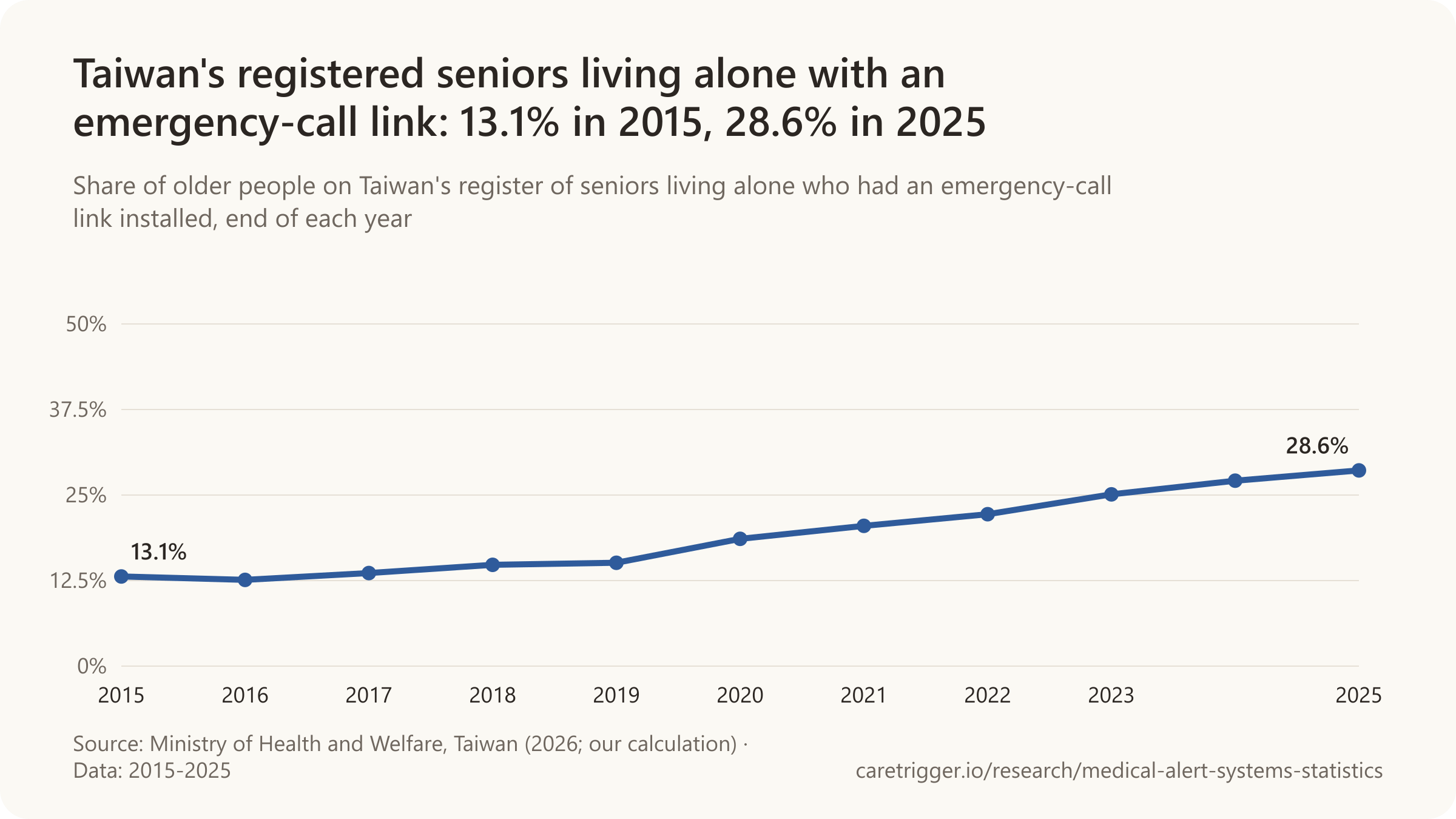
- About 32 per 1,000 Hong Kong residents aged 65 and older had a publicly subsidised emergency alarm in late 2024, through the welfare (CSSA) grant or public housing subsidies (about 52,800 people; Hong Kong Government; derived).
- 32,745 older welfare (CSSA) recipients in Hong Kong received the government grant for an emergency alarm ('Safety Bell') in 2020-21 (Social Welfare Department, 2025).
- 30,634 older welfare (CSSA) recipients in Hong Kong received the government grant for an emergency alarm ('Safety Bell') in 2021-22 (Social Welfare Department, 2025).
- 28,354 older welfare (CSSA) recipients in Hong Kong received the government grant for an emergency alarm ('Safety Bell') in 2022-23 (Social Welfare Department, 2025).
- 26,653 older welfare (CSSA) recipients in Hong Kong received the government grant for an emergency alarm ('Safety Bell') in 2023-24 (Social Welfare Department, 2025).
- 25,882 older welfare (CSSA) recipients in Hong Kong received the government grant for an emergency alarm ('Safety Bell') by end-December 2024 (Social Welfare Department, 2025).
- HK$42 million was spent on the welfare (CSSA) grant for emergency alarms in Hong Kong in 2020-21, about 0.1% to 0.2% of all CSSA spending (Social Welfare Department, 2025).
- HK$38 million was spent on the welfare (CSSA) grant for emergency alarms in Hong Kong in 2021-22, about 0.1% to 0.2% of all CSSA spending (Social Welfare Department, 2025).
- HK$35 million was spent on the welfare (CSSA) grant for emergency alarms in Hong Kong in 2022-23, about 0.1% to 0.2% of all CSSA spending (Social Welfare Department, 2025).
- HK$33 million was spent on the welfare (CSSA) grant for emergency alarms in Hong Kong in 2023-24, about 0.1% to 0.2% of all CSSA spending (Social Welfare Department, 2025).
- HK$23 million was spent on the welfare (CSSA) grant for emergency alarms in Hong Kong by end-December 2024, about 0.1% to 0.2% of all CSSA spending (Social Welfare Department, 2025).
- About HK$1,240 a year (roughly HK$100 a month) was spent per older welfare recipient on Hong Kong's CSSA emergency alarm grant in 2023-24 (HK$33 million for 26,653 recipients; Social Welfare Department, 2025; derived).
- 65 is the usual minimum age for Hong Kong's welfare (CSSA) grant that pays to install and use an indoor or mobile emergency alarm, for recipients who live alone or whose family cannot care for them (Social Welfare Department, 2025).
- More than 2,700 households of older people living alone or in pairs, and of carers, received a subsidised emergency alarm after referral by Hong Kong's district Care Teams by the end of 2025, out of over 79,000 households contacted (Labour and Welfare Bureau, 2026).
- About 4 per 1,000 people aged 65 and older in Taiwan had a publicly arranged emergency-call link in September 2025 (18,210 of 4.62 million; Ministry of Health and Welfare, Taiwan, 2026; derived).
- About 26,800 more seniors aged 60 and over in about 170 public rental blocks are getting Singapore's wireless Alert Alarm System, which connects a press of the button to a 24/7 helpline, in a rollout from January 2025 (Age Well SG, Government of Singapore).
- 80 is the age from which every Shanghai-registered resident living alone has been included in the city's government-purchased emergency call ('one-key') service since January 2022 (Shanghai Civil Affairs Bureau, 2021).
- 10 yuan a month is the emergency rescue service fee Shanghai's districts pay for residents aged 80 and over living alone who are not on low incomes; low-income residents also get the device and phone costs covered (Shanghai Civil Affairs Bureau, 2021).
Israel
- 17,214 people on Israel's long-term care benefit had an emergency call transmitter in their care package in December 2018, 9.5% of all 180,876 eligible (National Insurance Institute, 2020).
- 17,656 people on Israel's long-term care benefit had an emergency call transmitter in their care package in December 2019, 8.2% of all 216,616 eligible (National Insurance Institute, 2020).
- 19,910 people on Israel's long-term care benefit had an emergency call transmitter in their care package in December 2020, 7.7% of all 260,153 eligible (National Insurance Institute, 2022).
- 22,221 people on Israel's long-term care benefit had an emergency call transmitter in their care package in December 2021, 7.8% of all 286,630 eligible (National Insurance Institute, 2022).
- 23,482 people on Israel's long-term care benefit had an emergency call transmitter in their care package in December 2022, 7.4% of all 315,660 eligible (National Insurance Institute, 2024).
- 23,728 people on Israel's long-term care benefit had an emergency call transmitter in their care package in December 2023, 6.8% of all 346,546 eligible (National Insurance Institute, 2024).
- 24,197 people on Israel's long-term care benefit had an emergency call transmitter in their care package in December 2024, 6.5% of all 375,077 eligible (National Insurance Institute, 2025).
- About 118,000 older adults in Israel used an emergency button service in 2021, the country's most established telecare service (Myers-JDC-Brookdale Institute, 2022).
Australia, New Zealand and the Americas
- 27,371 Personal Alert Victoria alarm units were funded by the Victorian government in 2015-16, a free service for frail older people who live alone (Department of Health and Human Services, Victoria, 2016).
- 27,371 Personal Alert Victoria alarm units were funded by the Victorian government in 2016-17 (Department of Health and Human Services, Victoria, 2017).
- 24,621 Personal Alert Victoria alarm units were funded by the Victorian government in 2023-24, down from 27,371 in 2016-17 (Department of Health, Victoria, 2024).
- 120 older people received teleassistance in 2023 through two pilot projects in Chile's southern Magallanes region, the start of a national 'teleassistance for every older person' plan (Ministry of Social Development and Family, Chile, 2024).
- 1,225 people aged 70 and over had Uruguay's subsidised home teleassistance (button alarm) service in December 2023 (Sistema Nacional Integrado de Cuidados, 2024).
- 73.3% of users of Uruguay's home teleassistance service received a full subsidy in December 2023, so the service cost them nothing (Sistema Nacional Integrado de Cuidados, 2024).
- More than 1,200 people had Uruguay's subsidised home teleassistance service in November 2019; 66% were aged 80 or older and 85% were women (Presidency of Uruguay, 2019).
- 95% of users of Uruguay's subsidised home teleassistance service said they were satisfied or very satisfied with it, in a Care System evaluation reported in 2019 (Presidency of Uruguay, 2019).
Sources: Socialstyrelsen (2024, 2025, 2026); Statistics Norway; Public Health Scotland (2024, 2026); Scottish Government (2017); TEC Cymru; FarrPoint, commissioned by NHSX; Department of Health and Social Care (2023, 2026); Department of Rural and Community Development; Minister of State, Department of Rural and Community Development and the Gaeltacht; Minister for Health; ISTAT; KSH; Ministry of Labour and Social Affairs, Czech Republic; MPSV; Bundesverband Hausnotruf e.V.; INE; AFRATA, industry survey; aproxima Gesellschaft für Markt- und Sozialforschung for Initiative Hausnotruf; Monitor Pflege; Nivel; European Social Network (2024, 2025); Berg Insight; Statistics Korea; Ministry of Health and Welfare, Republic of Korea (2023, 2026); Ministry of Health and Welfare, Korea (2024, 2025, 2026); Statistics Bureau, Ministry of Internal Affairs and Communications; Fire and Disaster Management Agency, Ministry of Internal Affairs and Communications, Japan; Dai-ichi Life Research Institute; Administrative Evaluation Bureau, Ministry of Internal Affairs and Communications, Japan; Miyashiro Town, Saitama; Ministry of Health and Welfare, Taiwan, statistics compiled; Census and Statistics Department; Social Welfare Department, Hong Kong SAR Government; Labour and Welfare Bureau, Hong Kong SAR Government (2024, 2026); Hong Kong SAR Government; Age Well SG, Government of Singapore; Shanghai Municipal Civil Affairs Bureau and Shanghai Municipal Finance Bureau; National Insurance Institute of Israel (2020-2026); Myers-JDC-Brookdale Institute; Department of Health, Victoria (2016-2024); Servicio Nacional del Adulto Mayor, Ministerio de Desarrollo Social y Familia, Chile; Sistema Nacional Integrado de Cuidados, Ministerio de Desarrollo Social, Uruguay; Presidencia de la República, Uruguay
12 / UK switchover
What does the UK's digital phone switchover mean for telecare users?
About three-quarters of UK sheltered-housing alarms were still analogue in 2025 and 2026, ahead of the January 2027 switch-off (Department of Health and Social Care).

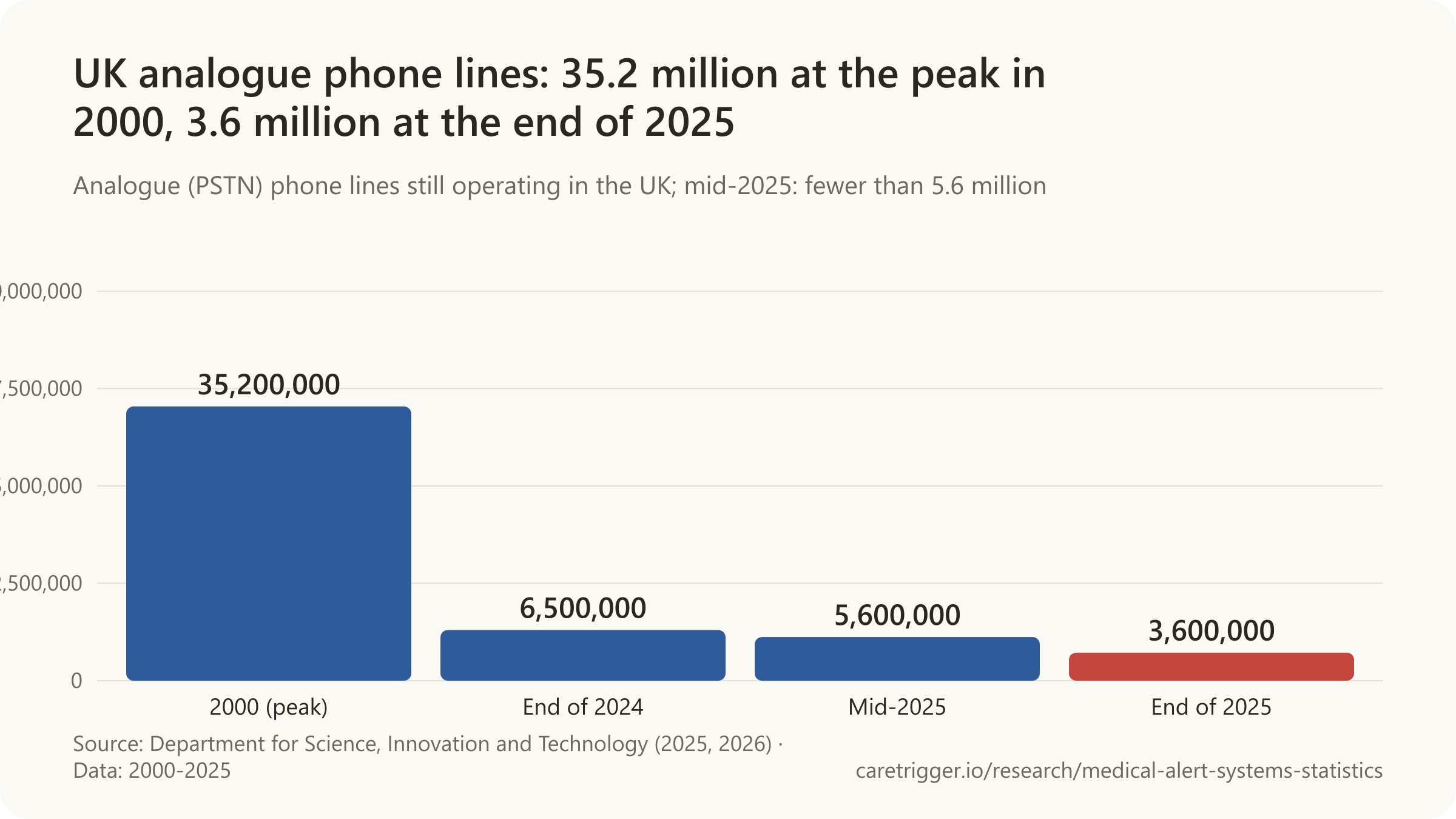
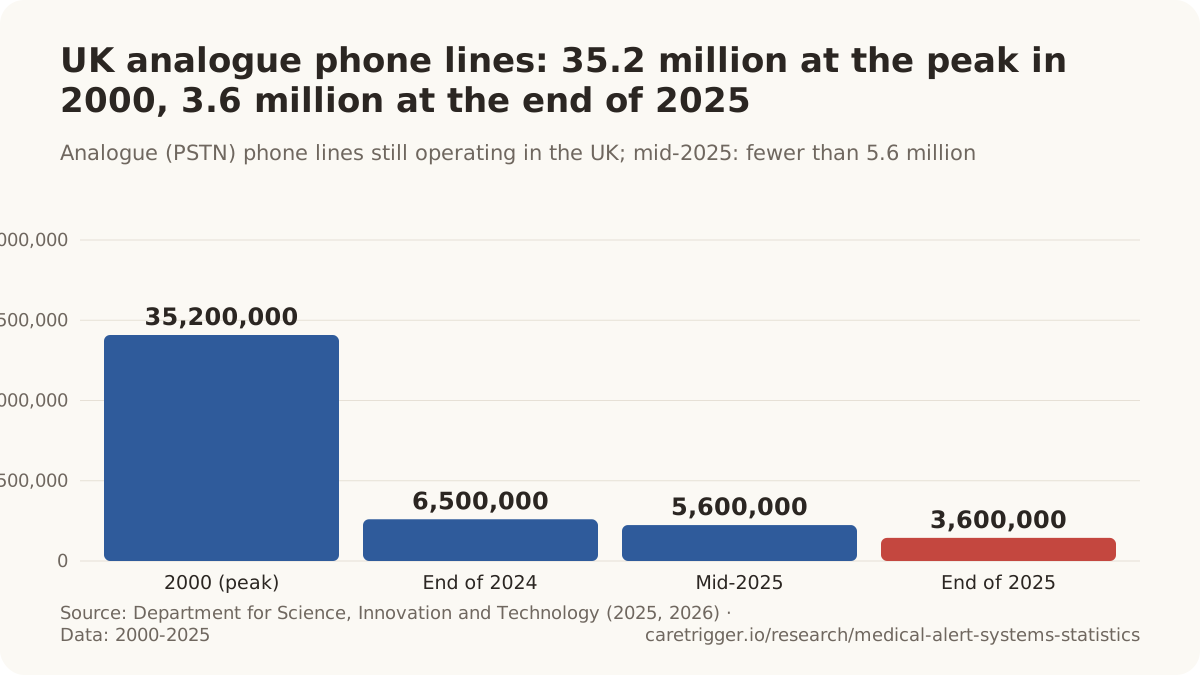
- About 2 million people in the UK use telecare, which relies on phone lines being moved from analogue to digital (2025).
- About one-third of UK personal alarms in people's homes were still analogue in 2025 and 2026.
- Ofcom fined Virgin Media £23.8 million in December 2025 for disconnecting telecare customers without proper support.
- One UK telecare supplier found 22.53% of analogue alarm calls failed to connect at the first attempt in 2025.
- Over 2,600 major incidents, each hitting 500 or more customers, struck the UK's analogue phone network from April 2024 to March 2025.
Sources: Department of Health and Social Care (2026, 2025); Department for Science, Innovation and Technology (2026, 2025); House of Commons Library; Appello
More statistics (22)
About three-quarters of grouped-living (sheltered housing) telecare alarms in the UK were still analogue in 2025-2026, ahead of the January 2027 switch-off (Department of Health and Social Care, 2026).
Most UK telecare alarms were built to call their monitoring centre over an analogue landline. As phone companies move every line to digital, an alarm that has not been upgraded can fail to connect, and a digital line stops working in a power cut unless it has a battery backup. Migrations were paused over these risks.
- About 2 million people in the UK use telecare services, which depend on phone lines that are being moved from analogue to digital by January 2027 (Department of Health and Social Care and DSIT, Telecare National Action Plan, 2025).
- About one-third of personal (home) telecare alarms in the UK were still analogue in 2025-2026 (Department of Health and Social Care, 2026).
- £23.8 million was the fine Ofcom imposed on Virgin Media in December 2025 for disconnecting telecare customers without appropriate support between August 2022 and December 2023 (House of Commons Library, 2026, reporting Ofcom).
- 22.53% of analogue telecare alarm calls failed to connect on the first attempt on average in 2025 (January to September), against 18.83% in late 2024, in one UK supplier's data (Appello, 2025).
- Over 2,600 incidents classed as major, each affecting 500 or more customers, hit the UK's analogue phone network between April 2024 and March 2025, a risk to telecare users (DSIT, 2025).
- End of January 2027 is when most UK landlines, which most telecare alarms have relied on, are expected to have moved from the analogue network to digital (Department of Health and Social Care and DSIT, 2025).
- 12 to 24 hours is how long existing analogue telecare units typically keep working on their internal battery in a power cut (Department of Health and Social Care and DSIT, 2025).
- Over 600 communication providers, not the telecare industry, control when UK customers are moved from analogue to digital landlines (Department of Health and Social Care and DSIT, 2025).
- 3.2 million UK residential customers were still on the analogue phone network in July 2025, about 19% of residential landlines, down from 5.2 million in July 2024 (House of Commons Library, 2026, reporting Ofcom).
- 31 December 2025 was the original industry target date for switching off the UK's analogue phone network, before migrations were paused over concerns including telecare alarms (House of Commons Library, 2026).
- 26.35% of analogue telecare alarm calls failed to connect on the first attempt in February 2025, the peak month in data from one UK telecare supplier (Appello, 2025).
Phone lines left on the analogue network
- 3.6 million analogue (PSTN) phone lines were still operating in the UK on 31 December 2025, down from 6.5 million a year earlier (DSIT, 2026).
- 6.5 million analogue (PSTN) phone lines were still operating in the UK at the end of 2024 (DSIT, 2026).
- 35.2 million analogue (PSTN) phone lines operated in the UK at the network's peak in 2000 (DSIT, 2026).
- Fewer than 5.6 million analogue (PSTN) phone lines were still operating in the UK in mid-2025, after over two-thirds had been migrated to digital (DSIT, 2025).
Scotland and local councils
- 142,000 people in Scotland receive telecare and are being moved from analogue to digital telecare (Scottish Government and COSLA, 2025).
- Over 86,000 dispersed (home) telecare alarm connections in Scotland had been upgraded to digital or digitally ready by the end of 2025 (Digital Office for Scottish Local Government, 2026).
- 22% of English councils responding to a 2022 survey had a digital-ready telecare solution in place, and 32% were putting one in place (Local Government Association survey, via Department of Health and Social Care, 2023).
- Over 96% of UK local authorities that provide telecare had signed a data sharing agreement with at least one phone provider by May 2025, so telecare users can be identified before their line is switched (DSIT, 2025).
- Over 98% of local authorities had signed at least one data sharing agreement with phone providers to protect telecare users by October 2026 (Department of Health and Social Care, 2026).
- 2033 is the latest year UK mobile networks will switch off 2G, which some personal telecare alarms still use, with networks closing in 2029, 2030 and by 2033 (DSIT, 2026).
A number we will not publish. Press reports of "two deaths" linked to failed telecare calls during the switchover cite no primary source we could find; the government says only that there have been a small number of fatalities.
Sources: Department of Health and Social Care (2023, 2025, 2026); House of Commons Library; Appello; Department for Science, Innovation and Technology (2025, 2026); Scottish Government and COSLA; Digital Office for Scottish Local Government
13 / Market and scams
How big is the medical alert market, and how common are scams?
More than 90,000 consumers complained to the FTC about 'medical alert' robocalls from 2012 to mid-2015 (Federal Trade Commission, 2015).
- Analysts valued the North American medical alert market at $3.7 billion in 2025.
- Another analyst firm forecasts a global medical alert market of $15.2 billion by 2030.
- A $25.3 million judgment was entered in 2019 against medical alert seller Lifewatch, with a permanent ban on robocalls.
- Just one of Lifewatch's telemarketers sent nearly 2 million robocalls a day selling 'free' medical alerts, regulators alleged (2015).
- Life Alert agreed in 2021 to pay New York $750,000 for not telling customers of their right to cancel within seven days.
Sources: Federal Trade Commission; Berg Insight; Grand View Research; US District Court, N.D. Illinois; New York State Office of the Attorney General
More statistics (15)
More than 90,000 people complained to the FTC about 'medical alert' robocalls between 2012 and mid-2015, the FTC told a federal court in its case against Lifewatch (FTC v. Lifewatch, 2015).
The industry's size is known only from analyst firms' estimates; two are shown, each named. Its consumer-protection record is public: a federal case against robocalls selling 'free' alarms, and a state settlement over contracts.
Market size
- US$3.7 billion (€3.4 billion) was the value of the North American medical alert market in 2025, according to analyst firm Berg Insight (The Telecare Market in Europe and North America, 2026).
- US$15.2 billion by 2030 is analyst firm Grand View Research's forecast for the global medical alert systems market, growing 6.4% a year from 2023 (press release, September 2023).
- €3.9 billion was the value of the European telecare market in 2025, according to analyst firm Berg Insight (The Telecare Market in Europe and North America, 2026).
Robocalls and scams
- A $25.3 million judgment ($25,266,886) was entered in 2019 against medical alert seller Lifewatch in the FTC and Florida robocall case, with a permanent ban on robocalling (FTC v. Lifewatch, stipulated order, 2019).
- Nearly 2 million robocalls a day were sent by just one of Lifewatch's telemarketers selling 'free' medical alert systems, the FTC told a federal court (FTC v. Lifewatch, 2015).
- $29.95 to $39.95 a month was the monitoring fee charged to consumers told their medical alert system was 'free', the FTC and Florida alleged in their complaint against Lifewatch (FTC v. Lifewatch, 2015).
- $2.0 million in instalments is what Lifewatch was ordered to pay against the $25.3 million judgment in the medical alert robocall case (our sum of the payments in the 2019 stipulated order).
Life Alert
- $750,000 in penalties, costs and fees is what Life Alert agreed to pay New York in 2021 for not telling customers of their right to cancel within seven days (New York Attorney General, 2021).
- Over 16,000 people in New York signed 36-month Life Alert contracts from 2014 to 2020 without being told of their legal right to cancel within seven days, the New York Attorney General found (2021).
- 11 minutes is how often Life Alert says it saves a life, counting each time a subscriber home alone in a real emergency pressed the button, could not reach a phone and was sent help; the company publishes no underlying data (manufacturer's claim, Life Alert website, accessed 2026-11-11).
- 800,000 or more lives saved since 1987 is Life Alert's own cumulative claim, by its own definition of a life saved; no data are published (manufacturer's claim, Life Alert website, accessed 2026-11-11).
How companies count. Life Alert's lives-saved figures are its own tallies: it counts a life saved each time a subscriber who was home alone in a real emergency pressed the button, could not reach a phone and was sent help, and it publishes no data behind them. Its "over 2 million calls a year" is a company tally too. Other makers' counts of members served and their response times are claims of the same kind, labelled as such on this page.
Where "I've fallen and I can't get up" comes from
- 1989 is the first-use date LifeCall (Emergency Response People, Inc.) gave the US trademark office for 'I've fallen and I can't get up', registered as its service mark for a medical emergency monitoring service in 1992 and later cancelled (USPTO).
- 2007 is the year Life Alert registered 'I've fallen and I can't get up!' as a trademark with the US trademark office, a registration since renewed (USPTO).
- 1988 is the first-use date Life Alert claims for 'Help, I've fallen and I can't get up!', which it registered as a trademark in 2014, a registration since renewed (USPTO).
Where the line comes from. "I've fallen and I can't get up" was first registered not by Life Alert but by LifeCall, another medical alarm company, which gave 1989 as its first use; that registration was later cancelled. Life Alert registered the phrase as a trademark in 2007, and "Help, I've fallen and I can't get up!" in 2014, claiming first use in 1988.
Sources: Federal Trade Commission; Berg Insight; Grand View Research; US District Court, N.D. Illinois; Federal Trade Commission and State of Florida; New York State Office of the Attorney General; Life Alert Emergency Response, Inc. (2026); United States Patent and Trademark Office (1992, 2007, 2014)
14 / Data
Download the data
All 908 statistics on this page, each with its source, verbatim quote and locator: CSV · JSON
Data behind each chart (CSV, 23 files)
- Older Americans using a smartwatch or other wearable: 0.7% in 2015, 14.3% in 2023
- South Koreans with an emergency call device at home: 7.3% at 65-69, 19.5% at 90 and over
- Why older Americans go without a medical alert: 49% have no health concerns, 23% cite cost
- Medicare Advantage members in plans offering a medical alert: 36.8% in 2023, 11.0% in 2026
- Medicare Advantage plans offering a medical alert: from 7.2% in 2018 to 29.5% in 2023 and 11.0% for 2027
- Members with a medical alert benefit: 72.6% of special needs plan enrollees in 2023, 5.5% of others in 2026
- When US medical alert users don't wear it: 64% not in the shower, 39% not while sleeping
- People over 90 who fell alone and could not get up: no alarm call in 78% of falls at home, 94% in care homes
- What medical alarm cases were: 68.7% tests, 11.7% accidental presses, 5.4% real incidents
- Hong Kong alarm requests that were emergencies: 7.6% in 2017-18, 5.3% in 2023-24
- South Korea's emergency safety service in 2025: 351,872 no-movement checks, 25,050 button calls
- Fall detectors on real falls: from 19% to 88% detected
- Fall detection in the lab and on real falls: 13 algorithms fell from 91% to 57%
- Ambulance responses to medical alarm calls in one US system: 96% with lights and siren, 25% ended in a hospital trip
- Whole System Demonstrator: telecare made no significant difference within a year
- Cheapest in-home medical alert plan by brand: $23.78 to $39.99 a month
- Public alarm schemes: from 111 users per 1,000 people aged 65 and over in Scotland to 1.3 in Italy
- Swedes 65 and over with a municipal safety alarm during the year: 216,907 in 2014, 293,045 in 2025
- Norwegians with a municipal safety alarm: 73,471 in 2009, 105,066 in 2025
- Italians 65 and over using a municipal emergency alarm service: 65,230 in 2011, 18,473 in 2023
- Hungarians receiving alarm-based home assistance: 38,091 at the 2008 peak, 13,596 in 2025
- Taiwan's registered seniors living alone with an emergency-call link: 13.1% in 2015, 28.6% in 2025
- UK analogue phone lines: 35.2 million at the peak in 2000, 3.6 million at the end of 2025
Charts and figures on this page may be reused with a link to https://caretrigger.io/research/medical-alert-systems-statistics as the source.
15 / Methodology
Methodology
What we included. Published figures on medical alert systems for older people, also called personal emergency response systems (PERS) or personal or social alarms, and telecare (an alarm with sensors around the home): how many people have one and who they are, wearing and using the alarm, alarm calls, fall detection, response and ambulance outcomes, trials and other studies of outcomes, prices and public charges, national schemes, the UK's digital switchover, the market and consumer-protection cases. Official statistics, peer-reviewed studies and public programme documents are preferred. Industry estimates (a trade association, analyst firms, a review site's online panel), makers' statements and suppliers' data are included where they are the only source, and each sentence says what it is.
The Medicare Advantage series. CMS publishes no count of Medicare Advantage plans or members with a medical alert benefit. We computed it from CMS's plan benefit package files for each plan year from 2018 to 2027, flagging plans that list the personal emergency response system benefit (code 14c11 among the supplemental benefits), and joined them to CMS's monthly enrollment by plan for February of each year; a plan counts as offering the benefit if any of its segments does. Employer-only plans, Part B-only plans, cost plans, PACE, medical savings accounts and drug-only plans are excluded; special needs plans are included. The method reproduces MedPAC's published shares of enrollees (7% in 2018, 24% in 2021, 12% in 2025). CMS suppresses plans with 10 or fewer enrollees, so enrollment totals are slightly low.
How each figure was verified. Every record carries the exact sentence or table cell from the source (quote) and where it sits (locator). A researcher confirmed each one against the source document, downloading and parsing PDFs and spreadsheets rather than reading web summaries of them; a script then re-fetched every source on the date shown at the top of the page, using publisher APIs and PDF text where the web page blocks automated access, and checked for the quote. Records the script could not confirm are kept only if the researcher's check was complete, and are marked for human review in the dataset.
Prices and makers' claims. Prices are each brand's own advertised price on its website on 11 November 2026: the lowest monthly fee for each type of device, before any device, setup or shipping fee unless the statement says otherwise. Review sites and resellers were not used. Response times and other success figures from makers are their own claims and are labelled as such; a stated response time measures how long until an operator answers, not until help arrives.
Definitions abroad. National figures count different things: people of all ages or only older people, households (South Korea), publicly funded alarms only (Sweden, Norway, Italy, Hungary, the Czech Republic), or every supplier (France, Germany). Rates per 1,000 people aged 65 and over are our calculation from each country's count and Eurostat or national population figures, and the statement says so.
What we excluded. Figures we could not trace to a document, cumulative counts of people "served" presented as current users, makers' detection rates with no published study behind them, two market estimates whose methods are not public, and the claims described in the "Numbers we will not publish" notes.
Rounding and derivation. Numbers are reproduced as published. In the key statistics and in the short sentences at the top of each section, large counts may be rounded; the exact figure is under "More statistics" and in the dataset. Derived figures (a share computed from two published counts, a monthly false-alarm rate computed from a yearly one, a price range across brands) say so in the statement and name the inputs. The bold figure in each statement is a reading aid, not an edit.
Updates. Sources are re-checked and new figures added quarterly, timed to the releases that matter here: CMS's plan benefit files each October, MedPAC's reports in March and June, The Senior List's survey in the spring, Socialstyrelsen and Statistics Norway in the spring, Public Health Scotland early in the year, and the UK switchover through January 2027. Prices are re-checked every three months. The next scheduled refresh is February 2027. Corrections are welcome through the support page.
Cite this page
CareTrigger. "Statistics on Medical Alert Systems: Who Has One, Who Wears It, How Accurate Fall Detection Is, and What It Costs." https://caretrigger.io/research/medical-alert-systems-statistics. Last updated 2026-11-11.
16 / FAQ
Frequently asked questions
What percentage of seniors use a medical alert system?
About one in ten in the US. An industry online panel put it at 9% of Americans 65 and older in 2026, unchanged since 2023; an analyst firm estimates 9.1% for North America, counting users of all ages against the population 65 and over; and fewer than 10% of Americans aged 50 to 80 had one at home in a 2022 university poll. Among older Americans with a disability, 17.4% had one in 2011.
How many people have a medical alert system in the US?
About 6 million, by industry estimates: the trade association puts US users at 5.9 million (2025). For North America, Canada included, an analyst firm counts 6.5 million users at the end of 2025 and an industry survey found 5.1 million subscribers in 2021. No government survey counts them.
Do seniors wear their medical alert?
Often not. In a German study only 14% of subscribers wore the button around the clock and 24% never did; in a US industry panel 18% said they always wear or carry it, and 64% take it off in the shower. In a home trial of a fall detector, 8 of 12 falls happened while it was not being worn.
How accurate is fall detection?
Less accurate on real falls than in the lab. Thirteen published algorithms detected 91% of simulated falls on average but 57% of real-world ones; studies of older people in real life range from 19% for a pendant in a nursing home to 88% for the best algorithm on a European fall database. False alarms ran from 0.36 to 2.2 a month per user in three real-world studies. No peer-reviewed study has measured the Apple, Samsung or Google watches on real falls by older adults.
Does Medicare pay for medical alert systems?
Original Medicare does not. Some Medicare Advantage plans offer one as a supplemental benefit: in February 2026, 11.0% of Medicare Advantage members, about 3.3 million, were in such plans, down from 36.8%, about 9.4 million, in 2023; for 2027, 11.0% of plans offer it. Medicaid home- and community-based services pay for alarms in many states: about 300,000 older Americans enrolled in both programmes had one in 2021.
How much does a medical alert system cost per month?
In November 2026, US brands advertised in-home systems from $23.78 to $39.99 a month and mobile devices from $24.99 to $84.95; fall detection added $7.95 to $15 a month, and many charge a device or setup fee. Life Alert publishes no prices.
Do medical alert systems reduce hospital visits?
Trials have not shown it. In England's Whole System Demonstrator, 46.8% of people given telecare went to hospital within a year against 49.2% on usual care, and deaths and moves into care homes were also similar; in a US trial with older fallers, as many returned to the emergency department with an alarm as without one. Some observational studies find associations with fewer deaths or admissions.
What happens to telecare alarms in the UK digital switchover?
Alarms built for analogue landlines can fail on digital lines unless they are upgraded. About 2 million people in the UK use telecare; in 2025 and 2026 about three-quarters of sheltered-housing alarms and a third of personal alarms were still analogue, ahead of the end of the analogue network in January 2027.
Sources: TheSeniorList.com; Berg Insight; University of Michigan Institute for Healthcare Policy and Innovation; Disability and Health Journal; Connected Health & Safety Association; The Edmonds Group; Zeitschrift für Gerontologie und Geriatrie; Journal of the American Geriatrics Society (2016, 2015); Sensors; PLOS ONE; IEEE Engineering in Medicine and Biology Society; Movement Disorders; Medicare Payment Advisory Commission; Centers for Medicare & Medicaid Services (2026a, 2026b, 2023); Health Affairs Scholar; CareTrigger (2026a, 2026b, 2026c); Life Alert; Age and Ageing; Academic Emergency Medicine; Economics & Human Biology; Department of Health and Social Care (2026, 2025a, 2025b)
17 / Sources
Sources
Every publication behind the figures on this page, by publisher. The dataset gives the source, the verbatim quote and its location for each statistic.
Show all 308 sources
Loading the list of sources…